
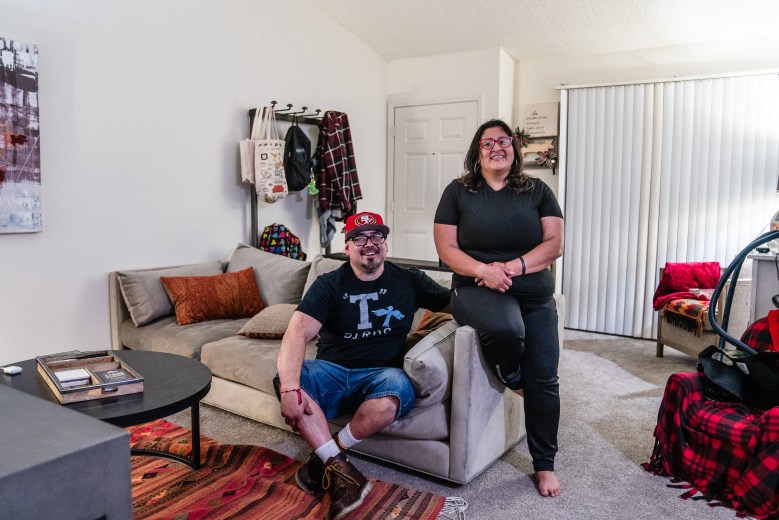
The first week in their new apartment, José, Mercedes and their three children slept each night on a pile of blankets on the living room floor.
The apartment’s two bedrooms remained untouched, at first, as the thought of sleeping apart felt almost foreign to the family of five.
“It’s like we all had to be near each other,” Mercedes said. José and Mercedes asked to use their first names to protect their privacy.
A few months ago, the family shared a one-room unit at the Hawthorne Veteran and Family Resource Center, a family homeless shelter run by Interfaith Community Services in Escondido.
Before that, José, Mercedes and their children were homeless. Their two daughters were 13 and 11 years old at the time, and their son was five.
They’d pool together the money they earned from Mercedes’ three jobs and Jose’s various temp jobs, to rent cars and U-Haul vans that they could sleep in at night. If they were lucky, they’d get a motel.
The day they moved into the shelter was one filled with relief, but it was only a small step in a long journey to find stable, long-term housing. As family homelessness increases and becomes more visible, many families face overwhelming barriers in a system that makes it extremely difficult to achieve stability.
This is one family’s story.
Their troubles started in early 2023 when Jose lost his job. He was working at a company that made parts for heavy-duty trucks. Mercedes was a stay-at-home mom at the time, so she could prioritize taking care of her son, who has cystic fibrosis, a condition that causes the body to overproduce mucus, potentially clogging organs.

After her husband’s job loss, Mercedes, who used to be a medical assistant, began picking up random shifts to stay afloat, and they received rental assistance from North County nonprofit Brother Benno’s, which helped them get by for a few more months.
But in August 2023, the family was evicted from their apartment.
They tried living with family members and friends, but there wasn’t much room for them, so that didn’t last long. They eventually found themselves homeless and surviving in motels and different vehicles. U-Haul vans were the most uncomfortable, but the cheapest to afford.
Mercedes worked three jobs every day to help support the family. Her first job at FedEx started at around three or four in the morning, then her job at her daughter’s school cafeteria started at around 9:30 a.m. and then her evening job at Target from 6 p.m. to 10 p.m. It was about 16 hours of work each day.
José worked at a temp agency, making little money and working long, random hours.
Their jobs were low-paying and only covered the essentials: food, motel stays, rental car costs and U-Haul fees.
At one point, Mercedes had called 211, a hotline that connects people with housing, food, employment assistance and more, hoping to get her family into a homeless shelter. They were put on a waiting list.
There are two homeless shelters for homeless families in North County – Interfaith’s Hawthorne Veteran and Family Resource Center and Operation Hope in Vista. Both are usually at capacity.
But one day, Mercedes got the call; they had been accepted into Interfaith’s shelter.
The Search for Housing

May 9, 2024, is an unforgettable date for the family. Not only was it their son’s sixth birthday, but it was the day they began their stay at Interfaith.
There, the family of five shared one room for about nine months.
Once they settled in, they were determined to take advantage of the resources they had. They dove into the workshops and counseling Interfaith offered, they meticulously saved their money and they took their case management seriously, Mercedes and José said.
Jeremiah Bellomy, program manager for Interfaith’s family shelter, agreed.
“They are among the best people I’ve ever had the opportunity to meet,” Bellomy said. “One thing that really stood out about them was their dedication to self-improvement. They always attended workshops, focused on not only improving their situation, but also improving themselves to be the best parents and human beings that they can be.”
José and Mercedes also spent their time searching and applying for low-income housing programs, like Section 8. These are programs that partially cover a low-income family’s rent through a subsidy paid directly to the landlord.
But subsidized housing programs have waitlists, sometimes upwards of 11 years.
“I kept applying and putting our names on all of these waitlists,” Mercedes said. “But some were three years, some were five years, even 10 years. It was so frustrating because we needed housing now.”
Adding to the sense of urgency was Interfaith’s length-of-stay policy, which, at the time, was six months. José, Mercedes and their kids had an “exit date” that was quickly approaching, and when it finally came, they still didn’t have housing.

“It was nerve-wracking to leave without finding a place,” Mercedes said. “We honestly didn’t know what we were going to do.”
For a couple of weeks, the family found themselves homeless again. They spent part of the time staying with family members before having to go back to the life they hoped they would never have to revisit.
They slept in their car and in a motel for several days before the shelter invited them back.
“Going back to sleeping at a motel and our car, that was a hard pill to swallow,” Mercedes said. “The money that we had saved while at the shelter started to go really quickly, and it was scary.”
It was also scary in a different way, José said.
“When we’re at these motels, I have to protect my family from the danger that can come with that,” he said. “These are the cheapest motels with so many different kinds of people around. I saw things that I didn’t want to see and certainly wouldn’t want my kids to see.”
Fortunately, Interfaith’s team had kept in contact with the family and invited them to move back into the shelter.
Bellomy said they originally implemented the six-month timeframe because they wanted to give families a goal to work toward and a way to create space in the shelter for accepting more families.
But after seeing the obstacles that families like José and Mercedes were facing in their efforts to find housing, they decided to move away from the six-month policy.
“Interfaith was new to serving this type of population when we started this family shelter,” Bellomy said. “We took a lot of things from our other programs and incorporated them here, like the six-month rule. But we realized it’s too short of a period for families, and we are moving away from that hard deadline.”
After moving back into the shelter, José and Mercedes spent the next two months applying for housing – not low-income, subsidized housing – but market-rate or affordable housing. Interfaith had offered to pay the deposit and first-month’s rent for the family once they found an apartment.
“Staying on a waitlist for the next 10 years waiting for low-income housing was not an option anymore,” José said. “We had to find another way.”
They received several rejections from apartments due to their credit scores and rental history, Mercedes said. Finally, José, Mercedes and their kids were approved for a two-bedroom apartment in San Marcos.
After more than a year of experiencing homelessness, the family of five was finally going to have a home again.
Unimaginable Barriers

Voice of San Diego previously reported that family homelessness has been steadily increasing in recent years, but according to service providers, is largely invisible as families tend to stay out of sight in an effort to protect their children.
But in the past several months, Bellomy and his staff have noticed some alarming new trends.
Homelessness among families is increasing to the point where it’s becoming more visible, meaning more families have been found on the streets, Bellomy told Voice. This includes an increase in families that have a child or a parent with a disability, he added.
“We are unfortunately preparing for this trend to continue, and for us to have to get more creative with how we provide adequate support for these families long term, especially families who need specific accommodations because of a disability,” Bellomy said.
Bellomy also said it’s becoming increasingly difficult to get families into long-term housing. Like in José and Mercedes’ case, families can’t afford to wait years for low-income housing.
“Every client we work with is impacted by this,” Bellomy said. “It’s heartbreaking because we are serving families that are experiencing trauma right now. Eleven years is too long; five years is too long.”
“The only way to see progress is to push our representatives to create more affordable housing in creative and nontraditional ways,” he added. “Otherwise, more families will fall into homelessness and will have no way of coming out of it.”
A Humble Design Surprise

In February, José, Mercedes and their children moved into their apartment.
It was hard for the family to wrap their minds around the fact that they had actually found housing.
“Our oldest was like, ‘No, mommy, I don’t believe it. I don’t believe it,’” Mercedes said. “Same with her dad; they both couldn’t believe that it was real because they had been discouraged and were told ‘no’ over and over again. It was hard for them to accept it and be excited.”
After huddling together in the living room for a week, it finally started to sink in. They began looking for free or cheap furniture and supplies to fill their new home.
But their case manager, Gina Sagapolutele from Independent Living Systems, who they had been set up with through their medical provider, Kaiser Permanente, had something else in mind. She recommended the family to Humble Design, a nonprofit that furnishes homes for people and families leaving homelessness for free.
Jose, Mercedes and their children were Humble Design’s 500th client in San Diego.

A 2024 UC San Diego Homelessness Hub study found that 98 percent of the nonprofit’s clients remain housed after receiving services from Humble Design.
“Having a ‘home,’ not just housing, is a powerful social determinant of health and well-being,” Laura Lavoie, executive director of Humble Design San Diego, told Voice. “Our goal is to break the generational cycle of homelessness.”
Humble Design’s staff conducted interviews with each family member to understand what kind of home they wanted, down to the color scheme. Then, they picked a date, sent the family out of the house for a few hours, and presented the family with their new home.
It was fully furnished with a couch, TV, coffee table, dining set, kitchen appliances, beds, desks, accent pieces, plants, a laptop, art pieces and more.
The family received their furniture on April 24.
“I walked through the door, and I was just holding back tears,” Mercedes said. “They created a home; this is our sanctuary, this is where we escape from the outside craziness in the world. They did that for us, and we are just so grateful.”

José and Mercedes said they are learning to enjoy the little things again.
Making coffee in their robes each morning. A clean carpet. Cooking meals. Their kids having their own space. Grabbing a snack from the kitchen. Watching TV together. Ordering pizza. Falling asleep on the couch. Having guests over.
“Other things, like having a dedicated space for our son’s cystic fibrosis treatments, mean everything,” Mercedes said, pointing to an area that included a small armchair, his treatment device and a white board hanging on the wall counting down to his birthday – May 9, 2025.
Their son was turning seven in his new home.

Before 2023, how long did they live in San Diego? The image presents a man with an SF hat, but the story is about SD.
She has been out of w0rk for quite some time however last month her check was 11,500 bucks only w0rking on the PC(Personal Computer) qe for 9 hours per day…..
For more detail visit this article Click on my user name<<<<
The sad fact is that families such as this in this story, are people who both work for a living and have children, and one of their children is in need of medical care on a daily basis, and they don’t make enough money to even provide a rudimenary shelter for their family because of all of the millions of “migrants” who came through our borders without permission who also had similar needs. The “migrants” were provided for with debit cards, free transportation to their desired area, etc., etc. These families in America were forgotten…ignored largely. There are need AMERICANS who need help. They should receive help before anyone breaking into our country…