

When José, Mercedes and their three children were homeless and unsheltered, they had to find creative ways to avoid sleeping outside on the street.
On most weeknights they stayed at a Motel 6 in Oceanside. Rates are typically cheaper on weekdays, they quickly figured out.
On weekends, or when they were running low on money, the five of them would sleep in various rental cars.
The sizes of the rental cars depended on how much money José and Mercedes were able to spend. Some were more spacious, like vans or Jeeps. Others were a tighter squeeze.
But if money was really tight, they would rent a U-Haul van for $20 per day, lay a few blankets down in the back and settle in for the night. The hard, flat surface was uncomfortable, but they made it work.
On rental car and U-Haul days, the family would shower and brush their teeth at a nearby Planet Fitness. Sometimes, they would go up to 10 days in a row sleeping in different vehicles.
Mercedes worked three jobs every day to help support the family. Her first job at FedEx started at around three or four in the morning, followed by her job at her daughter’s school cafeteria that started at around 9:30 a.m. and then her evening job at Target from 6 p.m. to 10 p.m.
In total, it was about 16 hours of work each day.
José, Mercedes’ husband and the father of their three kids, worked at a temp agency, making little money and working long, random hours.
It was a routine they had, unfortunately, perfected. And the life they used to live seemed like a distant memory.
“We used to have two cars and a motorcycle, you know, and the kids had all of their extra little toys, and they used to be able to snack on whatever they wanted – that’s one of the biggest things, our kids loved to snack,” Mercedes said. “We know what it’s like to have that independence and the privacy of our own home, where the kids had their own rooms, and they could just be kids.”
José and Mercedes, who asked us to use their first names to protect their privacy, are an example of a larger trend in North County and the San Diego region: Families are falling into homelessness at an increasing rate, but they’re not as visible as other homeless populations.
The Beginning

Mercedes described how her family’s circumstances snowballed beyond her control.
In early 2023, José lost his job. He was working at a company that made parts for heavy-duty trucks. Mercedes, at the time, was a stay-at-home mom, and one of her most important jobs was taking care of her son, who has cystic fibrosis, a condition that causes the body to overproduce mucus, potentially clogging organs.
When their family lost their only source of income, Mercedes, who used to be a medical assistant, began picking up random shifts whenever she could find them. They also received some rental assistance from Brother Benno’s, a nonprofit in North County that provides a variety of services to homeless and low-income people. They managed to get by for several months, but it never seemed to be enough.
“We couldn’t breathe; we were drowning in bills,” Mercedes said. “They just kept adding up, and we could never successfully get ahead of it all.”
It not only put a strain on their finances, but it also put a strain on their marriage. After 13 years together, Mercedes and José decided to separate, and José moved to Texas to pursue a job opportunity. Meanwhile, their son was in and out of the hospital because of his cystic fibrosis, causing Mercedes to miss crucial work shifts that were few and far between.
A few months later, in August 2023, Mercedes and her children were evicted from their apartment.
Suddenly homeless and with nowhere to go, Mercedes and her children traveled to Northern California to stay with her parents. But the four of them crowded into her parents’ living room wasn’t sustainable. And José’s living situation, crashing at a friend’s house in Texas, also proved to be unsustainable.
Determined to make things work and realizing they couldn’t lean on their friends and family for much longer, José, Mercedes and their children reunited in Oceanside in February 2024 after about nine months apart. The couple decided to give their relationship another try.
Their last remaining car gave out a few weeks later. Not long after, they relinquished it to the bank.
“That’s when we started living in rental cars and in a motel whenever we could,” José said. “And that’s when it really felt, like, ‘Oh wow, we’re homeless.’”
So, for about three months, José and Mercedes perfected their routine.
Wake up. Work. Drop off kids at school. Work. Pick up kids from school. Work. Sleep for a few hours. Repeat.
“We just had to keep going,” Mercedes said. “I kept telling myself, ‘I’ll just sleep later in my coffin. It’s not permanent, it’s not forever. I know our blessings are going to come.’”
Somewhere along the way, Mercedes called 211, a hotline that connects people with housing, food, employment assistance, mental health resources and more. She hoped to get her family into some kind of family shelter in North County, but she was told they would have to wait.
There are only two homeless shelters in North County dedicated to serving families, Operation Hope in Vista and Interfaith Community Services’ family shelter in Escondido called the Hawthorne Veteran and Family Resource Center. Both are usually at capacity and have waitlists.

“I described our situation to someone at Interfaith’s Carlsbad office, and the person told me they would put us on a waitlist for emergency shelter,” Mercedes said. “Truth be told, I was heartbroken.”
But they kept going. They had to.
Mercedes remembers exactly where she was when a program manager from Interfaith finally reached out to her. She had gone to Walmart to receive a wire transfer from her mom.
“It was probably for another extension on the rental car or money for one more night at the motel, and that’s when she called me,” Mercedes said. “I was immediately in tears.”
The program manager conducted a pre-screening interview over the phone to find out more about Mercedes and her family.
“I remember she asked me, ‘Well, where are you sleeping tonight?’” Mercedes said. “And I told her, ‘In a U-Haul van.’”
About a week later, Mercedes, José and their three children moved into Hawthorne Veteran and Family Resource Center. The date was May 9, 2024; their son’s sixth birthday.
Unhoused and Unseen

This year’s point-in-time count, the annual homeless census, reported zero unsheltered homeless families in North Inland County. In North Coastal County, there were four unsheltered homeless families counted.
Filipa Rios, Interfaith’s chief program officer, told Voice of San Diego that those numbers are a severe undercount. The rate of homelessness among families is actually increasing.
“A lot of individuals who are experiencing homelessness are typically out and about in areas where we can see them. Families don’t do that,” Rios said. “They’re typically hiding in their cars or places where they’re not visible because they’re trying to stay safe, especially those with children. So, it’s a lot harder to see an unsheltered family.”
Rios said there are many families throughout North County’s school districts that are considered homeless according to the McKinney-Vento Homeless Assistance Act, a federal law that ensures educational rights and protections for children and youth experiencing homelessness.
The McKinney-Vento Act defines homelessness as lacking a fixed, regular and adequate nighttime residence. This includes families who are sharing homes with other families or with a relative.
“There are a lot of families in our school districts that are doubled up and living maybe with a relative or with family friends… but they’re actually homeless and the schools will actually count them as being homeless,” Rios said. “So, those numbers within the school districts are much higher than what we see from a point-in-time count.”
She and Interfaith’s staff have also personally seen an increase in family homelessness over the years, Rios said. And many of the families they encounter have very similar stories to José and Mercedes.
Families typically fall into homelessness because of high cost of living, and if they experience a job loss, illness, rent increase, car troubles or other sudden setbacks, it can be extremely difficult for them to bounce back.
“We work with families not just on finding them a long-term place to live, but we’re also helping them increase their income… receive benefits… keep their kids in school, find affordable daycare,” Rios said. “We are helping them reduce the barriers that sometimes people just don’t think about.”
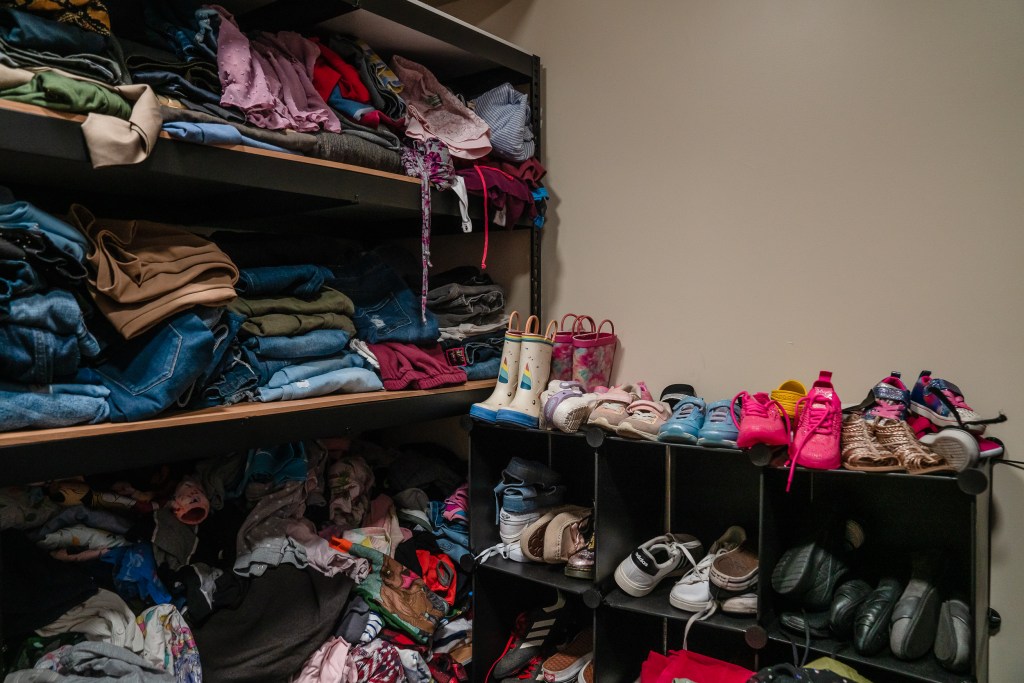
Interfaith’s Hawthorne Veteran and Family Resource Center houses 13 families at a time. Families are provided with private rooms, free meals, counseling, clothes, school supplies, access to showers, laundry, computers, playrooms and more. Case managers are available to help families find permanent housing, employment and other resources.
‘We’ll Get There’

It’s been three months since Mercedes, José and their three children started living at Interfaith’s family shelter.
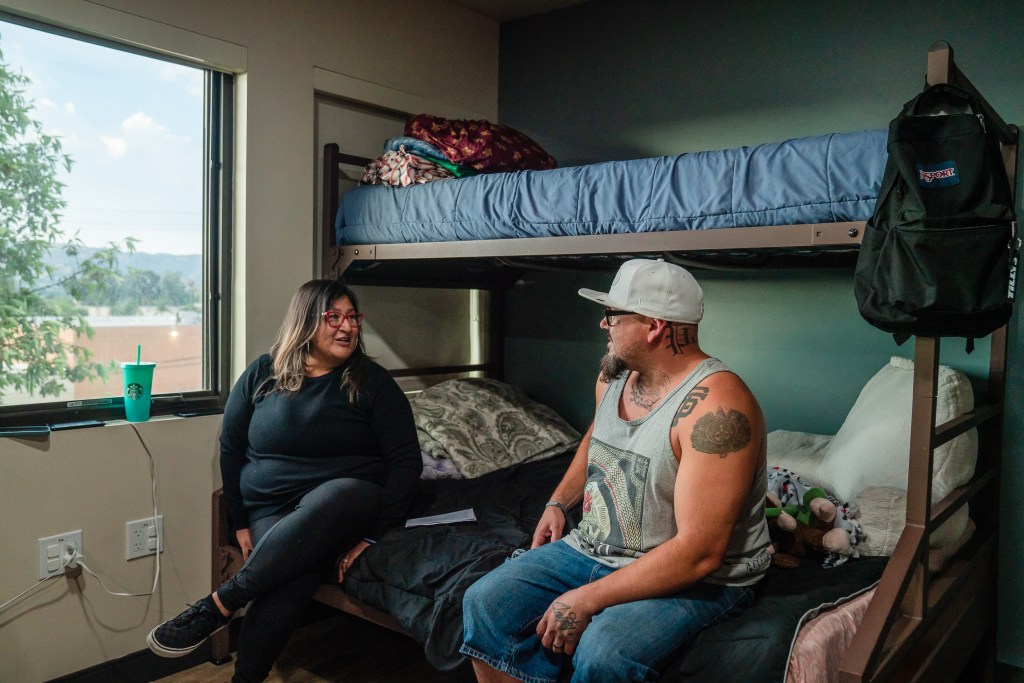
Against one wall of their room, in between two sets of bunkbeds, two vision boards are proudly displayed, one made by Mercedes and the other made by their 10-year-old daughter.
Mercedes’ board has magazine cutouts of a beautiful kitchen, a big backyard with a pool, a chic master bedroom and a couple of brand-new cars. Phrases like “Walking the walk,” and “Give your heart a little love” are placed strategically throughout the board.
Her daughter’s board, similarly, had a picture of a big house with a pool, but also included pictures of dogs, a bicycle, a cinnamon roll and a dining table set with a variety of foods and beverages.
“This represents some of our goals, and we’re putting it out into the universe,” Mercedes said. “You never know, things can happen.”
Since moving in, José has found a full-time job with regular hours at a family-owned company that sells parts for heavy-duty trucks, and Mercedes and the children are on summer break. Once school starts, Mercedes will start working at her daughter’s school cafeteria again, and that will be her only job, she said with a sigh of relief.
In the meantime, they’re working closely with their case manager to find long-term affordable housing for their family somewhere in North County, and they’re hoping to save up enough money to significantly reduce their debt and build up their credit.
The two did recently buy a car, but it’s in the shop being repaired. The couple laughed as they thought back on their complicated history with cars.
“My heart is so much more open now when I see homeless people and other homeless families,” Mercedes said. “No one wakes up like, ‘Oh, I’m going to be homeless today.’ That’s not how it happens, and I for one will tell you that I never thought I’d be in this position… but we’ll get there… back to that independence and stability.”


Two vision boards created by Mercedes and one of her daughters. / Ariana Drehsler for Voice of San Diego
Sakuya.in is one of best online toy shop for kids.You can buy toys for kids online at https://sakuya.in
He has tattoos on his face and neck and she doesn’t work. My tax dollars will support them and their kids forever. Is that fair?
Thanks for sharing this moving story. It’s amazing to see how resilient the family is, despite all the hardships. I’ve got a question though: How do families like José and Mercedes access resources without a stable address? Also, for someone considering travel or living temporarily in a vehicle, would you recommend Planet Fitness for showers?
For those thinking about the cost implications in different regions, I stumbled upon https://world-prices.com which might help, though I’m not sure how accurate it is these days.