
Encinitas is on track to bring in almost $5 million in new revenue next year, despite voters rejecting a sales tax measure last November that was projected to bring in $15 million annually for infrastructure improvements.
City officials including Mayor Bruce Ehlers are touting this year’s balanced budget. But the city still has millions of dollars in unfunded infrastructure improvements it will confront in coming years.
City staff presented a proposed budget at a special City Council meeting last week that showed the city will bring in $146.6 million in revenue in the fiscal year that begins in July, an increase of $4.9 million from the current year’s revenue projections. Staff estimates that the city will spend $139.9 million next year, which is $3.5 million more than the current year’s forecast.
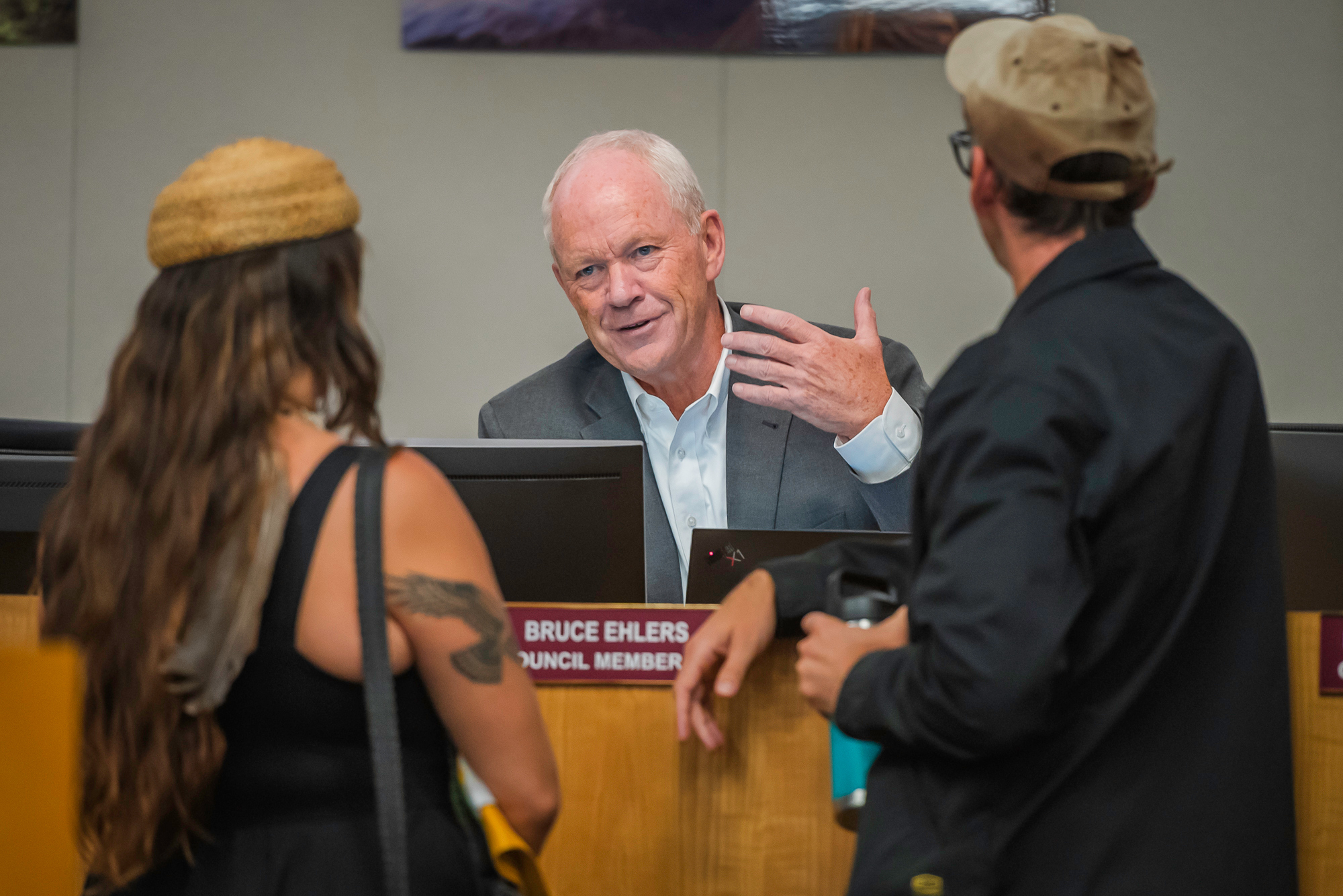
“We are in a very good position,“ Ehlers said. “I stand by my position when I ran that I was opposed to a regressive sales tax increase, and I think tonight is proof in that we didn’t really need it to approve a balanced budget, to achieve fundamental basic infrastructure and programs that cities need to deliver.”
Last year, Encinitas proposed a 1 percent sales tax increase, Measure K, that was rejected by nearly 52 percent of voters.
Ehlers told Voice of San Diego he thought the tax increase would have been regressive, meaning it would have impacted lower-income residents the most.
Measure K, which would have expired after 10 years, was projected to generate about $15.4 million each year for Encinitas, which city leaders said would have been used to address aging infrastructure.
But the proposed budget fully funds the city’s pension, debt, contractual obligations, reserves and some key infrastructure improvement projects, said city staff.
The San Diego County Taxpayers Association did an independent analysis of the tax measure last year and chose to support it, mainly because of the city’s need for future infrastructure funding.
“While the city has historically had higher revenues than expenditures, the trend of increasing expenditures poses a problem for Encinitas as they try to keep costs low while providing key infrastructure and performance,” the report read. “As a result, the city does not have additional revenue for day-to-day maintenance of their infrastructure… this can result in neglect of the infrastructure if no additional revenue is generated.”
I previously reported on Encinitas having the only sales tax measure that failed in North County last November and some of the likely reasons why. Read that story here.
More funds are expected: The city is also expecting to receive $14.7 million in development impact fees. These are one-time fees developers pay local governments when building housing projects to offset costs of infrastructure and public services impacted by the project.
The projected funds are from recent and pending developments, including Fox Point Farms, Sunshine Gardens, Quail Meadows and other housing projects that were, and continue to be, very controversial.
Encinitas leaders and residents have a history of criticizing and resisting state housing laws that require the approval of most housing projects. One prominent argument is that the state does not provide enough funding to offset the impacts of these projects.
I asked Ehlers what he thinks of that $14.7 million and if it’s enough to mitigate the impacts of these housing projects.
“No, it’s not,” he said.
He argued that the state should be funding its own housing mandates by subsidizing things like parking garages, street maintenance, traffic mitigation, low-income housing units and more.
“For example, let’s say we wanted to widen one side of the road on Santa Fe Drive to accommodate for increased traffic – that alone would probably cost around $5 million,” Ehlers said. “It’s not enough.”
The city anticipates collecting those funds over the next three to five years and will fund things like park development, park acquisition and traffic mitigation, Ehlers said during the May 28 council meeting.
Also coming down the pipeline is an estimated $2.6 million in federal reimbursement for a previous emergency storm drain repair project. That money is not yet reflected in the budget projections for the upcoming fiscal year.
The City Council will take a final vote on the proposed budget on June 18.
Around Town: We Checked in With Community Resource Center

Back in April, I wrote about a homeless services nonprofit in Encinitas called Community Resource Center, or CRC, that was receiving anonymous criticism from a social media account, along with general increased scrutiny from the community.
Critics said CRC was attracting homeless people to Encinitas. The anonymous account even said the nonprofit was strategically placing ads to attract people from other cities to their organization. CRC vehemently denied these claims, and there was no evidence to support them.
Still, the tension was high. Many called for CRC to be shut down, especially after the nonprofit announced plans to expand their downtown office into the property directly next door. This is still in the works.
I checked in with CRC CEO John Van Cleef to see how things have gone since I wrote that story.
“The conversation has shifted slightly,” Van Cleef said. “There continues to be a conversation from some groups that still want to shut down CRC, and there’s still a sort of poking of CRC, but they’re being confronted with new data from the point-in-time count that shows homelessness numbers are down, and from the sheriff’s office about crime rates being down.”
The point-in-time count is the annual homeless census, which showed that Encinitas saw a drop in unsheltered numbers this year, decreasing by 26 percent. The city’s unsheltered homeless population decreased from 123 people last year to 91 this year.
The overall Encinitas community has continued to support CRC’s work, which is showing positive outcomes, Van Cleef told Voice.
“My focus has been on engaging with the people we serve,” he said. “We’re not here to perpetuate the issue of homelessness, we’re here to address it.”
In Other News
- Sharp HealthCare is partnering with Tri-City Medical Center to assume operations and financial responsibility of Tri-City. The news comes after talks between Tri-City and UCSD Health fell through in July 2024. (Coast News)
- ICYMI: An ambitious plan to move hundreds of unsheltered homeless people out of an encampment that borders Oceanside and Carlsbad and into stable housing is having early success. (Voice of San Diego)
- An overdue study that could help restore sand to Oceanside beaches just received $2.27 million in federal funding. (Union-Tribune)
- A project to install protected bike lanes throughout Vista is raising safety concerns for some travelers along Melrose Drive. (Coast News)
Would like to know why it is taking so long to complete the work on 101 from La Costa south? After over 2 years of work it does not look like they have done anything except dig up the highway several times putting in large pipe. It is frustrating to see our tax dollars doing the same thing on the same street for so long.
While I appreciate a balanced budget (which Encinitas had previously as well) nothing has changed. I’m still crossing illegally over the railroad tracks in northwest Leucadia to get to the beach, grocery store, post office, restaurants, and coffee shops. I’ve been doing this for 28 years living here and I imagine I’ll still be doing it until I die, leave this area, or am too feeble to cross. I’ve gone through many groups of city council members over the years and they all talk a good talk but one thing never changes; there is never enough money for some fairly basic and badly needed infrastructure upgrades and changes. At least with this last group we finally got a stop sign at La Costa and Vulcan.