
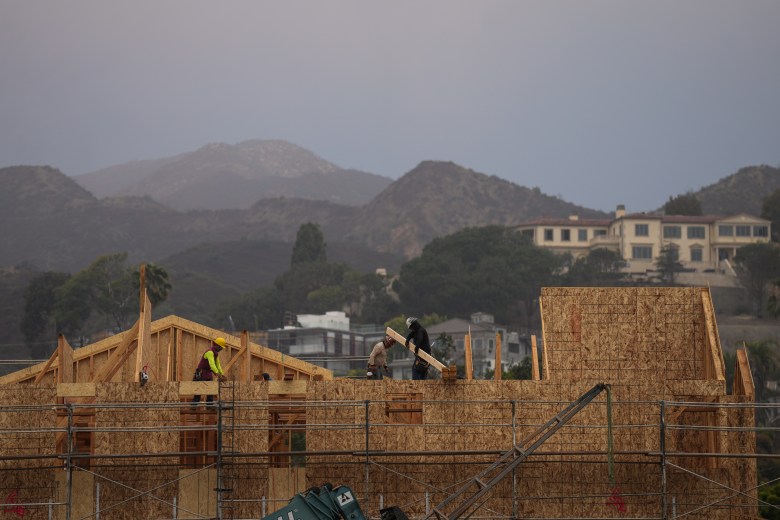
After the Los Angeles wildfires, the prospect of rebuilding gave hope to thousands of displaced residents, and the governor lifted numerous zoning rules and regulations to speed up the process.
But a year and a half later, very little has been rebuilt on the hundreds of scorched lots dotting Malibu, Altadena and the Pacific Palisades. Instead, many owners have chosen to sell their land rather than rebuild, and dozens upon dozens of parcels have been bought up by limited liability companies seeking to build. Because of that, fears have mounted that the relaxed rules will help developers get around coastal protections and build projects destructive to the environment or that block beach access.
New legislation proposes to cut off some of these benefits for new owners of homes destroyed by wildfires.
If Senate Bill 1229 becomes law, new owners would need approval from the California Coastal Commission to rebuild, regardless of the size or scope of the proposed replacement.
El Segundo Democrat Ben Allen, the bill’s author, said the legislation is intended to make sure homes scooped up by investors don’t block beach access or destroy nearby habitats.
Environmental groups support it, saying it closes a loophole that could be misused by developers to sidestop key coastal protections and build homes that endanger coastal bluffs, harm ocean life and cut off people’s access to public shores.
But critics worry it would slow rebuilding efforts even more.
Opponents accuse the Coastal Commission of enforcing the Coastal Act, its premier law, too tightly and blocking housing along the coast.
They worry a bill that restores these restrictions would slow the permitting process for new homeowners who would now have to get permission from the Coastal Commission.
San Diego’s coastline has largely been spared from the destruction we saw in the Palisades. But the proposed rules would apply statewide for any future disasters.
A Loss of Character?
Extraordinary costs and lengthy permit delays have made rebuilding a herculean task for the majority of L.A. homeowners.
Many have instead opted to sell their homes, resulting in a booming buyers’ market flooded by investors from around the world.
More than 40 percent of homes sold in Malibu and the Pacific Palisades were bought by investors in the last three months of 2025, according to a Redfin analysis. That’s nearly double from the previous year in Malibu, while none were sold to investors in the Palisades in 2024. This could make the rebuild process even slower, as investors are more likely to wait longer to rebuild to maximize their investment.
As locals fear what this could mean for their communities, a bureaucratic battle is brewing within the Legislature.
‘Unlocking Every Available Strategy’
Created in the shadow of the 1969 Santa Barbara oil spill, the Coastal Commission was formed to protect California’s coastline from environmental degradation.
But it’s been roiled by controversy in recent years, picked apart by critics from all sides who argue the commission hamstrings housing development on the coast, worsening California’s housing crisis.
There’s been some movement to weaken the commission’s power. Last year, lawmakers passed a bill that would shrink its authority over certain projects, such as student housing. The governor and Assembly speaker also appointed two pro-housing officials to the commission.
And immediately after the fires in January 2025, Gov. Gavin Newsom issued two executive orders allowing homes destroyed in Los Angeles and Ventura County to bypass Coastal Commission approval when being rebuilt.
State law already allows coastal homes destroyed by fires or other natural disasters to avoid the commission if they’re rebuilt mostly in the same shape and size as the previous home. But Newsom’s orders broadened those exemptions, creating fewer restrictions on the location, size or use of the rebuilt property. For example, homes could be rebuilt with new accessory dwelling units.
In response, the agency issued its own guidance stating that rebuilds must mostly be the same as the original homes to avoid commission approval.
Newsom swiftly rebuked the commission in a separate executive order calling its direction “legally erroneous” and ordering it “to avoid taking any action that interferes” with the governor’s mandate.
‘A Loophole’
The commission retracted its guidance shortly after and is now supporting SB 1229, according to spokesperson Joshua Smith.
“It closes a loophole that could be misconstrued as allowing larger replacement structures to be located in hazardous or environmentally sensitive areas when rebuilding after disasters,” Smith said in an emailed statement.
At a committee hearing earlier this month, Allen, who is running for insurance commissioner, emphasized the need to ensure looser restrictions for rebuilding aren’t misused.
“We’re just trying to make sure that if people are going to be selling off these properties, that a limited number of core Coastal Act protections are still gonna be preserved in the wake of the rebuild by a second purchaser,” Allen said.
Republican Sen. Kelly Seyarto said the bill would make it more difficult for new buyers to build if they have to go through the Coastal Commission.
“It’s going to devalue the property if nobody wants to buy that property because of all the constraints,” Seyarto said at an April hearing.
Allen and the Coastal Commission said they did not know of specific instances where larger homes have been rebuilt in place of destroyed homes along the coast.
“We don’t have any record or knowledge of this having happened, although since most disaster rebuilds are handled by local governments, we don’t know for certain the extent to which this has been going on,” spokesperson Smith said.
In Other News
It’s official. California voters in November will decide if billionaires should face a five percent wealth tax after Newsom failed to reach an agreement this week with union leaders behind the measure. He and most other Democratic power brokers in Sacramento vehemently oppose the measure over fears it’ll drive California’s wealthiest residents, and their tax dollars, out of the state.
An $11 billion housing bond also made the ballot. If approved by voters, the state could use that money to build affordable housing.
What I’m Reading Now
A jury couldn’t agree if a man accused of sparking last year’s deadly Palisades fires was responsible, The Associated Press writes.
Fears of ‘the big one’ resurfaced after a powerful earthquake struck Northern California earlier this week, per the Los Angeles Times.
Are e-bikes the new Heelys? San Diego, Carlsbad crack down on young riders zipping around a little too fast on their electric-powered wheels, the San Diego Union-Tribune writes.
Thanks for reading this week’s Sacramento Report. Please feel free to reach me with any questions or tips: nadia@voiceofsandiego.org.