
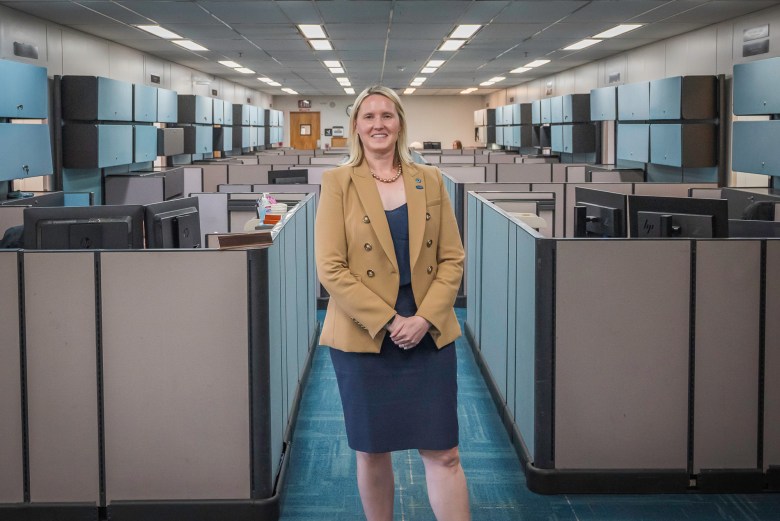
The city of San Diego’s new chief operating officer says the city is doing 99 percent of things right, but there are important challenges, like a huge backlog of infrastructure work, ahead.
In October, Mayor Todd Gloria appointed Bethany Bezak, the former chief performance and logistics officer, as the city’s day-to-day manager following continuous pressure from the City Council.
Bezak faces a long to-do list.
In her first 90 days, Bezak says she will be focused on outcomes residents can see and feel.
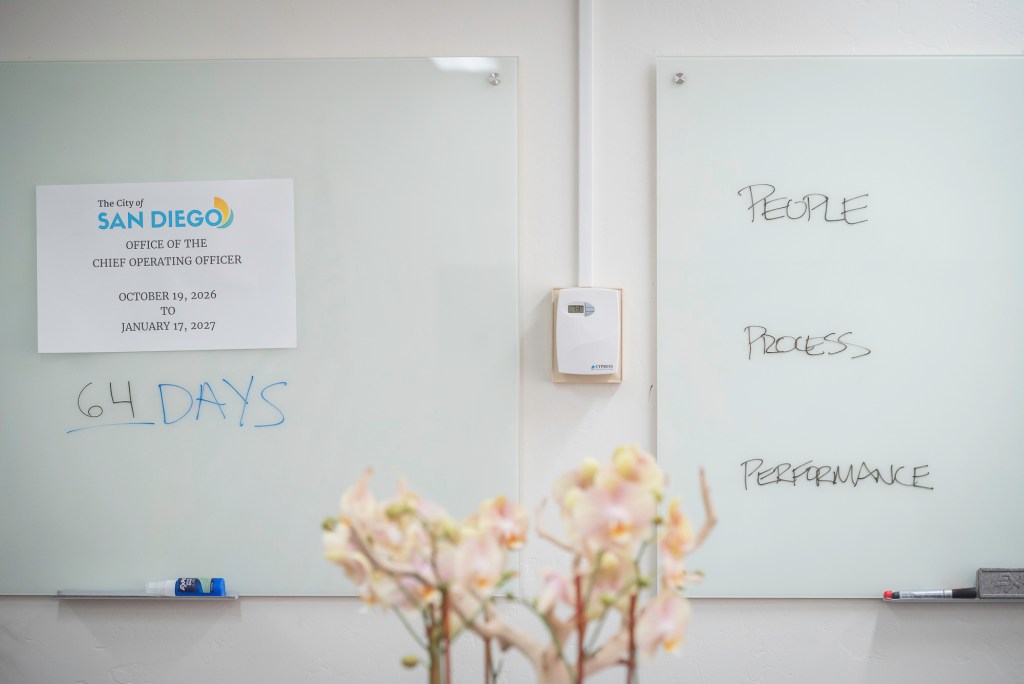
On a whiteboard in her office, Bezak scribbled down her mantra for her first three months on the job – people, process and performance. She said she’s prepared to question the status quo and look at how the city can make things easier, faster or stronger.
I interviewed Bezak and asked about the 1 percent of things that aren’t going as well, like how city officials plan to collect millions in undercharged trash fees and tackle challenges with the city’s streetlights repairs.
She said the trash fee error was unacceptable and laid the groundwork for how she plans to avoid a mistake like that in the future.
Bezak was also blunt about the city’s budget.
“We just can’t afford anything anymore,” she said.
Here’s our conversation below edited for length and clarity.
Mariana Martínez Barba: Since you’ve started the role, what would you say are the top three risks you’ve identified so far?
Bethany Bezak: Our infrastructure and just the general backlog of issues across the city. One thing that the mayor has recently announced is that the five-year outlook is balanced. I’m really excited that we’re finally in a situation where we can say, ‘we can live within our means, and the day-to-day resources that we have, we can sustain that.’
The challenge is we have an almost $8 billion backlog in CIP [Capital Improvements Project] work that needs to be done, and that means our city facilities we know are not in the condition that we need or want them to be.
When a library closes or a park and rec center closes, it’s because we haven’t been investing in some of the preventative maintenance and the repairs that need to have that investment. It is really impacting our residents day-to-day because we haven’t been able to keep up with the roof getting repaired, the HVAC system hasn’t had preventative maintenance, those types of things.
The number one risk I would say is our critical infrastructure and not being able to have invested in that in a long time.
I would say that public trust and confidence is a real risk. When we’re not able to fund some of those really core essential city services, that challenges the public trust and confidence in city government. I think that that’s the second one, which is very closely tied obviously to our critical infrastructure backlog.
Then the third one I would say is litigation. These are all unfortunately connected in somewhat of a vicious cycle because when you don’t fund the CIP [Capital Improvement Projects] infrastructure, when you don’t fund our facilities, you don’t fund the resources that we need for our teams to do their job. It ultimately does degrade public trust and gets to the point of paying out in litigation and risk to the city, which then takes way more money from the critical infrastructure that we actually do need to fund.
Martínez Barba: That was one of the things I wanted to ask is – what things keep you up at night? From an operational perspective, how can you improve trust with City Hall’s ability to deliver services?
Bezak: That actually can be done every single day with the work that’s already happening, and I think that what we need to do is take the 99 percent of the things that are [being] done really, really well every day.
Quite frankly, there’s probably 1,000 different activities that our city employees are doing, and I think we need to be able to translate that so the residents understand that every single day there’s a ton of good work that’s being done, and it’s being done on their behalf. It’s being done with their taxpayer dollars, and I think that we just need to communicate that more clearly to our residents and so that they’re focusing on the things that are happening instead of the things that aren’t happening.
An example I would say is on an average day, we’re picking up – we have residents that have, trash service, right? So over 200,000 residents have trash service, and we might miss 600 routes. Well, you hear about the people whose trash is not picked up that day, but you don’t hear from the people that their trash did get picked up every day.
Martínez Barba: You speak to this 99 percent of things going well. If we were to focus on that other 1 percent, for example, do you think that you would be auditing any city processes?
Bezak: I think what this will take – in terms of looking at our processes – is rolling up my sleeves.
What you will see from me, and what my employees will see from me, is I’m not sitting at City Hall every day. What I’m gonna be doing is meeting with our teams at, quite frankly, the foundational level, our workforce level, and making sure that they understand I’m there, that I’m asking questions of them to really understand what is the challenge that they’re facing.
And I’ll just give you some examples of what we’ve done in the past. It’s when people have said, ‘Gosh, our contracting process is too slow.’ OK. So then it’s meeting and talking with those directors or the people that are trying to get contracts out. What is the most challenging part of that process?
What is the thing that’s taking the most time? And getting to the heart of the issue. That takes nothing except for the willingness to ask the questions and a little bit of time.
Martínez Barba: I do want to move into the topic of streetlights, because an audit was recently presented to the Audit Committee on the city’s streetlight repair program. [The audit revealed a massive backlog of streetlight repairs and wait times of hundreds of days to get them fixed. The audit also found weak oversight and poor management of the program.] Could you explain to me or our reader in simple terms what’s going on with these streetlights?
Bezak: We’ve got 18 electricians that are skilled trades folks that are dedicated to our city streetlights.
In addition, we have very aging infrastructure. So the oldest streetlight actually that we have in the city is in La Jolla. It’s still standing. But the oldest streetlight is from the ‘20s, and the vast majority of our streetlight infrastructure is 30, 40, 50 years old.
Some of it is series circuits, which means it’s just like a Christmas string of lights. If one thing goes out in that infrastructure, the entire light system will go out. So you have this aging condition, you have a limited number of resources in our skilled trades, and you’ve got infrastructure that hasn’t been invested in decades to repair.
So you have all of this confluence really coming together, which is the reality about why we’ve got… as of today, I checked with our teams, we’ve got 8,300 streetlights that are out in our backlog. There’s 60,000 streetlights across the city. So what’s happening is we just haven’t invested in the infrastructure, and the ability of our streetlight electricians to keep up has been very challenging.
We’ve found a few different ways to try to alleviate that over the years. We have used some Parking District Funding to be able to get some of those turned on and that work done more efficiently. We also do have a streetlight prioritization process that we developed several years ago. So there’s weighted criteria that we use for determining the priority about how we repair streetlights.
Martínez Barba: One of the things the audit found is that there was an increase in staff and labor, but service wasn’t improving. How do you explain that to a resident?
Bezak: We’ve had real frank conversations with the auditor’s office about this. Some of the data and the way that they presented it probably didn’t tell a fully accurate representation of the situation.
When you look at just salary costs increasing, that was a big percentage of what they perceived to be an increase in resources. Those weren’t extra FTEs [full-time equivalent, as in full-time staff.] Those were sort of salary increases. You also look at the actual largest portion of that, I believe it was 60 percent in the report, showed that that was associated with increasing energy costs.
So when you look at their statement about there’s a lot of extra resources that are going to streetlights, that’s not a fully accurate representation. When you take those things out, there was a much smaller increase in the level of resources that were going to those. I think we just have to get to the foundational element about what we’re talking about.
Martínez Barba: The audit also pointed out that the overtime expenditures increased from $230,000 in fiscal year 2021 to nearly $1.4 million in fiscal year 2026. Could you explain to our reader why these electricians, these city workers were getting so much overtime?
Bezak: A big contributor to this… we’re required by state law to comply with a certain amount of time to respond to underground utility mark-outs.
What that means is that any utility provider that operates in the city of San Diego or across the state, whether that’s public utilities, infrastructure, water, sewer, whether that’s SDGE, whether that’s our teams, if there’s construction that is going on in the right of way, the person who is doing the digging and the excavation is required by law to call the system and to make the request for the utility provider to come out.
We have to come out, and we have to comply with the state law.
When we found that we probably weren’t keeping up with the response time that was needed, we made the decision in 2023 to ensure that we would meet the compliance of the state law and to ensure that we had safety within the right of way, and that’s why we made the decision to allocate the resources first to the DIG alerts and those mark-outs of the underground utility. And then second to repairing streetlights.
The reason that we did that is because there’s up to $50,000 fines per instance of not complying with the state law. In addition to that, there’s a big safety consequence of not complying with our electricians.
I’ll also add the reason that this is so challenging for electricians – I talked about the age of our streetlight infrastructure. So I wish I could tell you that I could pull up a map of the entire city, and I could say, “On this block, there is an electrical wire that runs down the center of the road.”
I wish I could tell you where it was. I wish I could tell you what the depth of that is. The reality is we can’t tell you that because we don’t have what are called “as-builts” for every single city street within the right of way that can tell us where that electrical wire is. If we did, that would make our job a lot easier.

Martínez Barba: I know the trash fee has been a point of contention for a lot of residents. Could you explain in your own words what happened and how bad that has been for the reputation of city services?
Bezak: The billing error was unacceptable. I see that as something that we need to improve upon in terms of ensuring our processes are stronger. I take that as a responsibility that I have as chief operating officer to make sure that all of our department teams have really strong processes to avoid things like that into the future.
The first time that the trash fee was passed, everyone had a consistent service level. Everyone had the same size bin. Everyone had the same number of bins, and what that meant is the first year that we submitted the data to the county, everyone had the exact same fee.
It was really easy to transmit the data because there was no permutation of individual custom service levels. What we found when we did a lot of the outreach in developing the trash fee is that people wanted custom service levels. They wanted to have the ability to have a certain number of bins, to select the size bin, to select the cost that they wanted.
Being responsive to residents, we developed a process where there was maximum flexibility, hundreds of different permutations – quite honestly – of the different service levels and what people were able to elect. So going forward from our first submission to the county for the trash tax fee and on the tax roll to this year’s submission, it required that every single individual line item that was submitted to the county to be accurate.
[It] always needs to be accurate, but it was even more important that it was accurate this year because everyone had a different selected service level. Our trash team, the environmental services team, worked really hard to develop a system of record. All of this information is in a centralized system of record.
What occurred this year is when the data was exported out of that system of record to modify the formatting for what the county required in terms of inputting that into their information, there were some changes that needed to be made to the file. Those changes were not made in the system of record because it wasn’t built to handle that in its current form.
I’ve taken personally a very deep dive with this with our environmental services team. And what we found is that any changes now in knowing what the county’s format is required to be will be made in our system of record, that way that there is a very clean and seamless export of the file format that will go to the county in the future.
Martínez Barba: How would you avoid a mistake like this happening again?
Bezak: I think that every time there’s a new process that we’re implementing at the city, every time someone’s role may change at the city, there’s a different point of contact or a lead within a department, we need to think about those moments and those milestones as being more important about where we invest our time and our resources to make sure that the process is very clearly identified, and we know exactly the role of everyone who’s going to manage it.
Martínez Barba: You’re planning to send out supplemental bills in January for all the people who were undercharged their trash fee. That’s supposed to generate around $11.7 million. How would you ensure people pay that supplemental bill?
Bezak: That’s a great question. For the folks that were underbilled the city will be sending supplemental bills. We expect that process to be completed for January to be able to send those out and then by mid-April the expectation will be that people will have paid that bill.
Now, if for some reason we don’t have 100 percent compliance with the payment of that bill then we expect that those unpaid fees for this year will be added to next year’s tax roll. So we’ve already coordinated with the county for what that would look like in the events someone does not pay this year’s tax bill for their solid waste management fee. They will end up having two separate line items that will go on their tax bill for next year. One will say 2027, the differential for what they did not pay this year, and then the next one will be for 2028.
Our goal is to make sure that we’re communicating this as clearly as possible. We would like to see 100 percent compliance with it; understood that might not happen, but we already have a process in place to ensure that we do collect that ultimately. It’s really important that everyone pays their solid waste management fee because that is allowing trash to be picked up. Any one person that doesn’t pay is really impacting others. It’s important that we have equity across the system.
Martínez Barba: Mayor Todd Gloria announced he has closed the city’s structural budget deficit. Can you walk me through your perspective on that when he talks about “holding the line” on city services.
Bezak: To be able to have now a balanced budget, a five-year outlook that looks like we’re able to afford the current level of service is a really huge deal. I think it’s really big for the city and for our residents. It’s really huge for our city employees as well to know that the current funding levels will be able to be sustained in terms of the resources that they will have.
So the way that we’re looking at it is that we really can’t add anything new. We need to live within our means, just like any household has to do on their monthly income. That means that if there is any new services, any new projects, anything new that the public or the Council would expect or want, then it would have to come from somewhere else.
There’s gonna have to be a sacrifice and a real evaluation of priorities if there’s anything new that is to be expected. I’m heading into this budget year process to expect that we maintain the same service levels that we have this year with very few changes. I think that’s important for the public to hear, and not look for new shiny objects, not look for big splashy ribbon cuttings and things like that.
We have to be able to maintain and live within the needs that we have. That doesn’t mean that things are great. It doesn’t mean that we like the service levels of park and rec centers and libraries. That doesn’t mean that I’m satisfied with the road condition. That doesn’t mean that we don’t have an $8 billion CIP [Capital Improvements Project] backlog and deficit that we need to fund.
It just means the day-to-day operations of the city can be sustainable with the current service levels, and we have to be very cautious and mindful about any conversation that’s talking about adding service levels. I think going into next year’s budget process, the public and council need to be very mindful of that and I think we need to take it very seriously.
Martínez Barba: Speaking to this balance and living within our means, what would be your message to the public for cuts that were done that can’t be restored moving forward?
Bezak: We just can’t afford anything more. I know that that might be painful for the public to understand, but I think it’s really important that we’re transparent and we’re honest with the public.
I think that perhaps over many decades we’ve had challenges probably with not having a very accurate message that would come out of decision makers. And really people understanding what the consequence is of over-promising and under-delivering, and I think that we need to be honest and transparent about that moving forward.