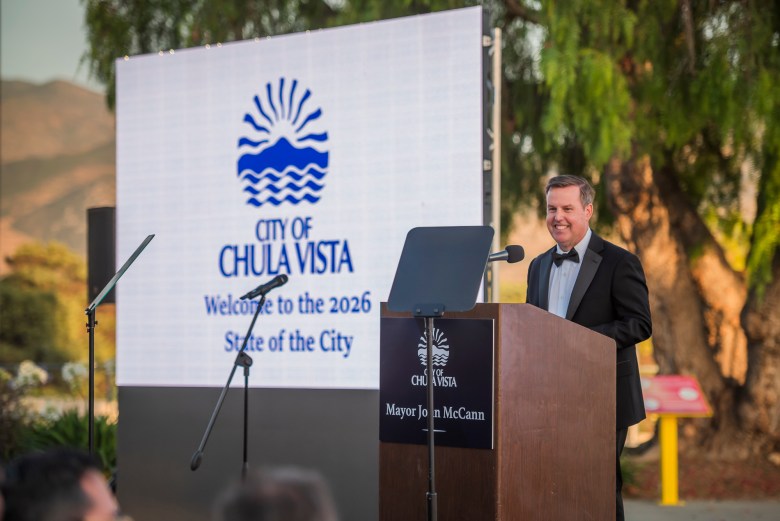
Attendees of Chula Vista’s annual State of the City speech Tuesday had every reason to wonder what exactly they were viewing.
Was it an annual update on the city’s progress? A Hollywood production? A Broadway show?
I described some of the eye-opening special effects kicking off the event in Voice of San Diego’s Morning Report today.
If you weren’t there, you missed: A Mission Impossible-style introductory film starring Mayor John McCann; a skydiver parachuting from a plane over the Elite Athlete Training Center, where the event took place; opera baritone Manuel Vera belting out God Bless America while McCann awarded medals to leaders of the city’s veterans organizations; and lots more.
The frills were fun. (And controversial in the eyes of the mayor’s Democratic critics, who rolled their eyes and asked who paid for it all.)
For the record, I asked the mayor’s staff how much the event cost and who paid. Amanda Fredeluces, McCann’s chief of staff, said the roughly $28,000 cost of the event was paid entirely either by McCann himself or by corporate sponsors, including Seven Mile Casino, Neighborhood National Bank, Cox Communications, the HomeFed Corporation and Republic Services.
The Elite Athlete Training Center is owned by the city, so there was no rental fee, Fredeluces said. Sponsors covered the $11,605 cost of catering and other event fees, as well as the cost of the Mission Impossible-style video, she said.
Sponsors also paid for the skydiver, though McCann himself paid the cost to jump out of an airplane during filming of the video, Fredeluces said.
Fredeluces called the event a success and said close to 500 people attended.
Strip away the extras, and the mayor – along with his fellow City Councilmembers and the city’s roughly 1,000 employees, who execute Council policy – actually do have a good story to tell.
Chula Vista is surrounded by cities in fiscal distress. National City faces a mounting deficit and just appointed its second interim city manager amid a protracted search for permanent leadership at City Hall.
San Diego’s budget woes are epic, and well-publicized.
Chula Vista, meanwhile, balanced its budget this year with no tax increases, no cuts to public services and fully funded reserves.
The city hit other milestones too.
The Council approved yet another large-scale development at the city’s rapidly evolving bayfront.
The Port of San Diego, in conjunction with the city, broke ground earlier this year on an expansion and upgrade of much-beloved Harbor Park.
The city opened two new fire stations, signed an agreement with San Diego State University to begin offering four-year nursing degrees at the city’s soon-to-be-opened Millenia Library, broke ground on a new permanent housing facility for homeless residents and approved a new park that will honor Filipino American military veterans.
Though the city reported lower than expected hotel tax revenue this year amid regionwide economic uncertainty, McCann said the city’s recently opened Gaylord Pacific Resort and Convention Center nevertheless ranks as the third-highest revenue-generating property in the Marriott corporation’s entire worldwide portfolio.
When McCann, in his speech, called Chula Vista “an undisputed economic engine and regional leader,” he wasn’t just bragging.
In a recent interview, McCann said he plans to make his city’s record of accomplishments a central theme in his upcoming re-election campaign. The success of that tactic will depend on what voters care about most this year.
Chula Vista Elementary School District Trustee Francisco Tamayo (who attended Tuesday’s event and was one of the eye-rollers) is McCann’s main opponent in the city’s mayoral race. He has signaled he intends to make the race a referendum on the mayor’s reluctance to comment on immigration issues.
And he has vowed to turn the city’s recent successes into a negative for the mayor by highlighting the extent to which Chula Vista’s rise is making the city unaffordable for residents.
McCann ended his speech on an inspirational high note, trying out a new slogan to complement his usual “this is Chula Vista’s decade.” (He said that too.)
“Today’s accomplishments are tomorrow’s legacy,” he said at the speech’s conclusion.
The accomplishments are real. The legacy remains to be seen.
The Tijuana River Gets It’s Moment in the Gubernatorial Spotlight
The humble, much-polluted Tijuana River has gained an unlikely new identity this year. It’s a must-see whistlestop for Democratic candidates running for California governor.
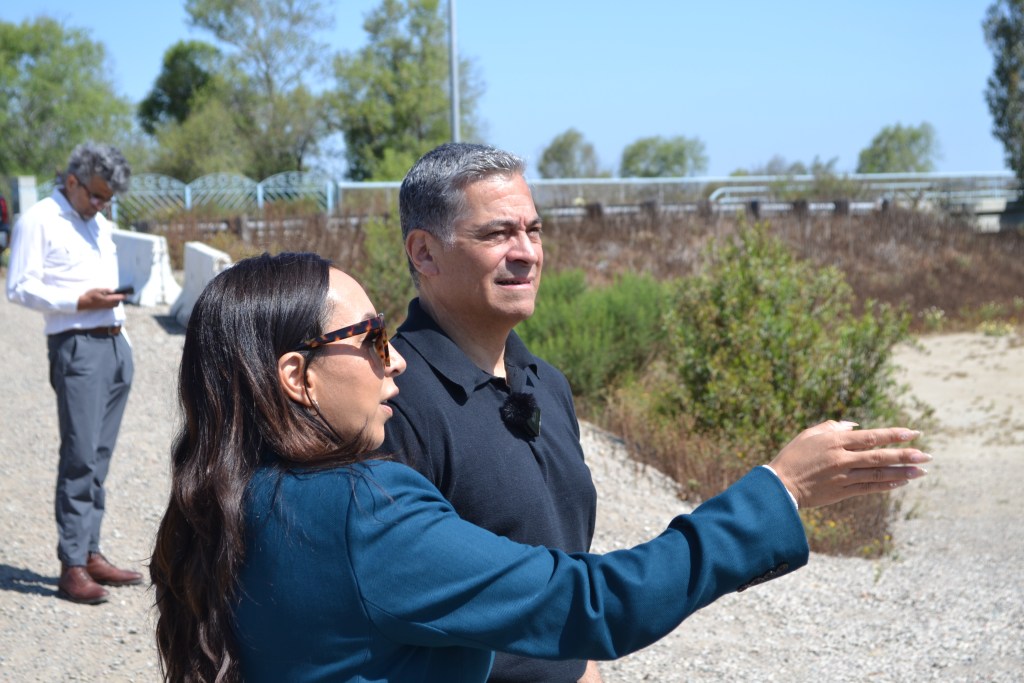
Former United States Health and Human Services Secretary Xavier Becerra on Wednesday became the sixth gubernatorial candidate to visit the river this year at the invitation of San Diego County Supervisor Paloma Aguirre.
Aguirre, whose personal charm belies an almost ruthless strategic ability to strongarm powerful people into doing what she wants, has conducted these candidate tours of the river’s smelly shoreline with a clear goal in mind.
From each candidate she has extracted a promise to declare a state of emergency at the river the moment they are elected to office.
Aguirre contends a state of emergency declaration would enable a similar declaration from the federal government, which in turn would free up funding and grease bureaucratic wheels.
That’s debatable. Not in dispute is Aguirre’s success in propelling each candidate toward seeing the river as she sees it: As a major issue requiring an immediate response.
Becerra, a far more careful and considered politician than some of the other candidates who have visited the river, took some convincing.
He asked a lot of detailed questions and seemed quite familiar with many of the larger policy implications. He voiced skepticism about the value of an emergency declaration without funding to back it up.
He listened attentively as a roundtable of local doctors, public health experts and residents (all selected by Aguirre) explained the severe health impacts of river pollution on South County’s most vulnerable residents.
In the end, they convinced him.
“I’d be prepared to declare a state of emergency,” Becerra said. “These declarations don’t automatically bring the funding. It does free up hurdles.”
Aguirre seemed to relax. Becerra’s tour ended with the discussion roundtable at Arandas Café, next door to El Tapatio, a local Mexican restaurant institution.
Aguirre introduced Becerra to Arandas founder Celia Aranda, who, along with her husband, Victor, started El Tapatio as a taco stand in 1979 and later expanded to opening Arandas, a gourmet breakfast and lunch café, next door.
Becerra, who grew up in an immigrant family in Sacramento, chatted with Celia about her business in Spanish and asked how river pollution affects her. A lot, said Celia. Aguirre, formerly mayor of Imperial Beach, beamed.
Notch another win for the strongarm charm offensive.
In Other News
Deputy Mayor Cesar Fernandez on Monday signed into law a new ordinance that strengthens city protections for immigrants and requires regular updates on city police interactions with federal immigration authorities. The measure, approved by the City Council earlier this year, comes as South County cities grapple with the effects of the Trump Administration’s ongoing immigration crackdown.
U.S. Rep. Juan Vargas announced earlier this month he and other San Diego-area members of Congress are asking for $100 million in next year’s federal budget for infrastructure upgrades to reduce pollution in the Tijuana River.
Two bills authored by state Sen. Steve Padilla that together constitute some of the nation’s strongest protections for young people who use A.I. chatbots advanced through key legislative committees this month on their way toward consideration by the full State Senate. The bills would restrict advertising and require safeguards to prevent chatbots from encouraging suicide or hooking children on protracted conversations.
The recently authorized South County Higher Education Planning Taskforce this week will begin gathering public input and sketching out plans for an envisioned four-year university in the city of Chula Vista. The taskforce holds the first in a series of public meetings beginning at 10 a.m. Friday at Chula Vista City Hall. More information here.