
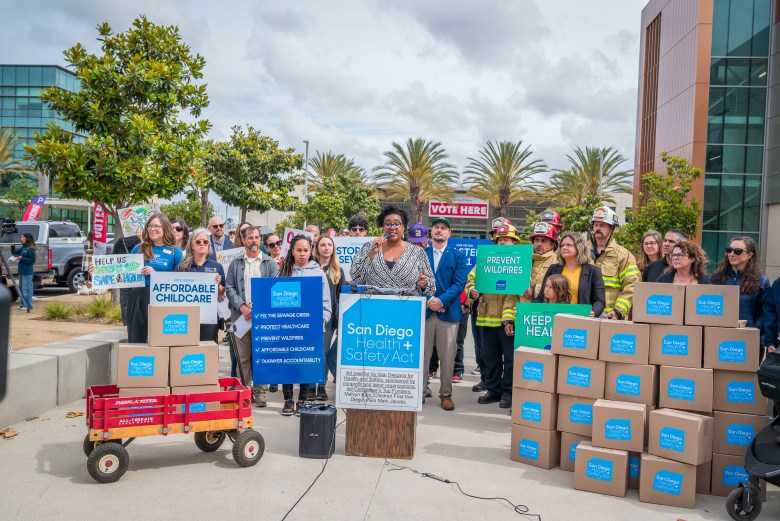
They say they’ve got the signatures.
The coalition behind a proposed countywide half-cent sales tax hike delivered more than 151,000 signed petitions to the county registrar on Monday in hopes of making the November ballot.
The San Diego County Health & Safety Act would raise an estimated $360 million annually to fund healthcare, child care, solutions to the Tijuana River sewage crisis and public safety.
The stinky headliner: The labor and advocacy groups backing the proposal have most emphasized that roughly $81 million annually would go toward combatting the Tijuana sewage crisis. But they have yet to flesh out specific plans for how that money would be spent. At least 20 percent of the funds would be directed toward infrastructure projects to “stop sewage flows from Tijuana into the United States or through the Tijuana River Valley,” according to the initiative, which was filed last year. The funding could also address related health issues and protect local waters from pollution.
Where more of the funding would go: Up to 60 percent of funds raised could support care and health services for children, health care for uninsured or underinsured people, food aid including staffing for CalFresh eligibility workers in the county, in-home health services and affordable health care. Another 18 percent could back public safety services, wildfire prevention and crisis response.
What’s next: The county Registrar of Voters has 30 business days to vet the signatures. The coalition needs at least 102,923 valid signatures to make the ballot but is hoping to automatically qualify with random sampling given the tens of thousands of additional signatures it turned in Monday.
Border Report: Mexico’s Dirty Beaches
The Tijuana River crisis isn’t just a San Diego problem. In Mexico, residents are also experiencing contaminated water and beach closures.
Water quality tests from late March reveal that Baja California is currently home to some of Mexico’s most contaminated water. It was the only state in a 17-state federal study to have beaches flagged as unsafe for swimming.
While federal health officials identified high bacteria levels at private beaches in gated communities further south of the border wall like San Antonio Del Mar, other studies are finding contaminated water in public beaches much closer to the border wall.
While some beachgoers and surfers monitor water contamination levels weekly, many other families remain unaware of the risk.
LAFCO Calls Off Investigation Into Water Authority
No one is getting rid of the San Diego County Water Authority just yet.
The San Diego Local Agency Formation Commission, or LAFCO, had planned to look into the possibility in what’s called a municipal service review, or MSR. But on Monday, LAFCO commissioners scrapped that process.
Service reviews are a key piece of LAFCO’s work. LAFCO has the power to audit services provided by local government agencies — as well as form, combine and dissolve government agencies.
LAFCO decided to initiate a municipal service review after two customer water districts successfully divorced themselves from the Water Authority for cheaper water elsewhere.
San Diego City Councilmember (and LAFCO commissioner) Stephen Whitburn argued the Water Authority has made significant progress selling its excess water supplies recently — and so it wasn’t necessary to continue studying the possibility of disbanding the agency. (Whitburn also serves on the Water Authority’s Board of Directors.)
“Arizona and Nevada are interested in buying water from San Diego County. Why at this moment… would the eight of us on this commission issue an MSR that raises the spectre of dissolving the San Diego County Water Authority?” Whitburn said.
Not everyone was in agreement. San Diego County Supervisor Paloma Aguirre (another LAFCO commissioner) wanted to continue the investigation into the Water Authority’s ever-rising rates.
“South Bay families know what it means to stretch every dollar,” Aguirre said. “Lower income households should not bear an outside burden for regional decisions made without clear accountability.”
Commissioners voted 5-3 to stop work on the municipal service review.
In Other News
- The San Diego Police Department is using AI to help with police dispatch, including using AI agents to answer non-emergency calls and to classify calls by type. (Axios San Diego).
- San Diego planning officials will ask the City Council Thursday to consider delaying the implementation of SB 79 in lower income areas and neighborhoods with challenges like high wildfire risk. SB 79 is a new state law that requires San Diego to nearly double the number of housing units allowed near transit stops. (Union-Tribune)
- In Oceanside, the City Council will consider extending a program to move homeless people camped along State Route 78 into long-term housing. It’s currently funded by an $11 million grant through a state program called the Encampment Resolution Fund. (Union-Tribune)
- Related: You can read more about Oceanside and Carlsbad’s joint effort to move hundreds of homeless people from encampments into stable housing here. (Voice of San Diego)
- The San Diego Community College District is facing a major cyberattack, district officials announced Monday. It started on Saturday and led officials to take some of the college’s internet, email and registration platforms offline. (Union-Tribune)
The Morning Report was written by Lisa Halverstadt, MacKenzie Elmer and Tigist Layne. It was edited by Will Huntsberry.

The sales tax hike hurts poorer people more. The sewage issue is being fixed. Govenor canadates would make it an emergency. The county just wants to spend on constituant pet projects and keep the raises flowing while moving water costs into sales tax revenues. Vote no.
“The coalition behind a proposed countywide half-cent sales tax hike delivered more than 151,000 signed petitions … The coalition needs at least 102,923 valid signatures to make the ballot.”
i hope you see the inaccuracy in the first figure, which is written correctly the second time.
Yep, the pitch for the signature gathering was all about cleaning up the Tijuana River pollution. I was asked at least a half dozen times to sign. How much were the signature gatherers paid per signature? (Yes, they’re paid.)
There’s a big difference between qualifying for the ballot and getting the votes. No one who solicited my signature mentioned the tax or that more than half of the funds generated would go to other things (aka the black hole of govt spending).