
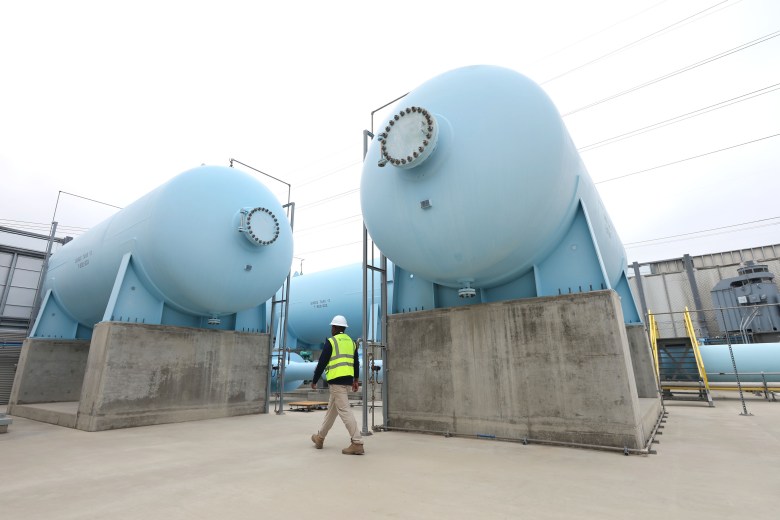
President Donald Trump’s top Colorado River official visited San Diego Wednesday to say the president sees “real potential” in developing more plants that make drinking water using the ocean – right off the California coast.
That’s a problem for environmentalists, who say desalination plants are environmentally harmful, energy intensive and costly.
“Imagine a future where a string of six, or even a dozen desalination facilities are operating along the California coast providing ample amounts of beautiful, clean, clear, fresh water in an environmentally benign way to serve not just California communities but to be shared at a reasonable price with… sister states to the east,” said Scott Cameron, acting commissioner of the Bureau of Reclamation, standing in front of the Carlsbad desalination plant.
He was there to sign an agreement with other major Colorado River negotiators from Arizona, Nevada and California to explore how states might buy and sell water across state lines – something that’s never been done before. The San Diego County Water Authority wants to sell off its expensive and energy-intensive desal water to these states, but needs permission from the other signatories to do so.
Even though San Diego is trying to get rid of desal water, Cameron took the opportunity to encourage California to build more of it.
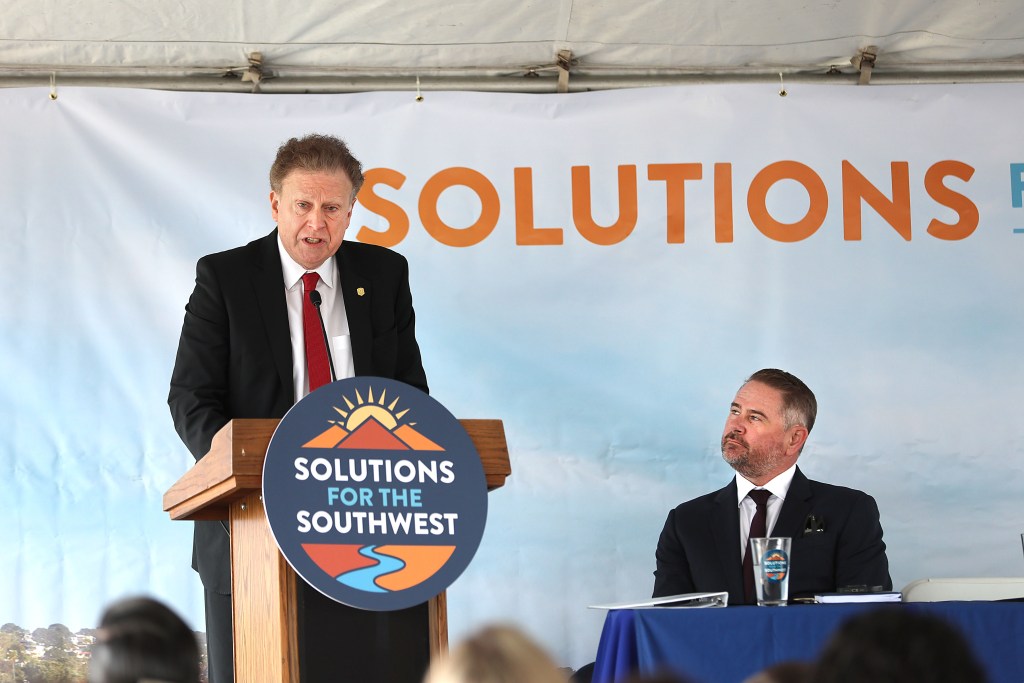
“I’m confident the state of California’s political leadership favors desal and I look forward to the date where the state bureaucracy fully aligns itself with making desal easier, faster and cheaper to permit so we can all benefit,” Cameron said.
When asked to expand on that, Cameron said he was talking about Gov. Gavin Newsom coming out on record as in favor of desal. In a Feb. 11 letter to governors in other Colorado River user states, Newsom cited desalination as among technologies that may be necessary to reduce pressure on the river, according to USA Today.
“That ought to provide some political coverage for other politicians in the state,” Cameron said.
Newsom terms out of office in January. The candidates that could replace him are still being decided as officials count votes in California’s Tuesday primary but the frontrunners are Republican Steve Hilton and Democrat Xavier Beccerra. It’s unclear where each candidate stands on the issue.
But it’s abundantly clear what environmentalists think about Cameron’s suggestion.
“Proliferating open ocean desal is a terrible idea,” said Patrick McDonough, an attorney at the environmental nonprofit, Coastkeeper. “Our Carlsbad plant is nothing short of a boondoggle. It’s extremely expensive. It’s energy intensive. It’s environmentally damaging.”
The best way to solve the crisis on the Colorado River, McDonough said, is simple: Use less of it.
“Then you don’t have to develop multibillion dollar infrastructure,” he said.
Coastkeeper fought the construction of the Carlsbad plant. It also battled and successfully helped defeat a proposal by Poseidon (the same company that built the Carlsbad plant) to build another large desal plant in Huntington Beach back in 2022.
Cameron’s agency operates the major dams on the Colorado River and leads negotiations between states on how to share the dwindling resource. But those negotiations are at a standstill and the Colorado River is hurtling toward record-breaking drought compacted by a predicted super El Niño that could raise temperatures even more.
A lot of legal maneuvering and dealmaking has to happen before the Water Authority could start selling off its water oversupply in order to bring down ever-rising water costs on its member agencies.
“We have to make this theory of interstate exchanges work because we are out of tools and out of other options,” said Water Authority General Manager Dan Denham.
Desal plants could really change the water situation in California. Wonder how the locals feel about this idea.
I agree and have pushed the idea in commentaries for several years. I do have a caveat, either the federal government or the other states have to pay for those Desal Plants which need to be powered by renewable energy. At $1.5 Billion per plant (today’s dollars), California cannot afford to build Desal Plants whose prime beneficiaries will be other states.
Those other states need to recognize that a Desal Plant is only part of a new system of water supply. That system includes Conservation, Recycling, and probably no Data Centers cooled by water.
BTW, done properly, this water market, could solve California’s budget crisis, and generate a yearly surplus for years into the future.
No one seems to remember the “demineralization,” plants that have operated in Chula Vista on Sweetwater River and it’s twin in Oceanside for more than 35 years+-, and use a fraction of the power to clarify far less salty brackish water with far less environmental impact like impingement, entrainment, and salty affluent.
I don’t remember the exact numbers, but I believe water transfers, local groundwater and other sources of county water wholesale for $500 to $800 less per acre foot than the desalination plant in Carlsbad. Should we be worried/surprised that federal officials lack or ignore data at the expense of consumers? A much longer conversation/article about water quality, supply & sustainability, and issues lime private sector incentives/disincentives to correctly size utility infrastructure and other challenges would require a broader interview/discussion and series of articles 🙂 just hoping!
Desal plants will be a necessary part of our water infrastructure going forward. To deny this is akin to denying costs and supply will continue to rise dramatically. Most people in our region are living paycheck to paycheck. It’s time for our leaders to lead in a proactive fashion on this topic for the people that continue to live here and those that continue to come. If we can put men on the moon we can build good and sound desal plants to affordably supply more fresh water to California.
I meant demand instead of “supply” in my initial comment.