
This post has been updated.
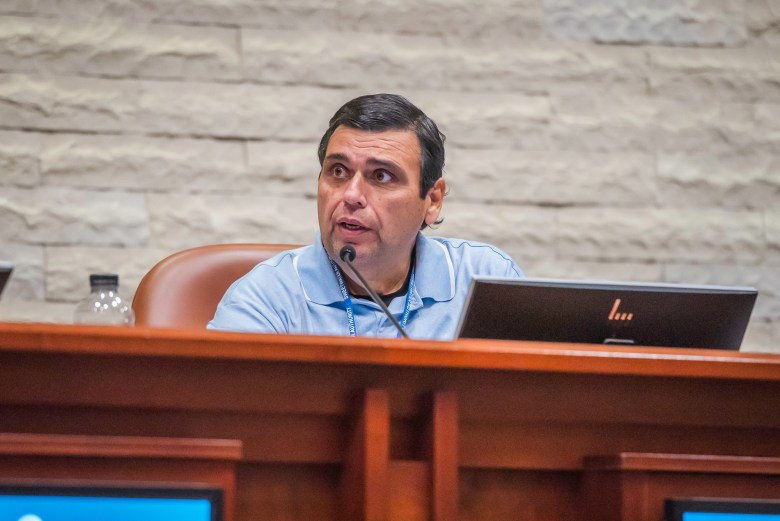
Jose Preciado is more upbeat than usual these days.
One year after being appointed to California’s powerful coastal commission, the Chula Vista city councilmember says he’s found optimism in peculiar places.
Technical presentations on zoning laws. A meticulous review process assessing whether plans, often to build more housing, abide by the California Coastal Act that requires development along the state’s coast to meet a bevy of rules to protect its natural beauty. Hourlong debates.
It’s a process most would find torturous. But Preciado thinks that’s where the good stuff — balancing environmental protections with the need for new development — lives.
“It’s just remarkable that this tension rightfully exists on the California coastline,” he said. “We can protect beaches. We can protect against sea level rise. And we can have nice things on the coast that can be a housing development. It doesn’t have to be either-or.”
Within a year, the agency has faced a recent state Supreme Court loss, an impending federal investigation and moves from state lawmakers to curb its authority because of its reputation for blocking housing on the coast. But despite its sour standing among policymakers, public opinion tells a different story.
Polling from the Public Policy Institute of California released this week showed that 82 percent of 1,578 adults surveyed think the coastal commission has been mostly good for the environment.
Preciado, who’s also a San Diego State University administrator, said he’s not surprised the public’s view drastically differs from that of the policy world.
“Most Californians that engage with the commission see it as an institution that’s holding the line on protecting the environment, on keeping the coast accessible,” he said.
‘A Pleasant Surprise’
Preciado joined the commission’s 12-member voting board last May as a longtime local official and academic administrator. He, along with Monterey County Supervisor Chris Lopez and Los Angeles real estate developer Jaime Lee, was part of a new crop of appointees vocal in their support for more development along the coast.
Preciado leans heavily on his South County roots. Few meetings pass without an invocation of his upbringing near Imperial Beach as a first-generation low-income kid who enjoyed going to the beach.
Preciado and the other new appointees have ruffled few feathers since their arrival, largely voting in concert with longtime commissioners, dimming fears from some environmentalists who worried they would not prioritize the environment in their decision making. Among the projects they supported was a plan last month to move water pipes near the Saturn Boulevard Tijuana River hotspot to help alleviate the rotten egg smell caused by hydrogen sulfide emissions.
“There was a real fear that, oh my gosh, these new commissioners are going to come and they’re just going to dismantle the safeguards and promote unfettered development on the California coast,” said assistant director of nonprofit Surfrider Foundation Jennifer Savage.
“Some would characterize it as a pleasant surprise at how overall positive they are voting.”
Preciado said that shouldn’t come as a surprise.
“I don’t think there are any folks on there who are anti-housing or anti-progress. I see very careful and thoughtful colleagues who are trying to do their best to honor the Coastal Act,” he said.
A 448-unit Encinitas apartment complex, which would be the city’s largest, overcame years of local opposition after the commission overrode local appeals from neighborhood groups who claimed project leaders didn’t adequately study its impact on nearby streams and wetlands.
Preciado says this project, which includes 90 units of affordable housing, makes him hopeful.
“I’m seeing more affordable housing on the coastline. I didn’t think it was possible.”
A PR Challenge?
Fifty years after its creation in the aftermath of the Santa Barbara oil spill, the Coastal Act — which governs the commission — remains one of the state’s marquee environmental laws.
Californians still care about the environment and think it’s worth protecting, according to the PPIC poll, which showed 55 percent of adults believe stricter environmental regulations are worth their additional costs.
So why does its reputation still stink in Sacramento?
Steve Blank, an adjunct professor at Stanford University and former commissioner, said the commission could have been better about attuning itself to the housing crisis and acknowledging its history of blocking housing.
“We tend to be a little tone deaf about the need for housing for more Californians. Personally, I think the commission could have been better about adapting to those circumstances,” Blank said, referring to his time on the commission.
Commissioners “poking SpaceX with a stick,” was also a tone-deaf, politically toxic move, Blank said. In 2024, the commission rejected billionaire Elon Musk’s proposal to increase the number of rocket launches near the Santa Barbara coast and chided his support of President Donald Trump in its decision. Earlier this year, the commission apologized for making “irrelevant” comments after the agency agreed to settle a lawsuit with Musk’s company over claims of political discrimination.
Earlier this year, lawmakers from Los Angeles proposed a bill that would have exempted most new developments in Santa Monica from coastal commission approval. Although the push ultimately failed, it was a reminder of the agency’s poor reputation on housing among Democratic and Republican lawmakers.
That perception is unwarranted, Preciado said, who said lawmakers love to attack the commission because it gets in the way of quick development by requiring the meticulous work of balancing environmental concerns.
“I’m hoping we come to an era where the Coastal Act and some of its processes are not legislated every year,” he said.
What I’m Reading Now
Residents remember an Escondido man as equal parts brash and generous after he was murdered outside his “Trump house,” The New York Times writes.
Gov. Gavin Newsom got a $250,000 boost in his campaign two weeks after announcing he and his family are being watched by federal investigators, from The Sacramento Bee.
Republicans vying for California’s gerrymandered districts have a tough road ahead. But they’ll be buoyed by a national campaign arm flush with cash, CalMatters explains.
Thanks for reading the Sacramento Report! Please reach me at nadia@voiceofsandiego.org for any questions or comments.
Correction: This post has been updated to correct that the commission apologized for making “irrelevant” comments after the agency agreed to settle a lawsuit with Musk’s company over claims of political discrimination. The agency did not agree to pay Musk’s company.
Leave a comment