
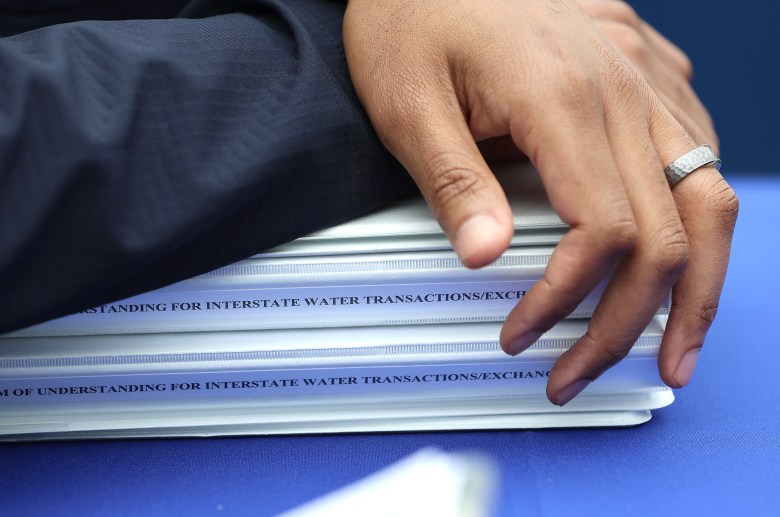
San Diego signed a deal Tuesday to start talking about something that’s never been done before: Sell water to other thirsty states in the Southwest.
The San Diego County Water Authority received a lot of national press recently because it’s probably the only water agency in this Colorado River-dependent region that has claim over more water than its people and industries use. Even The New York Times showed up Tuesday to catch the Water Authority’s general manager, Dan Denham, raise a glass of desalted water with top Colorado River negotiators celebrating their shared interest in creating an interstate water market.
Now it may take a small army of lawyers to pull off. Denham told me this deal is like “a QSA 2.0.” He’s referring to another very complex deal San Diego made in 2003 to buy water from farmers in Imperial Valley, who had to let some farm land go dry. It was a very complex arrangement involving the four major water agencies in Southern California.
“The effort itself is as big as the QSA,” Denham said.
It was hard because farmers in the Imperial Valley hold very old rights to Colorado River water. They would be some of the last to lose their water, after even whole U.S. states, should the river be pushed to the brink.
San Diego will need the Imperial Irrigation District’s buy-in on any future interstate water trades as well, the district’s Water Department manager, Tina Shields, has told Voice of San Diego. And some farmers are already worried that if urban centers start trading their investments like desalination or even recycled water, agriculture will be called upon to cut back as well, according to the Desert Review.
But this interstate deal wouldn’t trigger any new conservation or negative impacts to the environment like the QSA did, Denham told me.
San Diego wouldn’t actually be physically shipping its desalinated water to buyers Arizona or Nevada. The water would be exchanged on paper, so a buyer in Arizona purchasing San Diego’s water would take an equivalent amount of Colorado River water.
There are still a lot of questions: If San Diego is selling its water to another state, would that count against the total amount of water California gets from the Colorado River? Each state and its water rights holders are entitled to draw certain amounts. And when drought hits, everyone scrambles to agree on how to use less.
That’s the pickle the Southwest faces right now as Colorado River levels are at record-breaking lows.
Leave a comment