
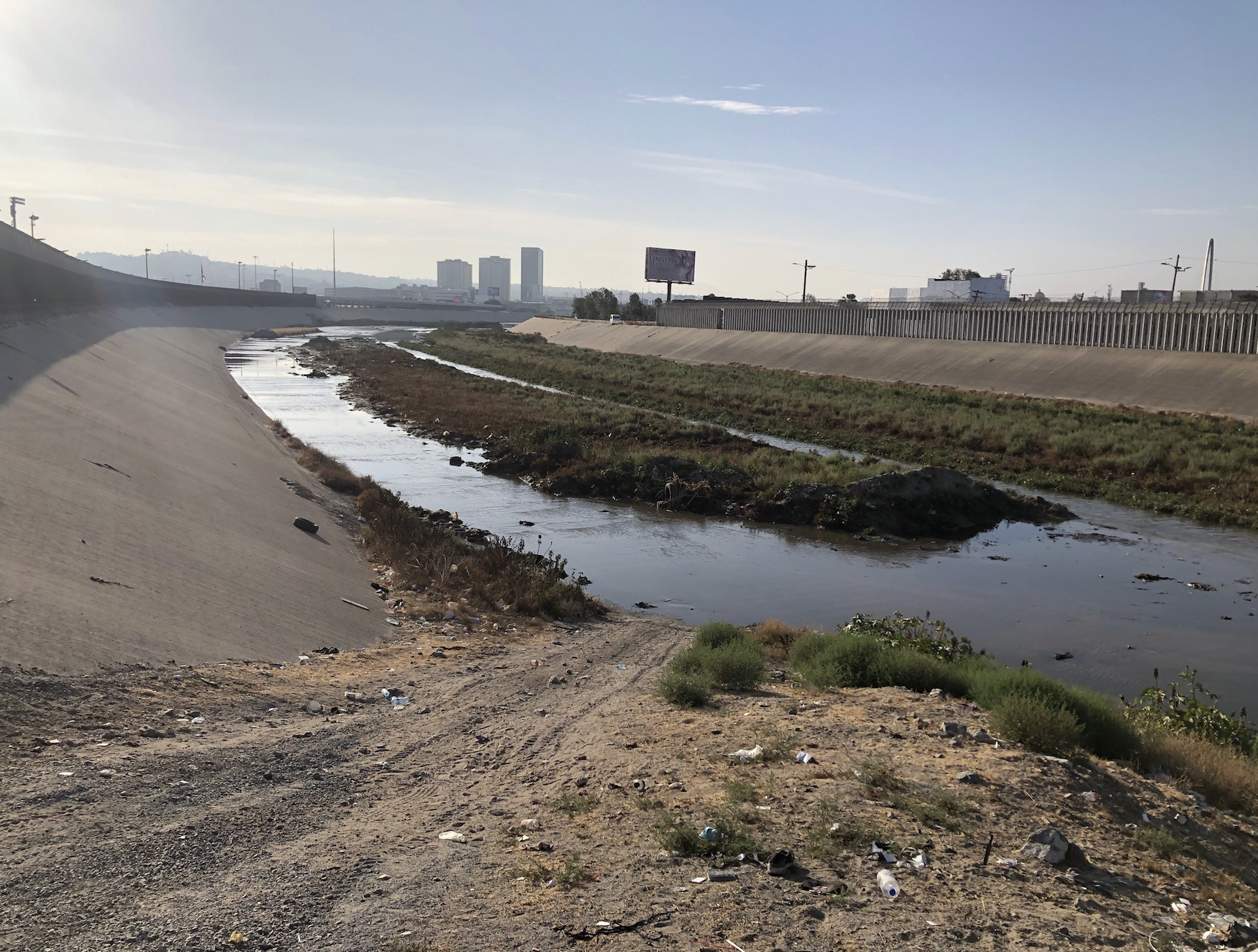
Around 1 a.m. this morning, about 13 million gallons of water, sewage and who knows what else flowed down the Tijuana River, across the border and into the United States.
At around 5 a.m., the level of sewer gas (called hydrogen sulfide) wafting off the river measured twice what the U.S. Environmental Protection Agency considers safe to breathe.
Kicker is, the river shouldn’t be flowing at all right now. It’s a seasonal river, which means it should be dry in the summertime, because it’s not raining (and hasn’t since May.)
Mexico sends part of its sewage through a pipe across the border to a treatment plant on the U.S. side run by the federal government. But nobody’s treating the Tijuana River itself, which is often contaminated by runaway sewage, once it flows into San Diego, through an estuary and finally into the Pacific Ocean south of Imperial Beach.
San Diego County Supervisors Paloma Aguirre and Terra-Lawson Remer think the county, and the county taxpayer, should.
“We’re done waiting for someone else’s timeline,” Aguirre said at a press conference on Monday.
In November, voters will decide whether to raise the county’s sales tax by half a cent. If they do, about $80 million of the money raised each year would be put toward solving the Tijuana River pollution problem. The measure doesn’t specifically say how the money would be spent, but Aguirre – whose political career has been fueled by solving the crisis – put out a plan to capture and treat the entire Tijuana River.
The two supervisors hope their colleagues at Tuesday’s board meeting will agree to infuse $1.8 million in county reserves toward that plan. The amount, they said, would pay to start mapping out how the county might do that.
Treating an entire river is no easy feat. In fact, this attempt on the Tijuana River could be the first of its kind.
Featured press conference speaker Natalie Mladenov, a professor of civil, construction and environmental engineering at San Diego State University, couldn’t name another project like it off the top of her head.
“In this country, rivers don’t have sewage in them, but we treat large volumes that come through pipes. We have the engineering capability to divert water… to a treatment system,” Mladenov said.
Here, we’re talking about a river – not sewage moved through a pipe.
The Tijuana River has long been plagued with stuff other than sewage. Water tests showed byproducts from banned soaps and cleaners, metals used in industrial plating, parasitic worms, and chemicals from plastics. The water would have to be treated well enough that it could either be reused, put back into the river channel or sent to the Pacific Ocean – where sewage treated at the border plant goes now.
There’s also a ton of sand the flowing river brings along with it, and trash, which can clog-up and sometimes break treatment facilities.
Then there’s the problem of where the county would build a treatment plant.
The Tijuana River estuary is divvied up among a patchwork of land owners from the International Boundary and Water Commission (the federal agency that manages the border plant) to the city of San Diego to California State Parks, Homeland Security, U.S. Fish and Wildlife, the Navy and private owners.
The EPA paid consultant PG Environmental to study river diversion back in 2021. The consultant looked at what it would take to build a system that intercepted the river water, and routed it to a new, advanced treatment plant at the existing border water plant owned by the federal government and operated by Veolia, a private contractor.
There’s lots of red tape. Altering the river would have to be OK’d by the U.S. Army Corps of Engineers and California’s Department of Fish and Wildlife. The project would have to meet zoning requirements by the city of San Diego. And, due to its proximity to the border, U.S. Customs and Border Protection would need to approve the plans, too.
It’s a costly endeavor. Building and maintaining the project over the infrastructure’s 40 year lifespan would cost an estimated $28 million and $63 million, depending on its size, PG Environmental wrote. An advanced treatment plant would cost another $280 million to $640 million to build and maintain.
That’s partly why the EPA ranked diverting the river through a treatment plant as the last thing to try and do on the U.S. side of the border in terms of solving the crisis.
But the supervisors believe this sales tax is their golden ticket around that. If voters approved the measure in November, the supervisors said the revenue for the river could be packaged into bond financing and provide billions to invest immediately. (Essentially, that path would allow the county to borrow far more money than the tax brings in each year, through the issuance of bonds. The tax money would be used as a guarantee to pay back the bond financing.)
Aguirre and Lawson-Remer said the county would play a role in owning whatever would be built at the border.
“It would definitely have to be a significant true partnership with other agencies… we’d have to partner with IBWC who has federal jurisdiction in that particular area we’re talking about,” Aguirre said.
She also mentioned the city of San Diego might play a role if the county were to incorporate the city’s South Bay Water Reclamation Plant as part of the solution. The parties could become a joint powers authority, which is a separate government entity created when two or more public agencies decide to share resources, services and power.
I asked, if this all were to happen, whether the county would then be legally responsible for the treatment of the river water. This seems like a huge legal liability given all of the surprises the Tijuana River could throw at those who try to wrangle it. The International Boundary and Water Commission is sued regularly for failing to clean the sewage it receives to Clean Water Act standards.
“The county currently already has a significant amount of legal responsibility and liability for clean water. That’s our job. I think we should be responsible,” Lawson-Remer said. “You don’t want supervisors who don’t want to do their job because they’re scared of being held accountable.”
In Other News
- California lawmakers greenlit a new San Diego sports arena, bypassing environmental hurdles. (CalMatters)
- Federal funding for a critical program that tracks ocean health, called the Argo float program, is about to run out. The National Oceanic and Atmospheric Administration informally agreed to continue financially supporting it, but President Donald Trump’s 2025 budget cuts gutted the organization’s ability to cover the costs. (KPBS)
- A new law making it easier to plug a solar panel into a regular outlet, which could dramatically expand solar access for renters, is heading to the governor’s desk, the Union-Tribune reports. I had been covering the bill’s progress through the legislature this year.
- A Sempra subsidiary sold off a gas distribution network in Mexico, reflecting the company’s move to concentrate on its regulated utilities in California and Texas. (Union-Tribune)
- Bike advocates say officials spend too much time penalizing e-bikers and not enough time fixing bike infrastructure to make riding safer. (KPBS)
- The thirsty state of Arizona is mulling plans to suck water supplies from Mexico’s Sea of Cortez, parts of which are protected marine habitats. (Voice of San Diego)
- About 250 people flocked to Fallbrook to oppose San Diego Gas & Electric’s proposed plan to build a high-voltage transmission line from Imperial County to the Orange County-San Diego County line. (Union-Tribune)
- There’s fewer beach fire rings on city beaches this year than before. So annoying. (Times of San Diego)
Advanced treatment with constructed wetlands I think would be most cost effective, and satisfy CA Fish & Wildlife. The treated effluent should be captured and re-used, the value of which should count towards construction, operation and maintenance of the wetlands.
For a few years, at about every other Board meeting, I’ve pushed for hand-held pollution monitors to find the cracks in the wall letting the air pollution through. I also by the way wrote to SDAPCD and a few others. I’m sure most people would be happy to know about these and plug ’em up. Big corporations are probably scared of being sued, but oh well. Let the chips fall where they may.
This is a state and federal issue. These two supervisors are in over their heads playing to their donor unions. I’ll be voting no.
this problem is 100% caused by mexico, but you will never hear paloma criticize mexico. ever. cause some pain for our neighbor, like closing the border periodically and they will come around, but our politicians side with mexico over the US
Ah Mexico, always sending over their best.
“Aguirre – whose political career has been fueled by solving the crisis – put out a plan to capture and treat the entire Tijuana River.”
is their plan to treat the “entire” 120 mile-long river or just the portion below the Rodriguez Reservoir where all the pollution is — the part that flows through Tijuana itself?
Politicians saying, “Give us $80 million a year and we can figure out how to spend it all.” No detailed plan, just a pie-in-the-sky hope of getting multiple national and international government organizations to co-operate and let us spend money doing we-don’t-know-what. The old saying is true: failing to plan is planning to fail – but we’ll get the $80 million a year bill, no matter how badly it fails. Nope!
This is Mexico’s sewage and the failure of the federal government to fix the problem by diplomacy, coercion, and/or funding an upgrade of the federal government’s water treatment facility. It is NOT the taxpayer in San Diego’s responsibility, nor is there an actual proposal with a budget to fix this issue, so I will not vote for this tax increase.