
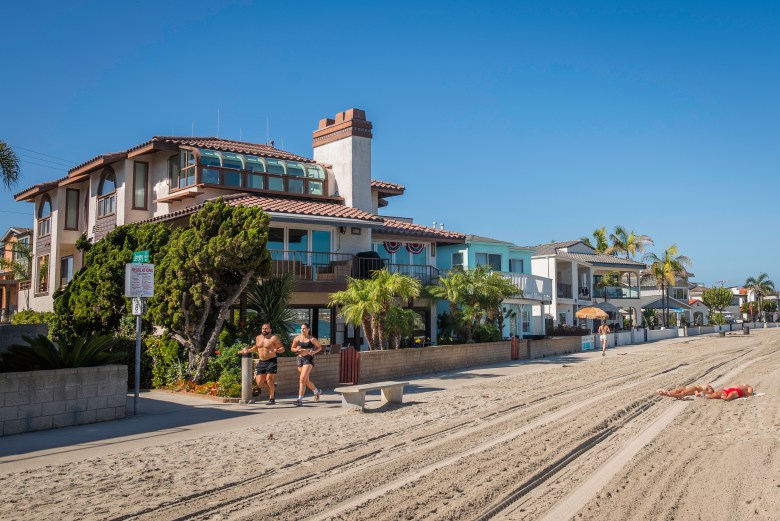
Airbnb spent at least $672,198 to fund the opposition of a single tax in four months — roughly a quarter of all expenditure lobbying spending reported in the city since 2019.
The money helped finance an opposition campaign against a tax targeting owners of short-term vacation rentals and vacant second homes. This campaign included voter outreach by the San Diego Regional Chamber of Commerce and a coalition of business, labor and public safety groups that included Airbnb and argued the tax would hurt San Diegans. An Airbnb political committee also paid $300,000 to a company that specializes in canvassing.
But the spending was not visible until after the San Diego City Council Rules Committee – which decides whether proposals advance to the full City Council or, in some cases, the ballot – had already rejected the proposal.
San Diego’s lobbying rules classify spending like this as expenditure lobbying. The term covers spending to influence a municipal decision without directly lobbying city officials. It can include advertising, texts or mailers, or payments to another organization to mobilize people around an issue.
Under San Diego’s rules, spending of more than $5,000 on those efforts must be reported to the City Clerk. The reports show how much was spent and which city decision was targeted but do not detail how the money was used.
Companies can wait until the end of the month following the close of a quarter to report the spending. That meant spending made by Airbnb during the final months of 2025 was not due to be reported until the end of January 2026, while spending during the first three months of 2026 was not due until the end of April.
The disclosures have since prompted Councilmember Sean Elo-Rivera – who was the one who authored the tax – to propose changing the city’s lobbying rules to require faster and more detailed disclosure.
“We’re not done with [Airbnb],” Elo-Rivera said in an interview. “Before we go back at them, we’re going to make sure the rules are right so people know what’s going on. I’m going to make sure that they’re not wearing brass knuckles when they get in the ring.”
Opposition to the Tax
In early October 2025, Councilmember Elo-Rivera proposed a new tax on vacation rentals and second homes, which he called the “Vacation Home Operation Tax to Preserve Housing.”
The proposal would have applied to an estimated 10,600 properties and, according to a memo from Elo-Rivera, could have generated as much as $135 million a year for the city.
Before the proposal reached a hearing, Airbnb came out against it.
An Airbnb spokesperson said the tax would raise costs for San Diegans who share their homes to make extra money.
The opposition quickly expanded beyond Airbnb.
The San Diego Regional Chamber of Commerce began sending text messages to voters urging them to contact members of the City Council and oppose the tax. The Chamber also sent mailers making the case against the proposal.
The City Council Rules Committee considered the tax on Oct. 22. Rather than vote on a final proposal, councilmembers allowed Elo-Rivera to continue developing it, with a completed version due back to the committee in January.
Over the next three months, the campaign against the tax continued.
By January, a broader coalition had formed to oppose the tax. On Jan. 7, a website called Keep San Diego Affordable went live, featuring statements from public figures including Chamber CEO Chris Cate and listing the San Diego Police Officers Association, Asian Business Association of San Diego and Western States Regional Council of Carpenters as coalition members. Airbnb was also listed as a member of the coalition. Cate is a member of Voice of San Diego’s Board of Directors.

It laid out arguments against the tax through a video and a series of bullet points. The case made against the tax was that it would raise costs for residents who rent their homes and threaten tourism-related jobs without creating any new housing. They argued revenue from the tax would just go to the city and would not help housing become more affordable.
At the bottom of the website, the sponsoring entity was identified as the Committee to Expand the Middle Class, a political committee sponsored by Airbnb.
Facing public pushback, Elo-Rivera amended his proposal during the months between the two committees. The plan shrank from a per-bedroom charge to a flat $8,000-a-year tax solely on homes whose owners have chosen to use them as empty second homes or vacation rentals plus $4,000 surcharges for corporate owners and those that violate city codes. Elo-Rivera argued the tax wasn’t about fixing the city’s budget problems. It was about prodding people to sell or rent their homes to local families who would live in them rather than tourists.
On Jan. 28, this new version of the tax came before the Rules Committee.
That day dozens of people showed up at City Hall holding signs opposing the tax. Representatives of the coalition featured on the Keep San Diego Affordable website were among them.
One attendee later told a Voice reporter that she had been paid to attend and declared she had traveled from Los Angeles with 45 other people with an LA-based group called Urbano Strategies.
Another group, Save Our Services LA, also brought people to the meeting.
During this meeting, several councilmembers made clear they still opposed the tax, so Elo-Rivera amended his motion on the spot, narrowing the tax to corporate and absentee owners of empty second homes only.
The committee ultimately rejected the tax. Councilmembers Kent Lee, Raul Campillo and Vivian Moreno voted no.
Elo-Rivera raised the issue after the hearing, accusing organizers of paying low-income residents to create what he called “fake community engagement” already suspecting that hundreds of thousands of dollars had been spent by his opponents.
The company did not comment on the accusation that they paid people to attend the meeting.
Follow the Money
After the vote, the lobbying filings began to fill in the financial picture of the opposition campaign San Diegans had just watched unfold.
Two days after the vote, Airbnb reported spending $372,198 under its own name to oppose the tax between October and December. The filing identified the amount and the measure but did not explain in detail how the money had been spent.
A separate filing from the San Diego Regional Chamber of Commerce, submitted a few days later, showed that the Chamber had spent $292,119 during the same period.
Its filing identified Airbnb as the sole source of the money.
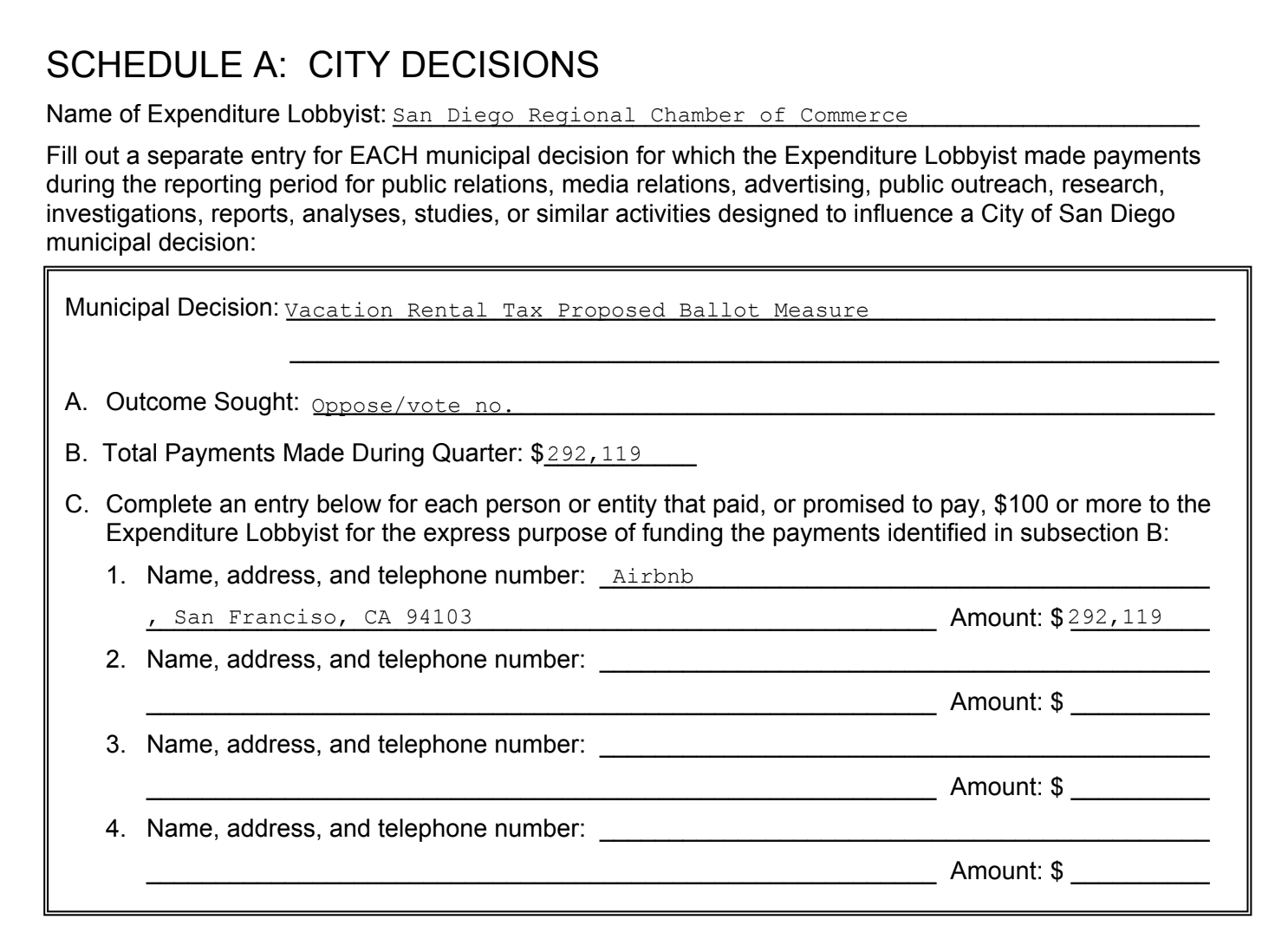
When Voice asked Airbnb about the two filings, an Airbnb spokesperson confirmed that the Chamber’s $292,119 was included in the $372,198 Airbnb had already reported. Which means that most of Airbnb spending in the last quarter of the year 2025 went to the Chamber.
The Chamber’s filing became public on Feb. 2, several days after the Rules Committee had rejected the tax.
Cate, the Chamber’s CEO, said the Chamber’s opposition to the tax was not connected to the funding it received from Airbnb.
“Our opposition to the proposal was in no way linked to any funding related to the outreach we did,” Cate said. “We took a position on the measure prior to any of that, and we opposed it because it’s bad policy.”
Cate also said the organization focused his effort primarily on text messages and phone calls to residents. He said the Chamber was not required to identify the source of the funding in those communications but chose to do so anyway “to be transparent.”
The mailers and text messages identified the Chamber as the sender, or said they came from the coalition of labor and business organizations. They did not disclose that Airbnb was the source of the funding.
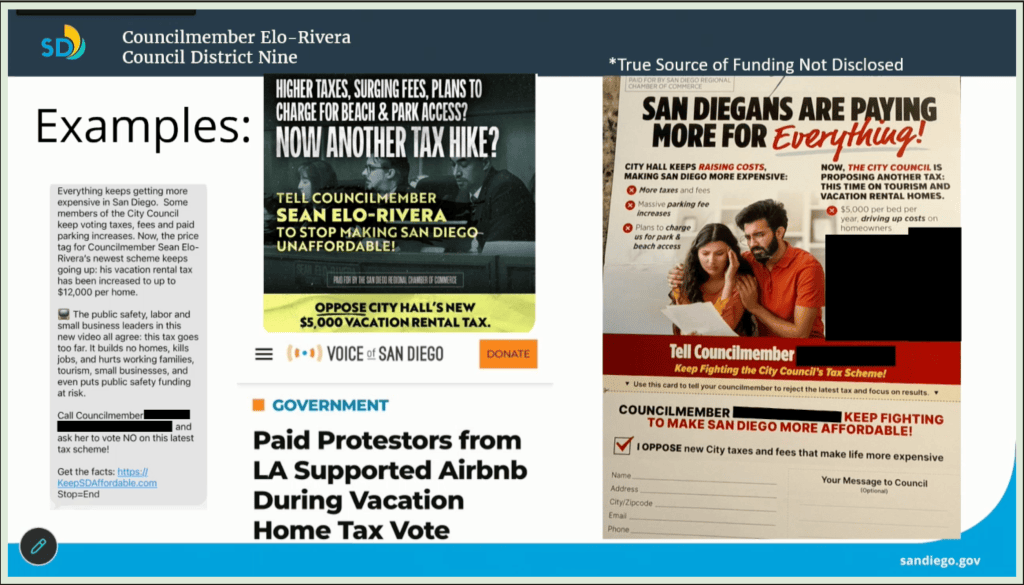
Chris Hambleton, a member and treasurer of the Tenants Councils of San Diego, which advocates for banning Airbnb from the city, said the company’s campaign had reached a lot of people. But it was not clear to everyone who was behind it.
“A lot of people, if they get a mailer or hear one person speak about an issue, don’t really have the context to know why that person is saying it,” they said. “Often, it’s the only thing they’re exposed to, so they just assume it’s true.”
Mobilize Community Partners
On Jan. 28, the day the Rules Committee rejected the tax; the hearing room was packed with people speaking against the proposal.
“San Diegans are deeply concerned about another hefty tax and we are proud to see the incredible turnout at City Hall today,” Justin Wesson, Airbnb’s senior public policy manager, said in a statement at the time.
Three months later, on April 28, a lobbying filing provided another piece of information.
This filing with the City Clerk showed that Airbnb’s Committee to Expand the Middle Class had spent $300,000 on what it described as “San Diego City Ordinance Activations.” The stated purpose of the expenditure was to “mobilize community partners.”
The filing did not mention the tax and did not identify the recipient or explain what the $300,000 paid for.
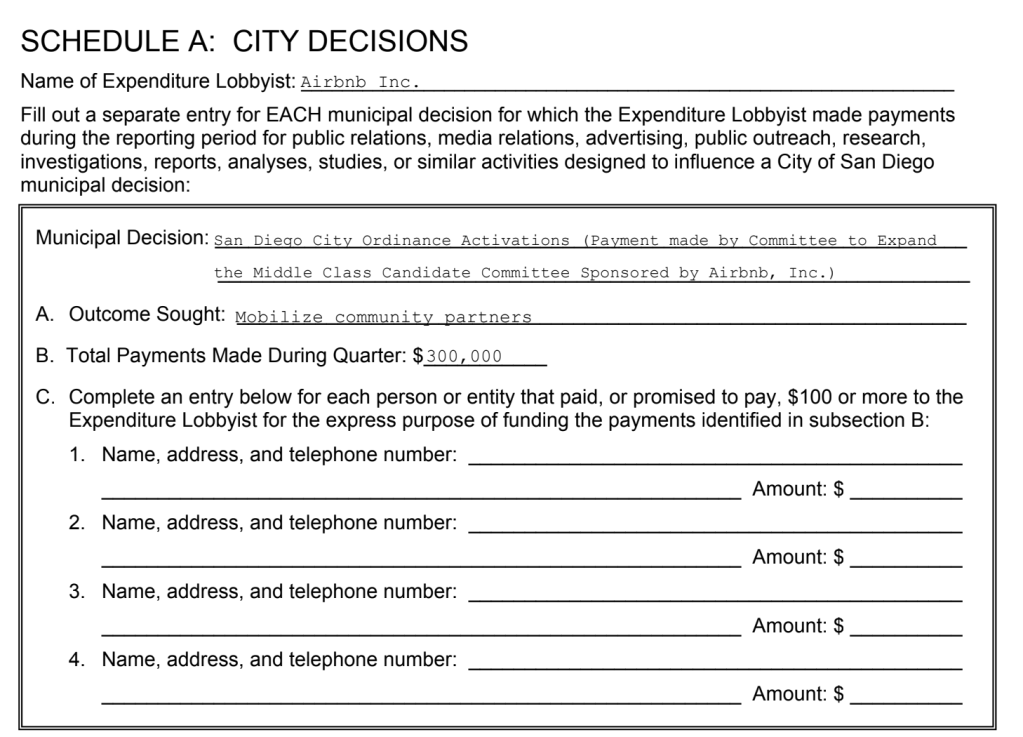
Voice traced the expenditure through the committee’s state campaign-finance filings. As a political action committee, commonly known as PAC, the Committee to expand the Middle Class has to file with the state of California to disclose its spending.
Those records show that on Jan. 16, 12 days before the Rules Committee hearing, the Committee to Expand the Middle Class paid $300,000 to Bridge Street Inc. The payment carried the same description: “San Diego City Ordinance Activations.”
Bridge Street is a Los Angeles entertainment company run by Martin Ludlow, a former Los Angeles city councilmember.
The payment was part of a larger relationship between Airbnb and Bridge Street. As previously reported, Los Angeles Ethics Commission filings show that Airbnb paid Bridge Street about $2.3 million in 2025 and 2026 in support for Save Our Services LA, a campaign advocating looser short-term rental restrictions on second homes. Urbano Strategies also helped organize Save Our Services’ Los Angeles campaign.
People affiliated with both groups were present at the San Diego hearing.
Airbnb did not directly respond to questions about the payment made to Bridge Street and what that money was used for.
The records do not establish that everyone who attended the hearing was paid, that everyone opposing the tax was organized by Airbnb, or that the people who spoke against the proposal did not genuinely oppose it.
They do, however, provide a more detailed picture of the behind the scenes of a campaign that Airbnb publicly described as opposition coming “squarely” from San Diegans affected by the tax.
Changing the Rules
The experience prompted Elo-Rivera to try to change the city’s lobbying rules. He thinks that the lobbying campaign was meant to send a message to him and other councilmembers.
“I think they were trying to teach me, and everyone involved, a lesson. I referred to it as collective punishment,” he said. “If they start unfairly bashing my colleagues with deceptive advertising as a result of a policy proposal I put forward, that will have a chilling effect on the willingness of not just me, but of anyone, to put forward a policy that they don’t like.”
His proposed ordinance would require expenditure lobbyists to report their spending within 24 hours instead of waiting until the end of the following month after a quarter closes. It would also lower the threshold for reporting from $5,000 to $1,000.
The proposal would require lobbyists to identify the original source of the money, even when it passes through another organization, and disclose the amount spent and the specific vendors and consultants paid.
Organizations that send advertisements, mailers or other public messages intended to influence a city decision would also have to identify their five largest funders and provide copies of the communications to the City Clerk.
The goal, Elo-Rivera said, is to give voters more information while a political fight is still happening, rather than months later.
“If you’re an everyday person and you see something and it comes from Airbnb, or it comes from another huge corporation that most people don’t think is on their side, they’re going to read what’s in front of them with a more skeptical eye,” Elo-Rivera said.
Hambleton said Elo-Rivera’s “follow the money” ordinance would make their work much easier because they could point out to residents who was behind a message.
“A lot of the lower-income tenants we talk to are often surprised when we explain to them that this is a structured opposition campaign and that they are using misleading propaganda,” they said. “I think it is good for people to see who funded the message.”
The ordinance is scheduled to come before the full City Council in September.
“I think they were trying to teach me, and everyone involved, a lesson. I referred to it as collective punishment,” he said.
Funny, that’s what San Diegans got when they voted no on the sales tax from Todd and company. What is fair about selectively targeting owners for tax revenue that was a problem created by Todd and company?
Visitors benefit greatly from all that San Diego has to offer, but we can no longer afford to maintain. San Diego has some of the lowest transient (hotel, Airbnb) and car rental fees of any major tourist destination in the US, it is perfectly reasonable to expect visitors to pay their fair share. Just look at your lodging, car rental bills from Spring Training in Arizona, next trip to Hawaii or NYC.
Selective reasoning doesn’t work to justify fee increases. Neither does comparisons to higher fee cities. The Ego-Rivera mantra of visitors paying a fair share is a joke.
Exactly. Slob Ego-Rivera is making a habit of making dividing specific groups and pitting them against each other. Hopefully that disgusting and dishonest man is never elected to any position ever again.
So the government wants information from the citizens faster, but celebrates the court decision to allow them to drag their feet when the citizens ask for information from them. More “Laws for thee, not for me” from our City Council.
The article clearly leans the rhetoric towards a major corporate giant changing an election, but what else did the Author “forget” ?
With nearly 6000 tier 3 and tier 4 licenses in the city of San Diego, meaning up to 6000 homeowners affected, many of which are using the revenue to fund their children’s education, their elderly parents caregiving, or simply trying to make ends meet.
As a homeowner and Airbnb host, I am grateful that lobbying was available for us during this time in San Diego.
Thank you for your service. Bozo. No one is stopping you from doing any of that. Pay taxes or sell your property to send your kid to USC or whatever.