
This post has been updated.
Sacramento Report Countdown
60 days until the November election
It’s a wrap folks.
Well, at least for now.
The 2025-26 regular legislative session has come to an end and members have packed their bags to San Diego.
Using CalMatters’ Digital Democracy database, we took a final look to see how rankings among the most and least effective lawmakers changed, as well as their voting records. (Note: Digital Democracy considers a bill “passed” after it is signed by the governor.)
Here’s what we found.
How Effective Was the Delegation in the Final Sprint?
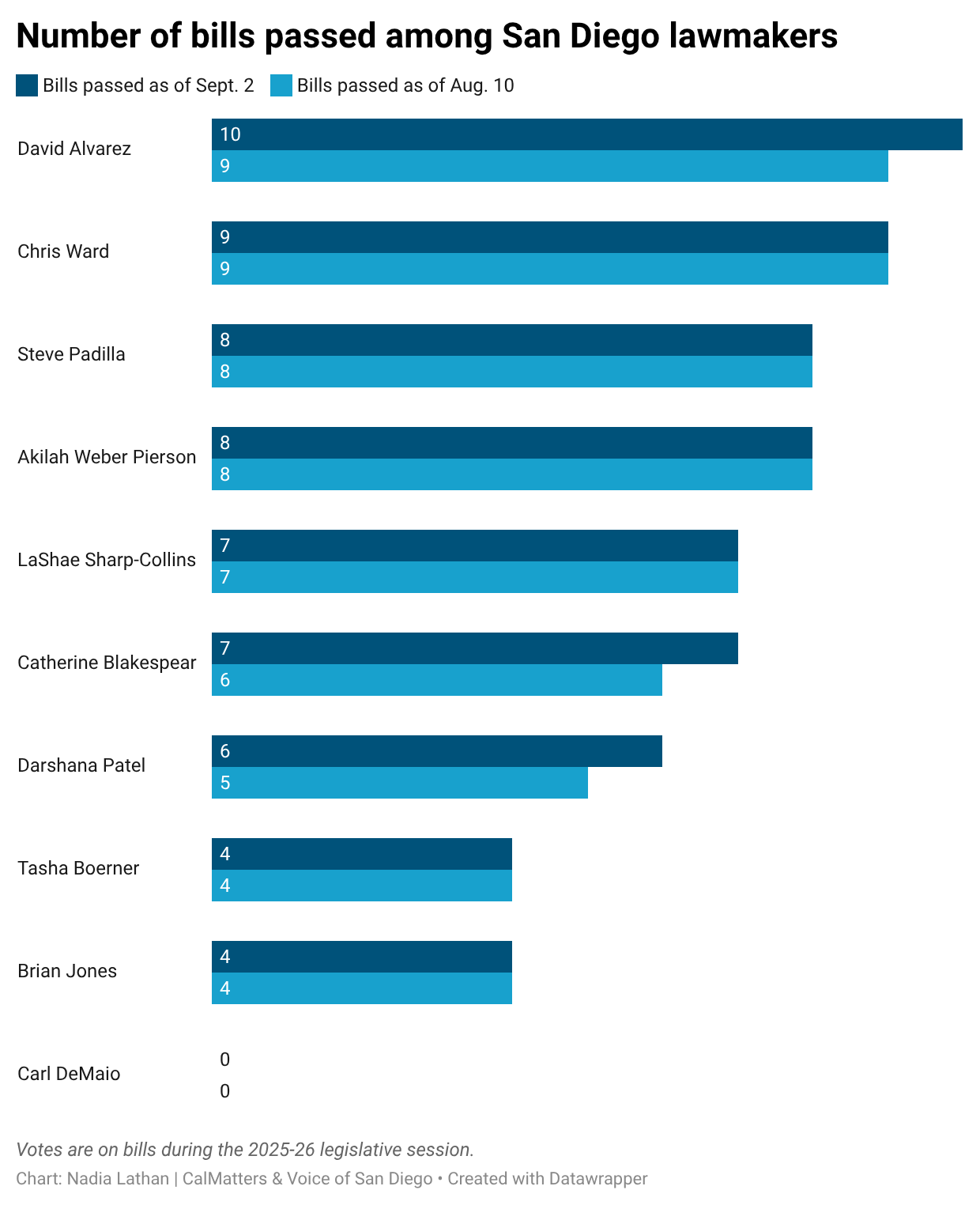
As we reported in a July Sacramento Report, Assemblymembers David Alvarez and Chris Ward, both Democrats, are among the delegation’s most effective policymakers, each with more than 23 percent of their bills passed.
Digital Democracy counts a bill as passed once it is signed by the governor. Legislators may have other bills approved through both houses, but those are not included in this count.
That carried through the final sprint of the session. Ward cleared a total of nine bills, the same as when we originally did our analysis, but he was still second overall in the 10-member delegation.
Alvarez, who represents Chula Vista, bumped his total from nine to 10 bills since August. He got his marquee legislation to expand four-year degree programs at community colleges through both houses this week. As the date of publication, it was not included in the count because it’s on the governor’s desk.
A different story unfolded for Ward’s flagship proposal to reign in big tech by curbing surveillance pricing, where companies alter sales prices based on personal data such as your gender or location. That bill failed for its second consecutive year, even as other states such as Maryland, New Jersey and Connecticut enacted similar restrictions this year.
Ward has sought to make California among the first to put guardrails around surveillance pricing despite strong opposition from businesses groups who watered the bill down last year to only include grocery stores.
That wasn’t enough, Ward said at the time, and Assembly Bill 2564 sought again to be a broader crackdown on the practice across major corporations. It died anyway.
He was “profoundly disappointed” that the bill didn’t get enough support to reach the governor’s desk, Ward said in a statement.
“With AI rapidly integrating into our daily lives, the silent targeting and pickpocketing of Californians trying to shop affordably will only get worse,” he said.
In the meantime, Ward follows shortly behind Alvarez and is ranked 39th overall in the Legislature for most bills passed. Alvarez leads the delegation at 34th out of all 120 members.
Assemblymember Darshana Patel, a Democrat, bumped up from five to six bills passed in the final days of session, and Democratic state Sen. Catherine Blakespear went from six to seven, placing her 63rd overall.
How Many Times Did San Diego Lawmakers Not Vote?
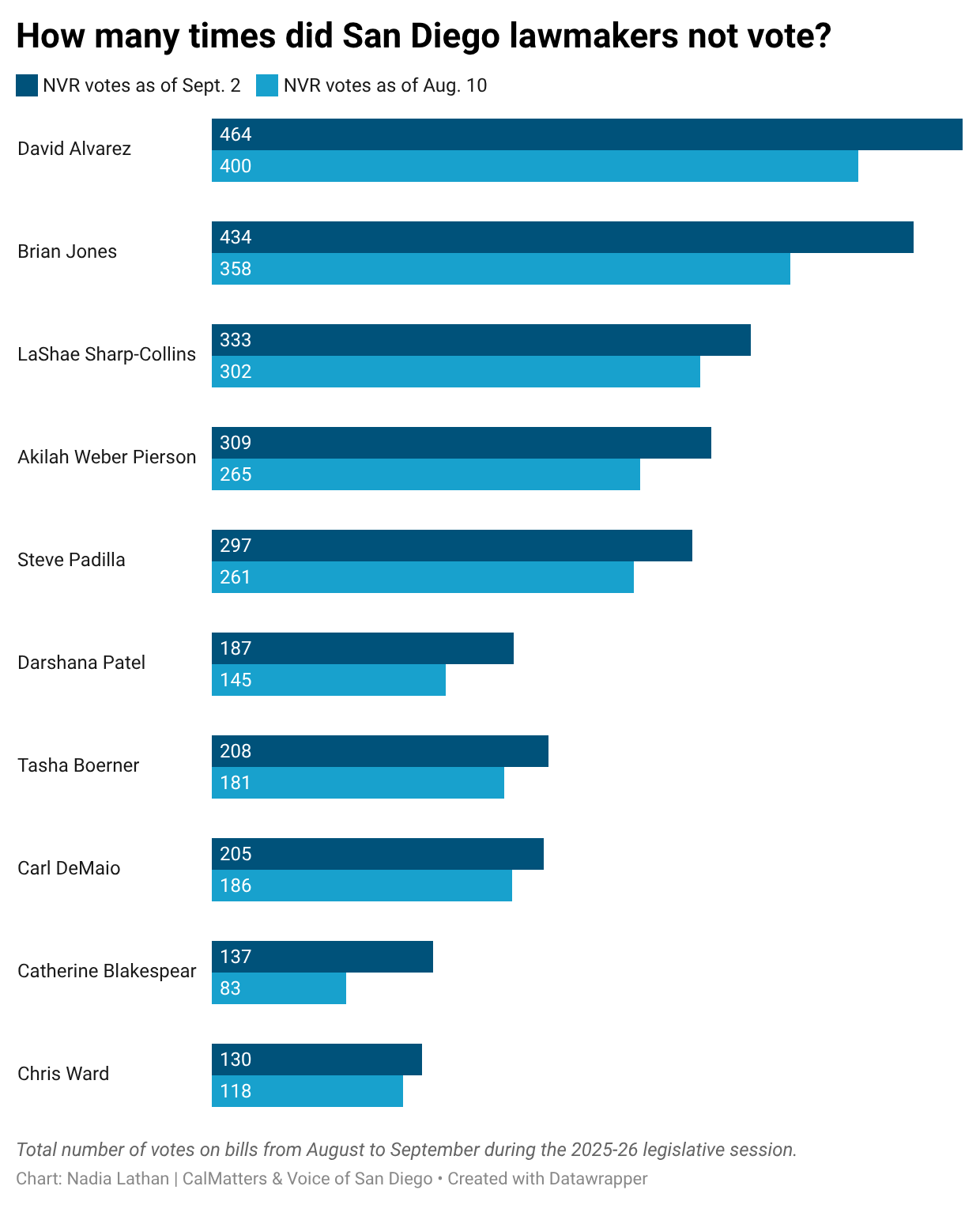
In California, when a lawmaker doesn’t vote on a bill, the online recording system doesn’t distinguish between an abstention, an absence or when the lawmaker is present but doesn’t vote. It all gets recorded the same as “no vote recorded.” As we mentioned in last month’s report, NVRs are commonly used by Democrats to oppose a colleague’s bill without doing so directly.
So the only way to know why a lawmaker didn’t vote is to ask them.
Alvarez — who had the highest amount back in September at 400 — still had the most among San Diego members at 464 NVRs as session wrapped up. GOP state Sen. Brian Jones, who terms out this year, was in second place with 434 votes, up from 358 in August.
Alvarez has previously said that a majority of his NVRs stemmed from absences for trips he’s taken for events in his districts.
Jones had the biggest increase, with a gain of 76 additional NVRs from August to September. Alvarez was second, with a 64-vote increase.
Ward had the smallest jump, moving from 118 to 130. As she was previously, Blakespear was also among the lawmakers with the fewest NVRs with 137 total.
Midway Gets Lawmakers’ Final ‘OK’
Fissures emerged among San Diego Democrats at the top of the week when it came time to approve (or not) an eleventh-hour deal, Senate Bill 344, to help the city’s long-awaited sports arena and housing project get around construction delays.
With a promise to deliver thousands of affordable housing units, state Sen. Akilah Weber Pierson, the bill’s author, said the legislation is critical to bringing more housing to San Diego.
Not everyone was on the same page.
Solana Beach Assemblymember Tasha Boerner, a Democrat who represents the neighborhood, said in a statement she didn’t support legislation to help fast-track the project, citing concerns over environmental protections.
“If we want to address California’s housing crisis, we need to allow for public scrutiny, and the public to sue when appropriate, to correct legitimate concerns and mistakes when assessing impacts,” Boerner, who didn’t vote on the bill, said in a social media post.
Republican Assemblymember Carl DeMaio was also opposed, saying the project would spur more development along the coast and obstruct views. He was one of two lawmakers to vote against it.
The bill cleared its needed two-thirds threshold to take effect immediately, with 72 out of 80 lawmakers on board in the Assembly and unanimous support in the Senate.
Gov. Gavin Newsom has until Sept. 30 to sign it.
Read more in my latest story for CalMatters.
Wildfire Deal Falls Apart as Newsom’s Influence Wanes
With just minutes to spare, California lawmakers this week rejected Gov. Gavin Newsom’s deal to reduce how much utility companies pay for sparking wildfires.
The last-minute punt on the governor’s last-minute deal came after rushed negotiations between the executive branch and legislators in recent weeks to figure out who should pay for utility-sparked fires — a priority for Newsom who entered office on the heels of California’s deadliest in state history
Assembly Democrats killed the bill package after Senate lawmakers watered down many of the provisions that Newsom wanted. The final proposal, Senate Bill 492, didn’t change how much insurance companies can ask for payouts and placed no limits on how much wildfire victims can recoup in costs.
While Newsom ultimately supported the deal, he acknowledged in a statement that it did not go far enough. “California cannot settle for half measures,” he said.
“Unfortunate” was what came to mind for state Sen. Steve Padilla, a Chula Vista Democrat and co-author of the package.
“It’s disappointing,” Padilla said. “I know for the Senate’s part, that we are all ready to roll up our sleeves and sit down at a table to begin the dialogue and discussion around trying to solve some of these bigger complexities,” he said.
“But the idea that something of great value to help Californians today didn’t include everything you want, is a failure” of leadership, he said.
What I’m Reading Now
Flock cameras are all the rage, literally. California lawmakers killed a proposal to regulate the controversial license-plate cameras for the fifth year in a row, CalMatters reports.
California Democrats looked to expand privacy protections for immigration aid workers. A right-wing uproar ensued, from The New York Times.
The San Francisco Chronicle dug into campaign donations made by employees at large companies to answer one key question: are your coworkers more Democratic or Republican?
Thanks for reading this week’s report! Please feel free to reach me for any questions or comments: nadia@voiceofsandiego.org.
Andrew Chan, a CalMatters’ engineer, contributed research to this report.
Correction: This post has been updated to clarify that Digital Democracy counts a bill as passed once it is signed by the governor. Legislators may have other bills approved through both houses, but those are not included in this count.