
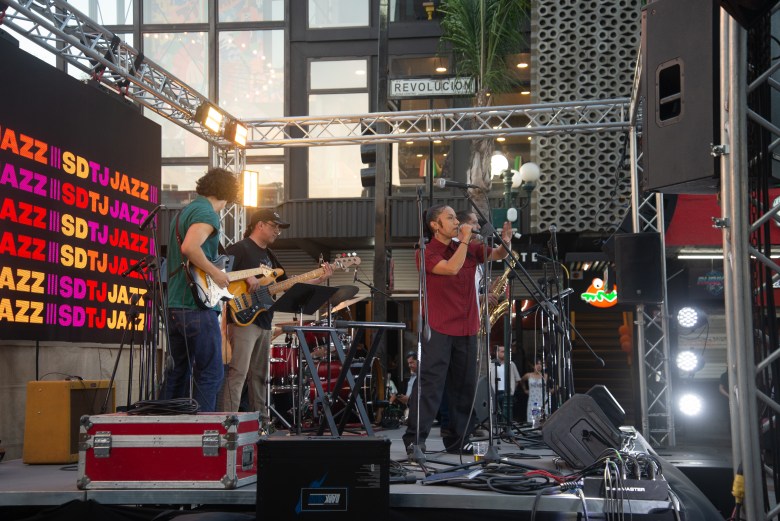
The gathering crowd had already taken up most of the chairs set up in front of a stage on Tijuana’s Avenida Revolución while the opening band was still finishing its sound check on Friday evening.
The San Diego Tijuana International Jazz Festival was in its second day, and one by one, a drummer, trombonist, saxophonist, bassist and guitarist tested their instruments.
Rapper Femina Fatal tested hers as well.
“Check uno, dos,” she repeated into the microphone.
Performing with Colectivo Fronterizo, Fatal added freestyled lyrics to the band’s intricate jazz fusion solos influenced by a variety of genres including funk, soul and cumbia. She said she felt like she was making history participating in the festival as a Hip Hop artist.
Originally from Ensenada, Fatal said she started out as a punk artist, using music to protest the issues she saw and experienced in the world.
“The simple fact of living in Mexico, being a woman and living in Mexico, that’s already a protest,” she said in Spanish during an interview after her set. “Things that I saw around me that weren’t correct — violence, gender inequality, economic violence, the terrible government that is always there, all the governments, the injustices.”
She said he realized that people had a hard time hearing the message clearly because of the sound of the genre, so she switched to Hip Hop in 2011 and learned to freestyle.
At the time, she said, she was the only woman rapping in Ensenada. She looked to raperas in other countries for inspiration, including Ariana Puello from the Dominican Republic, and French-Chilean artist Ana Tijoux. She also found inspiration in the protest lyrics of Chile’s Portavoz and Cuba’s Randy Acosta and in the sound of West Coast rap from the United States.
“I want to be a visible rapera not because I want fame or vanity but because I want other women to see that there are raperas, that we do it well, and we’re here doing it,” she said.
Julián Plascencia, director of arts nonprofit Promotora de Cultura de Baja California and organizer of the Tijuana side of the festival, said jazz has been an important part of Tijuana’s history, since, people would cross south to drink and listen to music in the city’s bars and restaurants during Prohibition. Three years ago, he joined his Tijuana Jazz and Blues Festival with San Diego Jazz Ventures to make the binational event.
“It’s important because jazz is a tool that contributes to society in the different countries of the world that promote it,” Plascencia said.
He said he chose Colectivo Fronterizo as part of the lineup because of the way the band blends genres and what that shows about music and influences in the border region.
“For me it’s something very representative of what is the mix of fusion for us in the border,” Plascencia said. “When we grew up here, our musical influences were different from the south, from Veracruz, from Mexico City. I love this fusion, this great, musical melting pot.”
He said he liked Fatal’s character and that it’s also emblematic of border life.
For Friday’s performance, Fatal said she used a mix of prewritten lyrics and freestyle verses.
Partway through the set, the band quieted for Fatal to perform an acapella.
“Somos sobrevivientes, impunidad sin precedentes, malditos presidentes, y su política de muerte, un país que juega con tu puta mente,” she rapped. We are survivors, impunity without precedents, fucking presidents and their policy of death, a country that plays with your fucking mind.
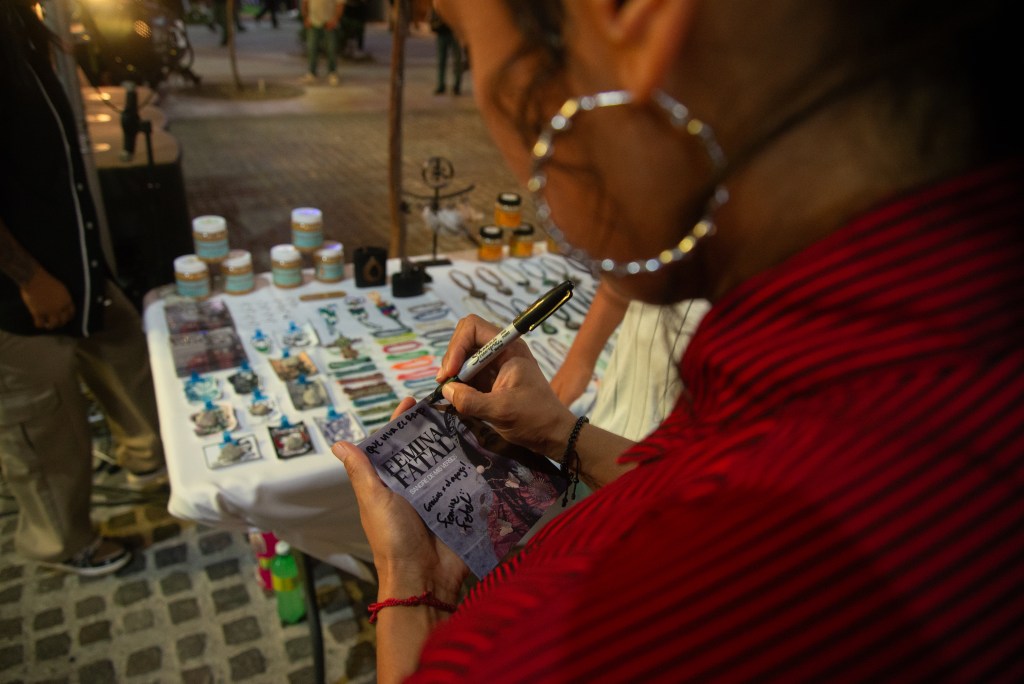
When the show finished, one young fan asked Fatal to sign a CD for his father, who had recorded almost the entire set on his phone.
After living in Tijuana and Mexico City, Fatal is back living in Ensenada. She’s also returned to her punk roots and performs with a band of women called Conchas Duras.
Fatal is hosting an event for women MCs at Mujeres Brew House in November.
Thank you for reading. I’m open for tips, suggestions and feedback on Instagram @katemorrisseyjournalist and on Bluesky @bgirledukate.
In Other News
End of TPS: Gustavo Solis reported for KPBS that San Diego’s Haitian community is struggling after the Trump administration ended their Temporary Protected Status.
Closed port: Concerns about a suspicious package shut down the Otay Mesa Port of Entry for more than an hour last Wednesday, Alexandra Mendoza reported for The San Diego Union-Tribune.
Lockdown in custody: Detainees and attorneys reported that Otay Mesa Detention Center went into lockdown during a recent visit from officials, I reported for Daylight San Diego. The movement freeze left a group of men trapped in a dining area without bathroom access for hours.
Campus enforcement: San Diego Community College District schools are installing signs to try to keep federal immigration officials from conducting operations on their campuses, Rhea Caoile reported for Fox 5 and KUSI.
Blocking Flock: I reported for Daylight San Diego that the American Civil Liberties Union of San Diego and Imperial Counties is representing the Partnership of the Advancement for New Americans to sue the city of San Diego over its use of automated license plate readers. Part of PANA’s motivation for the suit is because immigrant and refugee San Diegans are afraid to leave their homes.
Sanctions: The U.S. Department of Treasury announced sanctions against a long list of people for allegedly working as leaders or facilitators in the Sinaloa Cartel, Mendoza reported for the Union-Tribune. That includes the ex-husband of the Baja California governor.