
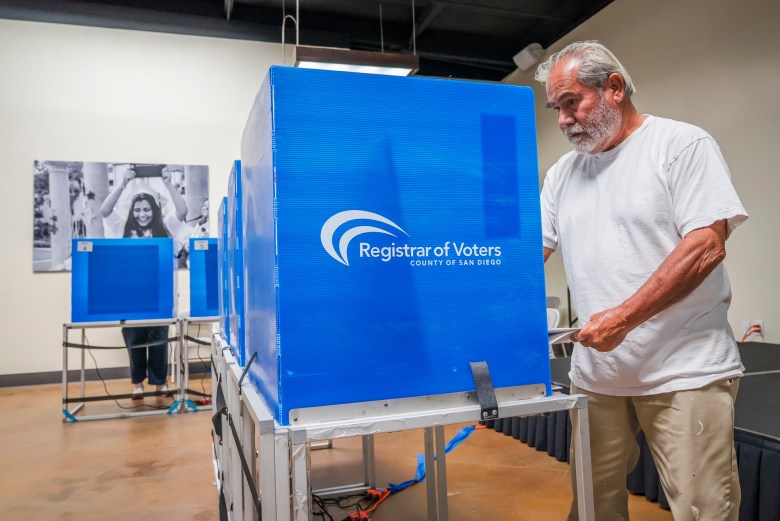
Among 14 statewide propositions crowding California ballots this year, Proposition 39 has flown mostly under the radar.
The voter ID measure, which would require California voters to prove their identity and American citizenship before voting, is nowhere near as widely known as breakout star Prop. 40, known as the “billionaire’s tax.”
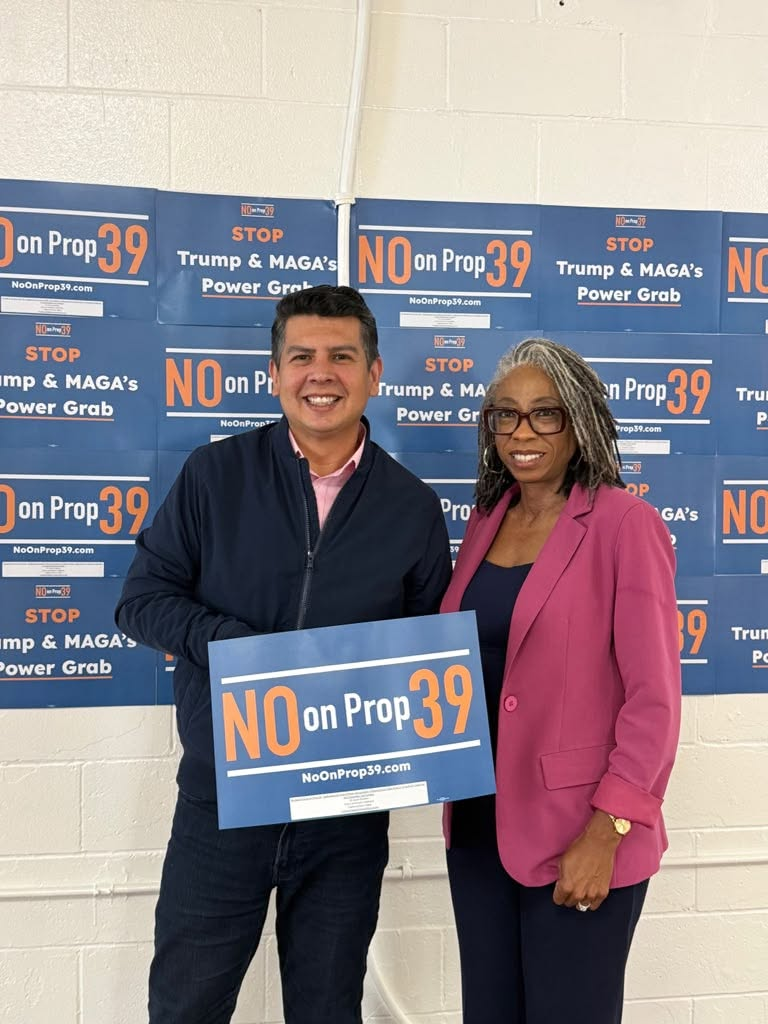
But according to a group of local leaders who gathered Tuesday for a No on Prop. 39 press conference at the Barrio Station community center in Barrio Logan, Prop. 39 should matter just as much, if not more, to California voters.
Especially in South County.
At the Tuesday event, state Assemblymember David Alvarez, along with San Diego County Supervisor Monica Montgomery Steppe, members of the San Diego chapter of the League of Women Voters, attorneys from the ACLU and members of other local advocacy organizations said Prop. 39 poses an existential threat to South County voters’ right to make their voices heard at the ballot box.
“We know from our history what happens when people who fear justice and equality decide who gets to vote,” Montgomery Steppe said of Prop. 39. “MAGA is targeting the same people who have been denied an equal voice in our democracy for generations.”
Alvarez said the ballot measure, which resembles measures in other states that have been linked to higher rates of ballot rejection for Latino, Black and Asian American voters, will make voting harder for local voters who lack ready access to identification documents.
“Under Prop. 39, simple errors like a single wrong ID digit could result in valid ballots being rejected,” he said.
The measure comes at a time of heightened tension over voting laws, election security and false allegations that the 2020 presidential election was rigged.
Earlier today, the Trump administration sued the state of California in an effort to block the state from counting ballots for roughly 20,000 voters the administration suspects of being noncitizens.
State officials rejected the suit as a baseless attempt to undermine California’s electoral process.
Courts have rejected similar administration suits in other states. Officials in Nevada recently examined a list of suspected noncitizen voters flagged by Trump officials and found that every one was, in fact, a citizen authorized to vote.
Backers of Prop. 39 say the measure is a straightforward effort to ensure election integrity that should not be controversial.
The measure requires in-person voters to show a valid government ID, such as a driver’s license, at polling places and requires mail-in ballots to include the last four digits of a voter’s driver’s license, Social Security or state ID number.
Three dozen states currently require some form of verification from voters, backers of the initiative say. California should be one of them.
“Politicians and the media will keep denying the fact that California has real problems with election integrity, but the message from the public is loud and clear in support of requiring voter ID as the best way to restore public trust and confidence in our elections,” said Prop. 39 architect and California state Assemblymember Carl DeMaio in a statement on the Yes on 39 campaign website.
A call to the campaign’s listed phone number was not returned.
Opponents said voters should not be fooled by Prop. 39 backers’ claims. California’s elections are already secure, they said. And voters already have to prove their identity when they register to vote.
“Voters should put [Prop. 39] at the top of their awareness list,” said Julia Gomez, a senior staff attorney for the ACLU who lives in National City and works with the No on Prop. 39 campaign. “It will impact everyone. But it will impact our community disparately.”
Gomez said studies of other states’ voter ID laws, including one recently enacted in Texas, show such laws disproportionately affect places like South County with high numbers of Latino, Black and Asian American voters.
“Every time you add a new requirement, it just creates more ways for people’s ballots to be rejected,” Gomez said.
Gomez said the Texas law, which went into effect in 2022, caused the state’s ballot rejection rate to jump from 1 percent to 12 percent.
But many of those rejections, she said, were for reasons that had nothing to do with whether a person was eligible to vote. State officials rejected ballots because voters wrote unclearly, accidentally transposed an ID number or got some other procedural detail wrong.
Voters who lack ready access to identification documents are especially vulnerable, Gomez said.
A study by the Brennan Center for Justice found Black, Latino and Asian American voters, along with older voters, disabled voters, women and even Republicans (many of whom skew older) all had ballots rejected at higher rates after the Texas law went into effect.
Gomez said many voters appear unaware of Prop. 39 and the risk it poses to places such as South County.
Polls of the measure’s support vary, with several recent polls showing the measure ahead though not yet winning majority support. Internal No on Prop. 39 campaign polls show the measure narrowly losing, though not by as much as opponents would prefer.
To raise awareness and build opposition, the No campaign has canvassed local neighborhoods on weekends and recruited volunteers for phone banks. Tuesday’s press conference was another attempt to get voters’ attention.
So far, the most persuasive attack against the measure appears to be its connection to Trump-aligned financial backers and Trump’s own efforts to tighten voting restrictions.
Voice of San Diego Sacramento reporter Nadia Lathan recently reported Prop. 39’s major funders include an out-of-state Trump-aligned billionaire, conservative tech financiers and an Airbnb founder who now works in the Trump White House.
Gomez said despite proponents’ claims, Prop. 39 is not, ultimately, focused on election fraud.
“We have very secure elections,” she said. The actual intent of Prop. 39, she said, is “creating chaos around our elections…so if Trump or MAGA loses an election, they can claim they didn’t actually lose.”
“We want people to exercise their right to vote,” she said.
In Other News
I was away on vacation last week and wasn’t able to cover a number of developments in our region. As usual in South County, it was a busy week. Here’s a roundup of some highlights:
- The Chula Vista City Council unanimously approved new rules governing the city’s use of AI, including tight restrictions on biometric surveillance and predictive policing. (Union-Tribune)
- Also in Chula Vista, officials from the city and the Port of San Diego on Wednesday celebrated the opening of Harbor Park, a new nautical-themed playground on the city’s bayfront that is part of an ongoing $15 million overhaul of what was formerly known as Bayside Park. Future improvements to the popular waterfront park adjacent to the Gaylord Pacific Resort will include a splash pad, new landscaping and pedestrian improvements.
- The National City Council on Tuesday voted 4-1 to take up a proposal to modify or eliminate councilmembers’ $100,000 annual discretionary fund budgets. I reported earlier that councilmember and mayoral candidate Marcus Bush proposed modifying or eliminating the funds because he said the city needs to cut expenses and the funds have been misused. Councilmember Jose Rodriguez, who also is running for mayor, opposed modifying the funds, saying the Council should focus instead on more significant efforts to bolster the city budget, such as a recently proposed tax increase on business licenses. The Council plans to consider Bush’s proposal next week. (Union-Tribune)
- San Diego County Supervisor Paloma Aguirre and state Assemblymember David Alvarez will team up this week to host a closed-door summit with other local leaders on the state of the Tijuana River sewage crisis. The two local leaders, along with several members of San Diego’s congressional delegation, will hear from regional environmental and public health experts about current health and pollution risks as well as progress toward solutions. Participants plan to brief reporters following the event, which will be held Friday morning at San Diego’s Liberty Station.