
When National City five years ago joined a parade of other California cities legalizing recreational cannabis sales, leaders were bullish.
Officials predicted legal weed would rectify past harms of drug enforcement, put National City at the cutting edge of the cannabis industry and eventually generate up to $6 million in annual tax revenue.
“We’re moving in a forward direction,” then-Mayor Alejandra Sotelo-Solis said.
That forward movement has been hard to discern.
Two cannabis companies sued the city, alleging improper evaluation of license applications. And a local hairdresser alleged she’d been duped into helping an out-of-town applicant pose as a locally owned business to score higher on application rankings.
This week, amid sluggish sales at the city’s four currently open dispensaries, the city’s economic development manager acknowledged the sector will likely never meet what he described as the city’s initial “honeymoon period” revenue estimates.
“The city probably will never see that amount,” said Economic Development Manager Pedro Garcia. Last fiscal year, according to city figures, the city collected just $492,205 from the 5 percent tax it levies on cannabis sales.
Garcia said that figure is in line with what the city predicted for the early years of legalized cannabis. But “I don’t know if it will grow as we had hoped,” he said.
Now, city leaders appear at odds over how to proceed. The City Council on Tuesday turned down a request from city staff to consider expanding the number of cannabis businesses in the city and allow dispensaries in more neighborhoods.
A staff report pointed out that a Council-imposed limit on where dispensaries can open has resulted in a concentration of businesses in a small, relatively out-of-the-way part of the city and prevented “investment in other commercial corridors.”
But Councilmembers said the city needs to help its existing businesses before adding more. They also nixed a request to consider filling two vacant sales licenses. Unlike five years ago, the mood of the discussion was downbeat and perplexed.
“It’s very disappointing,” said Councilmember Ditas Yamane, who stressed repeatedly she was not on the City Council when leaders greenlit cannabis sales.
Even Councilmember Jose Rodriguez, an enthusiastic backer of cannabis in 2021, who at the time sought to loosen regulations in a bid to help operators succeed, acknowledged the industry has not performed as hoped.
“We did not receive as much revenue as anticipated,” he said.
The disappointing numbers come as cities across California grapple with the reality – as opposed to the hype – of legal weed.
State voters legalized recreational cannabis in 2016. Since then, sales have trended down after an initial plateau. And black market operators, including illegal growers and sales operations with connections to Mexican drug cartels, have dominated the industry by offering lower prices and home delivery.
“It’s a tough economy,” said Alex Ayon, CEO of Sessions by the Bay, a cannabis lounge that opened in National City last year. Unlike regular dispensaries, the lounge allows customers to consume cannabis onsite in a comfortable, club-like atmosphere.
At the time the city legalized weed sales in 2021, leaders pointed with pride to the inclusion of cannabis lounges in the city’s ordinance. The city was the first in San Diego County to permit such lounges.
Since then, Ayon said, the cannabis industry’s ongoing struggles have stifled sales.
“The market is contracting and the black market and delivery are a challenge,” he said.
Ayon urged councilmembers on Tuesday not to expand the number of cannabis businesses in the city and instead to help existing businesses by easing sales license renewal requirements.
“We’re still finding our footing,” he said.
Ayon said Sessions by the Bay is not profitable yet and still needs time to grow.
“We see a path toward [profitability],” he said. “[But] consumer spending is down. People are prioritizing groceries and gas.”
Other cannabis industry players were blunter about what they said were National City’s missteps.
“I am as liberal as they come, but when you’re unfriendly to businesses, then they’re going to go elsewhere,” said Laura Wilkinson-Sinton, co-owner of one of two businesses that sued the city three years ago, alleging irregularities in how the city awards sales licenses.
“The city was so difficult to work with,” Wilkinson-Sinton said.
She said her company, along with the other company that sued, ultimately settled after the city re-evaluated their applications and denied them a second time.
Wilkinson-Sinton contrasted National City’s cannabis sector with the city of Vista, which in recent years has collected close to $7 million in annual tax revenue.
Wilkinson-Sinton said Vista got voter approval of cannabis sales via a ballot measure and permitted stores throughout the city.
National City’s proposal to legalize sales was controversial from the start. The City Council overruled an initial planning commission denial and muscled the proposal through despite opposition from residents, according to meeting minutes from the 2021 Council proceedings.
Ballot results from the 2016 statewide cannabis legalization voter initiative show a slight majority of National City voters opposed the measure.
In part to mollify residents, councilmembers limited operators to areas of the city zoned for light industrial uses. In practice, that means all city dispensaries are crowded into a small area on the city’s industrial west side far from most commercial corridors.
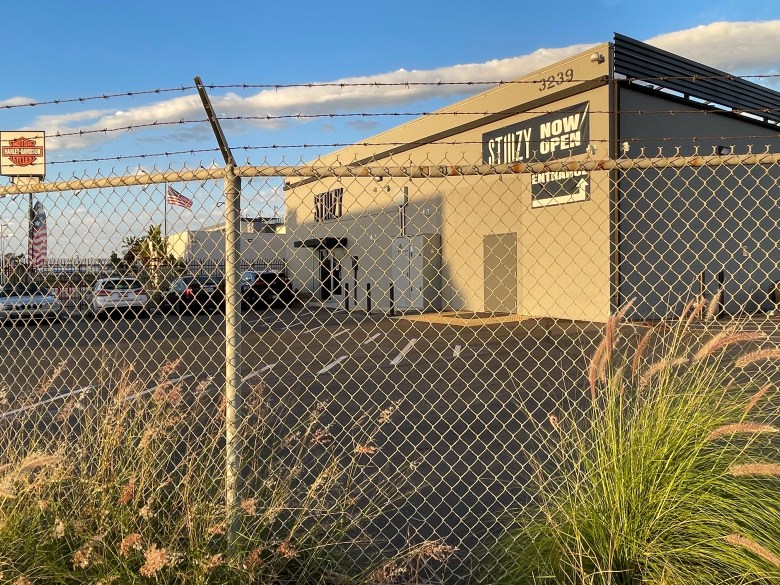
The National City location of the statewide chain Stiiizy, for example, is located on a nearly deserted corner at the far southwestern end of the city across from a freeway embankment and several warehouses.
Despite the effort to sequester dispensaries, residents on Tuesday still complained about trash and other problems near the city’s existing businesses.
“I clean up litter all the time,” said resident Ted Godshalk of a dispensary near his house.
Councilmembers on Tuesday said they are aware of problems with how the city has rolled out legal weed. But they appeared reluctant to do anything about it, citing the industry’s overall struggles and the city’s own bad experience with lawsuits and accusations of impropriety.
“We are at a saturation point,” said Mayor Ron Morrison, who in 2021 was the lone councilmember to vote no on legalizing cannabis sales. “If we were to open up to [more dispensaries, we would] put ourselves in a world of lawsuits all over again.”
Garcia said the dire depiction of National City’s cannabis sector is not entirely accurate.
He said judges in the two lawsuits filed against the city ruled in the city’s favor, and the city did not admit wrongdoing.
There have been no public safety incidents at the city’s four dispensaries, he said, and relations with business owners have been straightforward and professional.
As for the hairdresser’s accusation of being manipulated by an out-of-town company, Garcia said the city ultimately revoked the company’s license because it failed to meet deadlines and then tried to sell its license to another operator before even opening a storefront.
The company, Element 7, eventually went into receivership, according to business filings.
“We have a very fair and objective process, Garcia said.
The goal now, he said, is to stabilize the city’s cannabis sector and help it grow.
“I’m proud of how our program is running,” he said. “We’d like to see [it] progress.”