
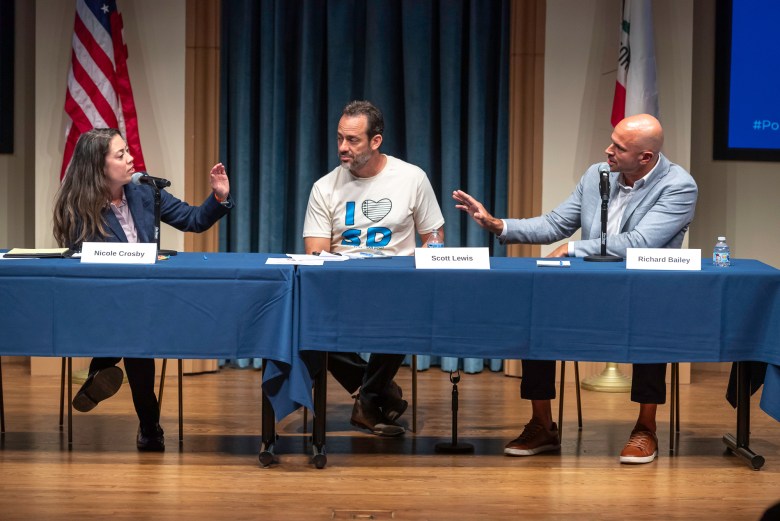
Everyone seems to be against Flock these days.
Look no further than the heated race in San Diego’s District 2 between Democrat Nicole Crosby and Republican-turned-independent Richard Bailey. Support of Flock cameras has become a standard line of attack in the race — what’s surprising is who is on the receiving end.
Supporters of Bailey have sent several mailers slamming Crosby for her support of Flock, dubbing her “San Diego’s Flock camera candidate.”
“San Diego has over 500 Flock cameras monitoring you every time you drive. With Nicole Crosby on the City Council, San Diego will get MORE,” one anti-Crosby mailer reads. Beside the text, an oversized Flock camera is positioned to capture the reader.

There’s just one problem: Crosby is a vocal opponent of Flock.
During public appearance after public appearance, she’s denounced the system and called for its dismantling. She joined Councilmember Stephen Whitburn at a recent press conference when he announced his opposition to the cameras.
She’s added her opposition to a recent mailer.
“The funny and the disappointing part is the AI slop and the lies that are absolutely unsubstantiated are being disseminated throughout our community,” Crosby said about the mailers. “I have been open about my disapproval of Flock cameras.”
Crosby, as a prosecutor for the City Attorney’s office, is more acquainted than most with how the system functions. She’s also supported by the union that represents San Diego police officers.
Still, she insists she’s never prosecuted someone using Flock data. She said her experience as a prosecutor informs her opposition to Flock, a private corporation collecting surveillance data of citizens without warrants.
“That’s not due process and it’s been terrorizing our neighborhoods,” Crosby said. “A camera or a drone does not help our response times when we’re talking to neighbors and knocking on doors they want a police officer to respond to things – they want people.”
The attacks shouldn’t come as a surprise. The controversial surveillance tech firm provides automated license plate readers for police departments across the country, including in San Diego. Over the past year, the company has become downright toxic, with some polls finding bipartisan disapproval of the systems.
The stakes are high: Whitburn’s anti-Flock shift gave the City Council its first 5-4 anti-Flock majority. But the mayor supports Flock. To override a mayoral veto, anti-Flockers will need to find a sixth vote.
That means whoever wins the District 2 race could make or break longstanding efforts to get rid of the cameras.
But the mailers also cast Bailey as an opponent of Flock. “Richard is 100% opposed to the invasion of privacy forced on San Diego by a proliferation of Flock cameras,” one reads.

Bailey hasn’t exactly said that himself.
In debates, he’s expressed reservations about Flock cameras, saying as a “civil libertarian” we should be “keenly aware of and do whatever we can to keep” from sliding down the slippery slope of government surveillance. But that’s hardly a full-throated condemnation of the tech. Adding to that murkiness, in the mailer that features the claim that Bailey opposes Flock, that’s the only policy position not supported by a citation.
But Bailey has updated his stance a bit in recent days. He told me he thinks the city’s continued usage of Flock cameras is unsustainable.
“The city failed to implement adequate safeguards and effectively communicate those safeguards to the public which ultimately caused the public to lose trust. Unfortunately, both the city’s reputation and public safety will take a hit,” Bailey said.
The mailers are paid for by the political action committee Protect San Diego – in support of Bailey for City Council 2026, which is financed in full by Point Loma attorney Steven Richter. In recent election cycles, Richter has become a big-time donor to conservative candidates. During the 2024 race, he donated $1 million to the political action committee of the local conservative organization the Lincoln Club.
Thus far this cycle, Richter has dropped $700,000 into the PAC. Richter did not respond to calls for comment, but in comments on NextDoor, his wife Carol Richter pushed back against claims the mailers portray Crosby as in favor of Flock cameras.
“Nothing was said about Nicole except that her supporters are in favor of the cameras. She and her campaign are surrounded by camera enthusiasts. No deceit there. Maybe re-read the mailer. Never says she is in favor,” Carol Richter wrote.

There’s some truth to that. Much of the content of the mailers is split between laying out criticisms of Flock and playing a sort of guilt by association game with Crosby.
“The politicians behind San Diego’s Flock cameras are all backing Nicole Crosby,” one mailer reads.
But others say Crosby is “San Diego’s Flock Camera Candidate.”
Candidates don’t have much legal recourse when it comes to misleading campaign mailers. California does restrict certain kinds of misinformation – like lying about endorsements, whether a candidate is an incumbent and details of an election, like voting location and date. But the Supreme Court has repeatedly struck down efforts to outlaw other kinds of deceptive information in political messaging, citing First Amendment protections.
Tom Wheeler, former chair of the Federal Communications Commission under President Barack Obama put it bluntly in conversation with NPR: “Unfortunately, you’re allowed to lie.”
So, it’s just another day in politics.