
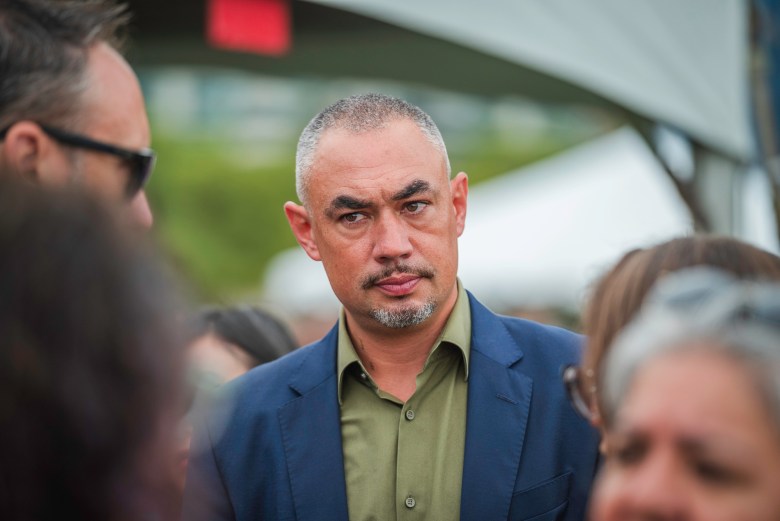
In a social media post, San Diego Councilmember Sean Elo-Rivera accused the police department’s leadership of flouting a city law meant to inform the public about instances in which officers responded to the scene of Immigration and Customs Enforcement arrests.
The law in question is the city’s Due Process and Safety Ordinance, which went into effect in May. It was inspired in part by chaotic scenes throughout 2025 during which ICE agents arrested residents accused of being undocumented. Officers with the San Diego Police Department were a familiar presence at ICE raids across the city.
Take the chaotic raid of Buonna Forchetta, an Italian restaurant in South Park. After residents gathered to protest the detainment of restaurant workers, SDPD set off flashbangs to disperse the crowd. Daylight San Diego reported the department sent 41 officers to an ICE call at the 47th Street trolley station last year and handed over an individual they’d arrested to immigration officials.
Despite laws prohibiting SDPD’s collaboration with ICE, many residents were left asking what exactly are local police doing there?
The ordinance sought to clarify that question. It included the requirement that the department issue incident reports within three business days when officers respond to calls for service from “law enforcement activity by federal law enforcement agency personnel” when the alleged crime is a “protected personal characteristic.”
That term covers all sorts of things, including a person’s immigration status. In short, the law required SDPD to notify the public when they respond to the scene of ICE arrests with reports that include the names of agencies present, whether they’d been presented with a judicial warrant and identifying information of the personnel involved, including badge numbers and which agency they belong to. Another element of the law required the department to notify councilmembers.
But in a social media post, Councilmember Elo-Rivera, who helped push for the ordinance, claimed SDPD Chief Scott Wahl hasn’t been providing those reports.
“Chief Wahl is ignoring the law. The public is being left in the dark,” the post reads.
Since the law’s passage, Elo-Rivera said his office has received only four of the required notifications. At least one unnamed Council office hadn’t received a single one, according to the post.
When it came to the required public-facing notifications, SDPD hadn’t issued a single one.
In an email, SDPD spokesperson Ashely Nicholes wrote that the department is committed to meeting the responsibilities of the ordinance.
When officers respond to “federal officials investigating an alleged crime involving a protected personal characteristic, including immigration status” they notify all councilmembers and the mayor, she wrote.
“Our commitment is to follow the law, keep people safe and make sure our communities and elected officials are informed,” Nicholes wrote.
Elo-Rivera clearly disagrees.
But what’s especially frustrated him is what he sees as a disconnect in SDPD communications. As efforts to dismantle the city’s license plate reader network have heated up, department officials have repeatedly sent communications advocating for the network. Meanwhile, they’ve been largely mum on the required communications regarding ICE.
In one instance, a community relations officer emailed residents touting the positive impacts of the Flock network.
“We should be strengthening law enforcement’s ability to protect our neighborhoods, not taking away technology that has demonstrably helped solve violent crimes,” Community Relations Officer Terrell Totten wrote in the email. “I encourage everyone who supports retaining these cameras to contact our elected representatives and express that support,” he continued, providing councilmembers’ email addresses.
That response stands in stark contrast to SDPD’s approach to ICE enforcement messaging, Elo-Rivera said. He claimed that in conversations with the police chief, Wahl told him it was “too controversial” for SDPD to release communications about the enforcement actions
“I have a problem with the selectivity of what’s worth speaking up about and what’s not,” Elo-Rivera said. “They have more than enough money in their communications budget to communicate to the public about things that are of this much importance to the community.”
In the social media post, Elo-Rivera also plugged a petition he’d launched calling on SDPD to “stop hiding SDPD’s presence at ICE enforcement.”