
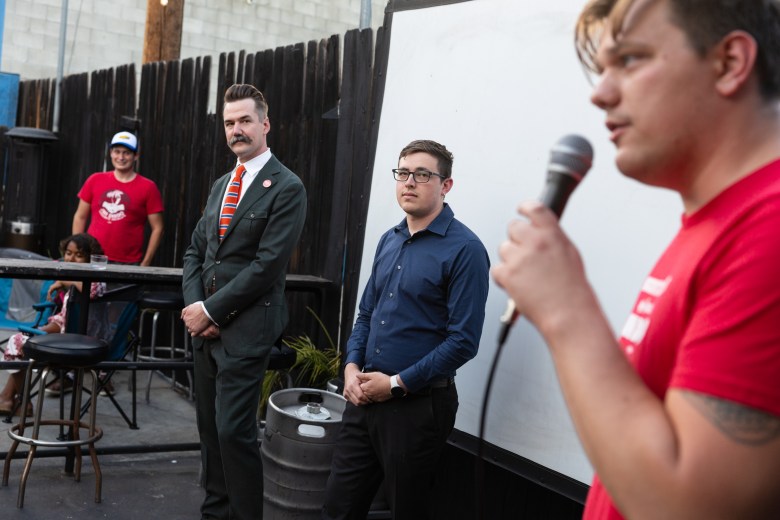
On a muggy Friday evening, dozens of people funneled into a courtyard of the Rolando-area headquarters of the United Domestic Workers of America. The local chapter of the Democratic Socialists of America had partnered with the environmental advocacy group San Diego 350 to throw a climate town hall.
Many wore DSA-burgundy-colored hats or t-shirts. They chatted next to a DSA sign-up booth, some grabbing snacks from fold out tables bearing Oreos, fruit and homemade sandwiches.
Jean Valcin, an engineer, stood chatting at a water cooler. He’d never viewed himself as a socialist, but amid this wild political moment he’d started looking for new ways to get politically involved. He’d attended some ACLU meetings, but that wasn’t doing it for him. Then he found the local DSA chapter.
“DSA is the one organization doing things that feel responsive,” Valcin said. “I have a [DSA] card, so I guess I’m a socialist now,” he added with a laugh.
Socialism has been a political boogeyman in American politics for generations, but in recent years some of the stigma has begun to wear off. The ideology has infinite permutations and interpretations. Broadly speaking, it often refers to a political system with more equal distribution of resources.
To some, that means collective ownership of major elements of production, like land, factories and corporations. For many people, it’s as simple as higher taxes for the wealthy and government-provided healthcare – two proposals that have surged in popularity.
The organization had gotten some big names to fill the space – San Diego City Councilmember Sean Elo-Rivera and County Supervisor Paloma Aguirre. That two rising stars in San Diego Democratic politics would appear on a flyer alongside the word “socialists” was a coup in and of itself.
Aguirre isn’t a DSA member, but she’s the kind of dynamic politician they’d like to recruit. Some members even canvassed for her during her 2025 campaign for supervisor. It was clear why.
When asked if she supported public power, she responded, “Yes, I support public everything.” It elicited big cheers from a crowd interested in public takeovers of corporations and utilities.
When conversation reached a recent decision by the Air Pollution Control District to not regulate diesel emissions from large emitters like warehouses and instead rely on voluntary incentives to cut down on pollution, Aguirre took aim at fellow Democrats who held a majority on the board.
“It was a betrayal to the people of National City and our entire region,” she said.
Decisions like that were why it was so important to “get the right people in office,” she said.
When it was his turn to speak, Elo-Rivera built on Aguirre’s condemnation. Unlike Aguirre, he is a DSA member – by far the most high-profile one locally. Though he hasn’t necessarily shouted it from the rooftops, it also hasn’t been a huge secret.
Over the past 20 years, the county has shifted from red to purple to blue. Now, the city of San Diego was completely blue – nine Democratic councilmembers, Elo-Rivera said.
But that complete control may just let people off the hook. Relying solely on incentives to stop polluters was “neoliberal shit that we just can’t do anymore,” he said.
That’s why it was so important to get everyone engaged, he said. It was also why it may be time to flex a new, more DSA-aligned form of political power.
“There are still people who have a very purple mentality,” Elo-Rivera said. “But then I’m looking at the red DSA shirts in the room, like, ‘Hey, let’s do a different version of purple.”
For years, DSA chapters across the country were relegated to shadow boxing on the margins of American politics. That was especially true in places like San Diego, where conservative politics long dominated.
But now entirely new groups of people, often disenchanted with mainstream political offerings, have swelled the size of DSA chapters in cities around the country.
San Diego’s chapter is no different. In less than two years, its membership has nearly tripled. But while some local chapters have built muscular electoral machines – harnessing legions of eager doorknockers to help propel socialists like Zohran Mamdani to the mayorship of America’s largest city – the same hasn’t been true in America’s Finest City.
A new crop of DSA activists is working to change that.
‘Everything that We Had Hoped For’

San Diego’s DSA chapter didn’t just appear out of thin air.
San Diego County Office of Education Trustee Gregg Robinson first began attending local DSA meetings in the early 1990s. Back then, it was mostly a reading group.
Like Berkeley-educated Robinson, the couple dozen people who attended were bookish intellectuals and academics in their 60s. They were bright and charismatic, he said, but lacked connections to working people.
“We hungered for that,” Robinson said.
They weren’t entirely politically impotent, but when they tried to connect to labor movement figures, they didn’t get far. Sometimes a member would stand outside a factory, handing out lefty newspapers.
“It was pretty pathetic, but we did our best,” Robinson said.
Over the years, Robinson lost some connection to the chapter. But then he was hit with the one-two punch of President Donald Trump’s re-election in 2024 and Mamdani’s win in New York. The former inspired rage; the latter inspired hope. Both pushed him back to DSA. What he saw floored him.
At the chapter’s most recent convention, most of the nearly two hundred people who filled the room looked to be in their 20s. And it wasn’t just academics this time, it was working class people and people of color.
Over just the past two years, the chapter’s membership has grown from about 500 to nearly 1,400. That growth has outpaced even the sharp increase nationally, where membership has more than doubled to more than 125,000.
“I felt like crying. I thought ‘This was everything that we had hoped for,’” Robinson said. “It wasn’t just old farts talking about this important book and how growing economic equality needs to be recognized, this was a room full of young people who feel it in their guts and were hungry to do something.”
‘The Antidote to Despair’
Under an unrelenting September sun, about 40 people milled around the back patio of the College Area-bar Majorette. Over pickle beers, corn ribs and chicken sandwiches, they chatted about Abdul El-Sayed’s recent primary win in Michigan. They were almost universally young, sporting tattoos and baseball caps. Many dutifully donned time-worn Bernie gear.
They were there for a fundraiser for two of the chapter’s endorsed candidates this cycle – Kenneth Zuniga, a DSA member running for mayor of Vista, and Alexander Kraft, a non-member running for mayor of El Cajon.
Chapter co-chair Connor Bennett stood at the back of the patio, microphone in hand. Bennett is a 33-year-old naval architect who designs electric ferries – a textbook example of the young professionals DSA often attracts. Bearded, bespectacled and wearing a DSA baseball cap, he launched into his stump.
“We know that our positions are popular in San Diego… We know that working people are fed up, and they want more affordable housing. They’re fed up [with] the way that we keep funding our police departments rather than funding community services like bathrooms and schools and rec centers,” Bennett said into a microphone. “This movement… is the antidote to despair in San Diego.”It sounds great, but what does the antidote to despair actually mean?
“Imagine taking a day off from work in a future without capitalism,” a webpage for the national DSA organization reads. “You have no debt. You don’t need health insurance. You don’t pay a mortgage or have a landlord, because comfortable housing is a human right. Your retirement is publicly funded. Food, education, energy, medicine, and transportation aren’t for-profit businesses; they are common goods and utilities.”
To get to that utopic vision, DSA proposes a slew of changes, from establishing a universal healthcare system and a Green New Deal, taking public ownership of the largest corporations and industries and reforming the electoral system by abolishing the electoral college and U.S. Senate.
“DSA has written this program for ending capitalist oligarchy and creating a real democracy. Some of these demands may be won under our current system, but we know complete victory will require building a new society from the ground up,” the webpage reads.
But even landing on that utopic vision was a procedural matter. Members vote on everything, from what committees to establish, what local priorities to pursue, what politicians to endorse and even who should represent local chapters to vote on issues nationally, like that policy framework.
But the group isn’t actually a political party. It doesn’t have its own ballot line, meaning its candidates don’t run as DSA members. Instead, they generally run as Democrats, often against more establishment incumbents. They’ve succeeded from Colorado to Washington D.C. and, of course, New York.
That’s sparked fierce animosity from members of the Democratic establishment. Drawling Democratic grand vizier James Carville labeled the organization a “pack of fools.” One Atlantic columnist described DSA as a “parasite” putting the Democratic Party at risk of being “overrun by extremists who will poison the party’s national brand.” The national organization’s fierce criticism of Israel’s destruction of Gaza has also put DSA at odds with some establishment figures.
That uneasiness cuts both ways. Many DSA members aren’t comfortable with Democrats either. They often hope to crack the calcified political duopoly and spin out a new party altogether. For others, the goal is to shift the Democratic Party’s internal politics to be more in line with their views.
“As DSA members – and I think this is a feeling felt among a lot of Democrats – we don’t think that the Democratic Party represents our values in practice, even if they, in theory, represent them a lot of the time,” Bennett told me.
In the group’s parlance, DSA is a “multi-tendency socialist organization” that contains a dizzying world of factions duking it out over priorities.
Some, like the Commie Caucus, prioritize grassroots base building through tenants and labor unions over electoral politics. Others, like the more moderate North Star caucus, view electoral politics as the path to a more socialist future.
That variation is a draw for many members. DSA is often just one of a constellation of activist groups members are a part of – from ones advocating for transit to urbanism to immigration to environmentalism.
That energy can be funneled into chapters’ working groups focused on issues like migrant rights, environmentalism or electoral politics. Those bespoke spaces have made some feel the foundational changes they’re pushing are more attainable.
Tajhay Banks helps lead DSA San Diego’s electoral working group. Like many members, the recent college graduate has been active in Democratic spaces for years, serving as president of SDSU’s College Democrats, a delegate to California Democrats’ assembly district election meetings and an intern to San Diego Councilmember Stephen Whitburn.
Despite that heavy involvement, disappointment with the Democratic establishment drew Banks to DSA. He doesn’t want a “return to normalcy” in whatever post-Trump world emerges. For him, that means not being able to afford a home, corporations’ continued domination of the electoral system and evermore wars waged overseas.
“I don’t find that acceptable, which is why I’m in an organization that hopes to end those things,” Banks said. “DSA has given me genuine hope for the future and the belief that things can change for the better.”
‘Starting Small’

When chapter co-chair Ryan Hill, a union organizer, arrived in San Diego a year ago, he was fresh off the high of starting an entirely new DSA chapter in Sonoma County. Over the years, it’s exploded in size, becoming the fastest growing chapter in the country.
In San Diego, Hill expected to find a muscular chapter that had helped a handful of elected officials into office. Instead, he found a chapter that had largely stayed out of politics – even voting against endorsing Bernie Sanders’ presidential runs in 2016 and 2020.
“It was a little bit of disappointment,” Hill said. “From my understanding, there was kind of a long history of anti-electoralism in this chapter – people who didn’t think elections were worth participating in or just thought that the chapter wasn’t strong enough to participate in elections.”
For years, the chapter preoccupied itself more with grassroots endeavors than electoral ones. They helped operate community farms, worked with migrant rights groups to organize immigration enforcement watches and tried to organize a tenant’s union.
Starting in 2024, though, that began to change. With the help of the California chapter, DSA San Diego stood up its electoral working group, which had previously disbanded due to inactivity. The local chapter also endorsed and canvassed for a pair of statewide rent control acts.
The effort was small, drawing just 16 canvassers who knocked on about 1,100 doors over about 38 shifts. Voters ultimately rejected the measure handily.
The chapter also engaged in something of an experiment that cycle – endorsing a member running for local office. Erin Evans, a tatted, hardcore-music-loving sociology professor at Mesa College, ran for the board of the San Diego County Office of Education.
She said the decision to ask the chapter for an endorsement was a “no-brainer.” She was already a DSA member, had locked down labor’s backing and, critically, wasn’t looking to move up in office. That meant she wasn’t concerned with the possibility that a DSA endorsement made her less electable long term.
But the local chapter hadn’t fully developed its endorsement process, which for DSA can be pretty elaborate. It usually requires candidates to secure signatures from dozens of members, after which the endorsement is voted on by a chapter’s electoral working group. Oftentimes, local membership of local chapters then get their own vote.
“It felt like I was a teaching tool. Like, I was helping them cultivate their process and that foundation that you need to build support for candidates,” Evans said.
Evans won her race, notching an early success for local DSAers. She’s currently the only DSA-endorsed office holder countywide.
To DSA members, endorsements are serious business. They function as a commitment that the chapter will put significant energy into getting a candidate elected — often through canvassing – and mobilize around their political priorities while in office. That may mean members will show up en masse to a meeting to advocate for a policy proposal.
But the commitment goes both ways. The organization expects endorsed candidates to continue to work with a chapter while in office. Chapters have even created Socialists in Office committees to coordinate with their elected officials.
DSAers have publicly debated not only about whether to endorse candidates, but how best to ensure their elected officials don’t stray from the organization’s ideals. In the LA mayor’s race, national DSA leaders are currently threatening to revoke the DSA LA’s recent endorsement of chapter member Nithya Raman.
In 2025, DSA San Diego threw in for Proposition 50, the Democratic effort to gerrymander California congressional districts in response to a similar Republican effort in Texas. For many members, this felt like something of a coming-of-age experience. In prior campaigns, they’d relied on printed materials and maps from partner organizations. This time they created those things on their own.
“With each one of those campaigns, we grew the number of people out canvassing, the number of people with the skills to do that sort of organizing and the number of doors knocked,” Bennett said.
They ultimately knocked on about 1,900 doors over 69 canvassing shifts.
Mamdani’s election in New York City late last year energized the chapter’s electoral focus even further. In conversations with DSAers, the mayor’s name comes up again and again. Even advertisements to prospective members refer to him: “How can San Diego get our own Zohran Mamdani?” reads one flyer for a DSA 101 meeting the group regularly holds at the Malcom X Library in Valencia Park.
Mamdani’s election also brought in a flood of new members, many of whom were more veteran political operators eager to be part of an organization that was gaining traction. That included Aidee Mariscal, a union organizer with SEIU Local 221, which represents public sector workers in San Diego County. She runs some of the chapter’s DSA 101 sessions and said attendees bring up Mamdani up at every single one.
“Seeing somebody go up against the Democratic establishment and win was really inspiring,” Mariscal said. “It felt like something good was happening even while things are falling apart.”
In April, members voted to adopt electoral work as one of the chapter’s two priorities alongside continued efforts to push back against Immigration and Customs Enforcement activity locally.
Then a couple of months later, San Diego Councilmember Elo-Rivera approached members about supporting Measure A. The initiative began as an effort to tax Airbnb rentals and empty second homes, but Elo-Rivera later narrowed it to a tax on only second homes with no fulltime resident, after a council committee rejected the initial proposal.
It felt like a vote of confidence in the chapter, Bennett said. Proof that they’d begun to mature and were being taken seriously.
The chapter endorsed the measure and functioned as a primary door knocking force for it, mounting 100 canvassing shifts and knocking on more than 2,800 doors in just a month. While still comparatively small in a city of 1.4 million people, it was a meaningfully larger effort than DSA had ever mounted. Despite Measure A losing by six points, local DSA leaders – and Elo-Rivera – view it as powerful growth.
“To see DSA members who, with their hearts, felt the purpose behind Measure A and were willing to put boots on the ground and talk to members of the community about it, that was really important not just for DSA being a bigger, stronger chapter, but for achieving electoral success on progressive efforts in the future,” Elo-Rivera said.
With local candidates Kraft and Zuniga, DSA has embarked on its most ambitious effort yet – simultaneously backing two campaigns in different corners of the county. The chapter’s also guaranteed to double its number of elected officials thanks to a late endorsement of a member running unopposed for the board of the MiraCosta Community College District.
Alongside the near-weekly social events, like book club meetings, movie nights or gardening events, the chapter’s calendar is clogged with fundraisers, canvasses and phonebanks. Members have knocked on thousands of doors throughout the county – a greater number than ever before.
It may work. It may not. Both candidates are long shots. But if nothing else, Bennett said, they’ll have even more experience for whatever’s next.
“Starting small and then growing is what the DSA advises,” Bennett said. “New York City DSA did not start with Zohran running for mayor. They started with small assembly districts in Queens and Brooklyn and grew from there to a field campaign that was capable of running a mayoral campaign.”
So far, it’s been a story of small successes so far. But the chapter hopes its Zohran-moment is coming.
‘Political Maturity’
While tensions between the DSA and the Democratic Party have exploded nationally, they’ve been less explosive locally.
Will Rodriguez-Kennedy, the chair of San Diego County’s Democratic Party, acknowledged DSA is a “growing force,” but said the organization is still dwarfed by the larger party. There are more than 800,000 registered Democrats in the county, to say nothing of the powerful labor unions that that play an outsized role in local politics.
“There are parts of my party that have significant concerns about the DSA’s platform, but I’m sure… a DSA member would have some significant concerns about people in other parts of the of the party,” Rodriguez-Kennedy said. “There are some leaders who might want to, like, purge or stop DSA from participating, and that’s not my approach.”
Rodriguez-Kennedy himself has been at the center of some tension. During a panel at the Progressive Labor Summit in April, Bennett, the DSA co-chair, referred to some elected Dems as “corporate Democrats.”
Rodriguez-Kennedy was offended and called the term a “slur.” The story still inspires chuckles among people in DSA circles. It also highlights the central tension: What Democrats see as a slur is foundational to DSA’s worldview.
It’s particularly chafing to Rodriguez-Kennedy, who grew up in the South Bronx congressional district currently represented by DSA alum Alexandria Ocasio Cortez. The district is one of the poorest in New York.
“There are members of the DSA who may not have a high view of me because they don’t know me. They certainly don’t know my background, and they probably aren’t from the same class of people that I am from,” Rodriguez-Kennedy said. He was unsubtly hinting at the common criticism that DSA is filled with people who, themselves, aren’t as working class as their policy proposals would suggest.
But not all local Dems think DSA members should be welcome.
Chris Pearson is the chair of the La Mesa-Foothills Democratic Club. He’s spent half a century in Democratic politics working as everything from a campaign manager to a national delegate. His condemnation of DSA is unequivocal.
“They’re a batshit crazy fringe group just like MAGA, and I base that on their platform,” Pearson said.
Though he doesn’t think the group’s growth is that spectacular, it doesn’t surprise him. People are pissed off with the Democratic party’s inability to stand up to Trump. Even Pearson’s felt that anger. Seeing endless pictures of Chuck Schumer in his “goddam Granny glasses” makes him want to “smack him on the side of the head.”
But he insists DSA isn’t the right answer to those frustrations.
“I’m a results guy. I want somebody who can figure out how to write the legislation, line up the votes, and stop this shit,” Pearson said. “The DSA doesn’t have the capability to do that. These are folks that can protest and wave flags, but they can’t govern.”
That criticism – the these just aren’t serious people view of the DSA – has persisted for years. Even some DSA members harbor concerns.
Much of that seriousness question will depend on whether the chapter can build necessary relationships with labor power players. But Robinson, the old-school DSA member, said his chief concern is about discipline. Can leftists resist the urge to become consumed with infighting and splinter? Can they avoid wasting energy on alienating issues?
“We need to be the left wing of the possible,” Robinson said, quoting DSA founder Michael Harrington, who espoused a more pragmatic approach to pitching socialism. “So, yes, DSA can play a huge role – the enthusiasm, the young people out there – if there is a political maturity.”
‘A Progressive Movement’
So far, the local chapter hasn’t overly focused on national politics.
Their advocacy has long revolved around local issues, like the removal of Flock cameras and embraced efforts to municipalize the local electricity grid that would drain some of the power from corporate entities like San Diego Gas & Electric. These issues have divided Democrats locally.
The San Diego City Council voted unanimously against putting a municipalization effort on the ballot in 2024. But last week, buoyed by a new anti-Flock majority on the Council, the budget committee advanced an effort to cancel a contract with the controversial surveillance corporation.
Those kinds of developments make Bennett think public opinion is tipping toward DSA.
“There are signs that even if we don’t have… X number of DSA politicians or X number of ballot measures we’ve won, shifting that Overton window and pulling even mainstream Dems that don’t call themselves socialists toward our positions is still a huge win,” Bennett said. “We’re not scary. Our ideas aren’t that crazy,” he added with a laugh.
San Diego was never going to be an immediate slam-dunk for DSA. For generations, it was a Republican stronghold. To Richard Nixon, San Diego was his “lucky city,” to Ronald Reagan it was his “good luck city.” Barack Obama was the first Democratic presidential candidate to win a majority in San Diego County since Franklin Delano Roosevelt in 1936.
That’s meant coaxing local politicos to wave the DSA banner hasn’t been easy. Some still hide their affiliation.
“There’s a lot of folks who are members who probably don’t tell people we’re members,” said one labor leader who is a member but asked not to be identified.
In recent years, San Diego has become one of the bluest metros in the nation. That’s opened up space on the party’s left flank for more DSA-aligned politics, said Elo-Rivera.
“It also changes what people think is possible, and an essential element of effective organizing is the belief that you can win and that things can change,” Elo-Rivera said. “Hopelessness is a very, very bad ingredient for effective organizing.”
Since his election to San Diego’s city council, Elo-Rivera has become the region’s lefty darling. It’s also a poorly kept secret in San Diego politics is that he’s eyeing a run for mayor in 2028. It will likely put him up against one of the godfathers of Democratic politics in San Diego – Scott Peters.
To come out on top, Elo-Rivera will likely need the kind of ground game and grassroots backing DSA has mustered in other cities. And he seems to think the organization will be more of an asset than a liability.
“Any office that I’m seeking, I would want to have a conversation with [DSA] and would likely seek their endorsement,” he said. “Whether it’s supporting a candidate, me or otherwise, or supporting issues, I think as a progressive movement in San Diego, we only stand to win when DSA is engaging in that sort of real electoral work.”
Shauna McKenna, who runs donor communications for the University of California, San Diego is one of the chapter’s few veteran members, having joined nearly a decade ago. She’s seen firsthand the organization’s peaks and valleys.
To her, Elo-Rivera’s willingness to openly identify as a DSA member speaks to how far the chapter has come. This isn’t a leftist school board member with no higher aspirations, this is a councilmember in America’s eighth-largest city with mayoral ambitions.
“It’s no longer a political dead end to align with and be a part of DSA as the driver of your political future. So, many more of those folks from left electoral politics are not just joining DSA, but getting active in our spaces,” McKenna said.
While some political campaigns end after elections, DSA’s aspirations are big – “transform our political economic system” big, she said.
“Are we at a point where people are taking us seriously? I think we are, and that’s fantastic,” McKenna said. “But there’s a lot of work that that we have to do as an organization. We want to bring many, many, many more people in. We need masses in order to achieve the kinds of transformations that we want to achieve.”