
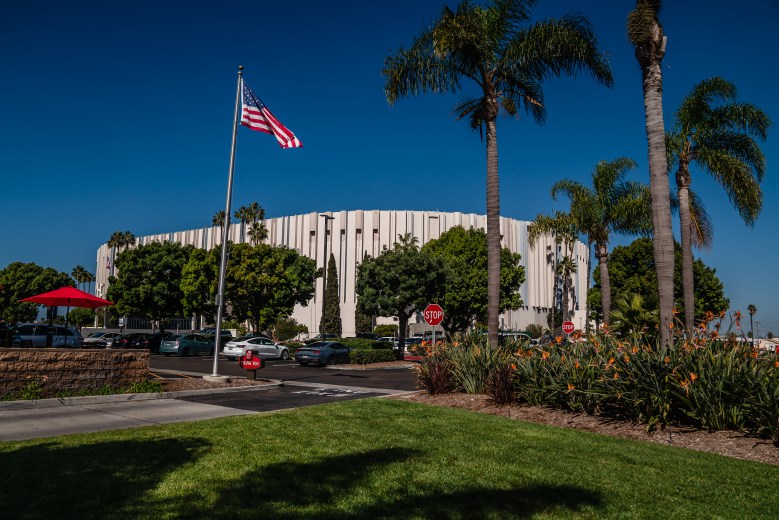
More than eight years ago, the city of San Diego, then led by former Mayor Kevin Faulconer, stopped signing new long-term leases with the businesses that rented land around the Sports Arena. At the same time, it began updating the zoning plan for the neighborhood.
As we wrote then, it looked like the city was finally, truly planning a massive redevelopment for the nearly 50 acres of land it owns in Midway.
Then, we watched one failure after another, as the city pursued what Faulconer and then his successor, Mayor Todd Gloria, envisioned. The courts threw out two ballot measures. Nevertheless, the city persisted and selected a development partner, negotiating an agreement over four years. With another lawsuit looming, the city’s leaders took the extraordinary effort of getting state lawmakers and the governor to give them special protection from lawsuits.
Finally, Monday night, the San Diego City Council approved the $4.2 billion redevelopment project known as Midway Rising.
The revamp on the Pechanga Arena site will include a new 16,000-seat arena. It will be where Dixieline Lumber sits now. Developers believe it will be close enough to the Old Town Transit Center to walk and that the investment they’re making will spur investments all along that walk. And that will make it somewhere you would want to walk.
Then they will build more than 4,000 housing units – roughly 2,000 of those as income-restricted, affordable units – in addition to parks, commercial and retail space.
As part of the project, the City Council approved an Enhanced Infrastructure Financing District. It would dedicate a portion of future property tax revenue generated by the development toward reimbursing developers for eligible infrastructure costs.
(The county must also approve this.)
A report by the independent budget analyst estimates the developer will spend roughly $460 million in upfront costs to improve the surrounding infrastructure. This includes road work, sidewalks, lighting, parks, bike lanes and more. The project may be able to recoup some $378 million of those infrastructure costs through the enhanced infrastructure district.
(All those reports are here.)
The independent budget analyst estimates the city could receive approximately $884 million to $1.23 billion in ticket fees and rental revenues over the century-long duration of the various agreements.
About the affordable housing: The Council also approved the project with additional protections to ensure affordable housing units are “net new.” Last month, we reported how the agreement initially didn’t include that.
That version of the plan would have allowed the development to be a “receiver” site. That would have meant it was allowed to absorb affordable units from other projects — rather than build net-new units. The practice is known as off-siting.
Councilmember Kent Lee brought forward an amendment to ensure Midway Rising builds net-new affordable units.
“I believe that the package that we have before us today combines substantial public benefits with meaningful developer obligations,” said Lee during the Council meeting. “It preserves the city’s ownership of the land. It now includes stronger protections to deliver new affordable housing and to ensure that the city benefits in the act of a refinance.”
A Bill to Make Data Centers Pay for Power Comes With a Catch
A bipartisan national bill would make data centers, not taxpayers, pay for their own energy costs, including the grid upgrades necessary to power them. That could be a big deal for any future data center at the NAVWAR site downtown should the project ever be realized.
The bill, however, does a whole lot more than that. It also eases the permitting process for the electric transmission lines and natural gas pipelines that move energy across the country. Going forward, they’d have more limited environmental review.
That means it will be easier to move clean energy across the country — and also natural gas, which is contributing heavily to the warming of the planet.
Some Dems, like local Rep. Scott Peters say it’s worth the trade-off because we need more transmission lines to transition the grid away from fossil fuels. But some environmental groups are vehemently opposed, arguing that it’s time to phase out natural gas, not fast track it.
Read the Environment Report here.
Socialist Pulls Ahead in Vista Mayor’s Race
For days, Democratic mayoral candidate Kenneth Zuniga has been sitting on pins and needles. Zuniga is a 28-year-old Democratic Socialist and as the days have ticked by he has moved closer and closer to becoming Vista’s next mayor.
In each successive ballot drop prior to Monday, he’d inched closer and closer to former Councilmember Joe Green.
That changed on Monday night, when the San Diego County Registrar of Voters released the largest ballot dump yet. Zuniga pulled ahead of Green by 459 votes. With about 5,000 votes remaining to be counted, Zuniga is cautiously optimistic.
“I still have a lot of doubt, but just seeing this huge drop was just unbelievable,” he said.
Escondido mayor now in trouble: The latest count of votes released by the Registrar Monday showed Escondido Mayor Dane White behind Elias Velazquez, who is the information director for Brother Benno’s Foundation, a homeless-serving nonprofit. The organization’s CEO is Paul McNamara, who was the mayor of Escondido until White beat him.
White is just 240 votes behind Velazquez but the trend has been toward Velazquez.
Brother Benno’s has had a tense relationship with the city of Oceanside.
Encinitas’ Conservative Majority Still Hangs in the Balance
A tight mayoral race in coastal North County has Encinitas residents on the edge of their seats as voting results continue to trickle in.
Incumbent Mayor Bruce Ehlers, a conservative-leaning Independent, is locked in a tight race with Democrat Rimga Viskanta, a former San Dieguito Union High School District board member. Since initial results dropped Tuesday night, the two have repeatedly traded the top spot, separated by around 160 votes or less.
The latest update has Viskanta leading by just 57 votes.
At stake is the political direction of the City Council. In 2024, Ehlers was elected alongside two conservative-leaning councilmembers. Conservatives ended up with a 4-1 majority.
Since taking control, the conservative majority has tightened enforcement against public camping and cut back on homeless services within city limits. At the same time, ICE agents in Encinitas have fueled backlash from most residents against the broader, Republican-led federal administration.
Now, control of the Council comes down to the mayor’s race and two council district races.
District 4: Appointed Republican incumbent Marco San Antonio trails Democrat-backed challenger Brad Lefkowits by 987 votes.
District 3: Democrat-backed Arielle Golden holds a slim 63-vote lead over Republican Ed Sprague.
In Other News
- Santee voters rejected a one-cent sales tax increase for the second time in two years. Officials said Measure Y would help with long-term revenue, infrastructure projects and projected budget shortfalls, but it’s so far failing by 3,787 votes. (Union-Tribune / Registrar of Voters)
- Several San Diego County school bond measures seem to be passing, including Mountain Empire Unified, San Diego Unified, Vista Unified and more. The measures would allow districts to make renovations and repairs to aging buildings and infrastructure. Money generated by previous bonds has also gone to expensive athletic facilities — sometimes at the expense of classrooms, critics have argued. (KPBS / Voice of San Diego)
- An all-affordable housing project proposed for a rail station in Oceanside is moving forward. The project was proposed by the development arm of Father Joe’s Villages. (Union-Tribune)
- Warm weather in the 80s and above is expected to last through Friday. Mind you, it’s Nov. 10. (Union-Tribune)
The Morning Report was written by Mariana Martínez Barba, Jakob McWhinney and Tigist Layne. It was edited by Will Huntsberry.
Midway rising will indeed be good for San Diego, but ut will not be great. First of all, the sports arena is too small. San Diego has waited decades for a new arena, and when it gets ones, it will be too small for an NBA or NHL team. What is the point of a large city have a small arena? If San Diego has gone this far and has investors with deep pockets, why not add 2000-4000 seats to this arena to attract an professional team to the city. Another problem is traffic. So I do not see anything about new parking for this arena. If there is no parking, where will all the cars going to be while attending an event. Why is the trolley not being extended to the arena? Need to have a new trolley line running from old town, thru the midway area and down to the airport. If San Diego wants to be a big city, it needs to act like a big city. Do away with all this small city mentality and build big. Big arena with new trolley line will really help San Diego. The visitors and the residents will benefit from a new trolley line.
City owned stadiums went out with the Chargers. The NBA has been tried, and the NHL minor league Gulls are already here. Trolley lines around an already bottlenecked freeway system are another 4 billion. Glad you think taxes just grow on trees.
The master plan features roughly 4,500 to 7,040 parking spaces overall, which is balanced to serve the new 16,000-seat arena, 4,200+ residential units (including 2,000 affordable housing units), and 130,000 square feet of retail and plaza space. Mind you most households are two incomes per unit and likely two cars per unit as well. So good luck parking.
The projection that people will walk from Midway Rising to the Old Town trolley stop proves Midway Rising is based on magical thinking. Have any of the city’s employees or politicians actually done that walk?!
Even if the area were redeveloped such that people didn’t walk past decrepit buildings and homeless encampments, it wouln’t change the many dangerous street crossings: 7-8 lanes of the Pacific Coast Hwy, 7-8 lanes of Taylor/Rosecrans, and particularly the 8-9 lanes of Camino del Rio West. The latter is the I-8/I-5 ingress/egress, so having long lights for large numbers of pedestrians to cross so many lanes will also amplify traffic and access issues.
EIFD Reimbursements cover actual infrastructure costs plus a master developer cost of capital accruing at up to 3.00% compounded annually.
Upon completion of the new 16,000-seat sports arena, the Midway Rising team will retain future ticket revenues from the venue to help reimburse the cost of building the arena itself. The standalone cost to construct the new 16,000-seat entertainment center (arena) is estimated at $526.4 million. All while believing everything built will stand for 105 years and final completion in 2050. Todd Gloria and the council will be long gone if anything wrong happens.