
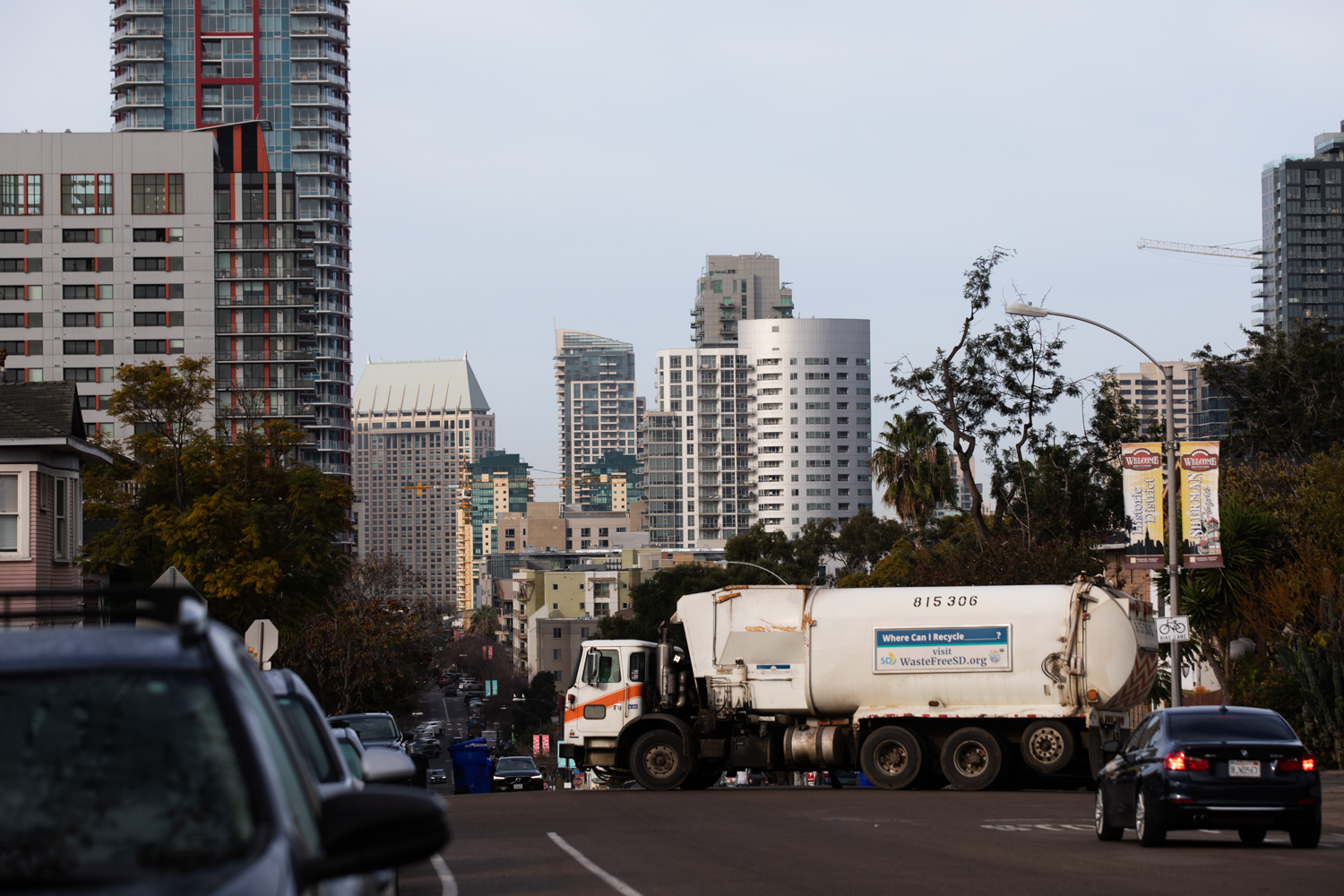
Forget the current budget deficit.
If voters repeal San Diego’s trash fee, city leaders say their only option would be to cut up to $150 million from city services like stormwater, fire and police departments.
“Outside of new revenue coming in, there’s no other option,” said Charles Modica, the city’s Independent Budget Analyst.
A business advocacy group is pitching a ballot measure that would remove the fee for fiscal years 2028 and 2029. They need 21,000 signatures to get the repeal on the November 2026 ballot – far fewer than other signature-gathering efforts.
“The effort is off to a fantastic start,” said former Mayor Kevin Faulconer, who is leading the repeal on behalf of the Lincoln Club Business League. He didn’t say how many signatures the group has gathered.
While the former mayor says the city needs to repeal the fee and scale back its spending, Mayor Todd Gloria and other city leaders say the repeal could result in a big blow to the city’s budget.
“The magnitude of those cuts is going to be significant,” said Modica.
Modica said the money generated from the trash fee is about 5 percent of the city’s budget. That is more than what the city spends on the library system in a year, and about what it spends on its network of sidewalks and streetlight, he said.
“The city would need to really have a real conversation about just picking a service that it is currently providing and not providing that service anymore,” Modica said.
Since 1919, a law known as the People’s Ordinance required the city to collect trash, without charge, from any home with direct access to city streets. The city paid for trash pick up out of its general fund.
In 1981 and 1986, voters amended the People’s Ordinance to prevent city officials from ever charging fees for city trash collection. In 1981, voters declared that residential trash collection would remain free, although there could be a fee for industrial and commercial waste. In 1986, voters approved an amendment that would require residents who live on private streets or multi-family homes like apartments to pay private haulers to collect their trash.
Single-family homeowners with access to city streets continued to get trash picked up without paying a fee.
In 2022, voters narrowly approved Measure B, a new amendment to the People’s Ordinance that allowed the city to start recovering costs.
The amendment also clarified which properties are eligible to receive city-provided services. This includes properties on public streets that are not mixed-use or commercial. City workers will also only pick up trash at lots with one to four residences maximum.
City officials estimated the fee would be between $23-$29 per month per customer when they put Measure B on the ballot. But a cost study later revealed that the fee needed to be higher, so the City Council opted for a much higher fee of $43.60 last summer.
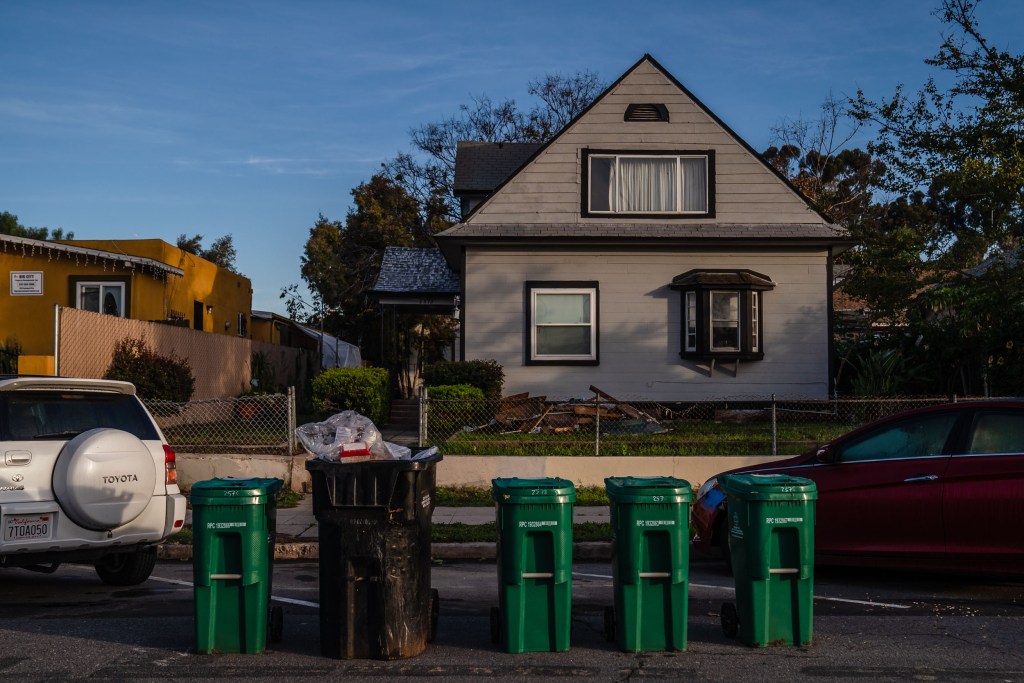
The full cost for the year turned out to be between $32.82 and $43.60. The fee also increases each year. When people got their tax bills, they were furious.
A group of homeowners sued the city, alleging officials are charging more than what it costs to pick up trash. A judge recently denied the city’s request to dismiss the lawsuit.
“The ability to charge for trash barely passed at the ballot box,” said Faulconer. “If the city would’ve told people it was going to be double what they said it was going to be, it wouldn’t have passed. That’s, again, why people are angry and rightfully so over a bait and switch.”
At least one councilmember, also agrees that the City Council should have never doubled the fee. Henry Foster – along with Councilmembers Raul Campillo and Marni von Wilpert – voted no on the fee last June.
In a recent candidate forum, Foster said he would like to lower it to the estimate the city offered voters when Measure B passed.
“We need to right our wrongs. We need to take care of our structural deficit, but we need to take the trash down to $29 — no more,” said Foster.
Modica said two factors increased the fee.
First, the Environmental Services Department had historically estimated its customer base was much larger. The department thought it served around 285,000 addresses. Since the department didn’t bill households, it didn’t keep track of which households it served.
A cost-of-service study by the Environmental Services Department in 2022 revealed it served a little over 222,000 addresses. Essentially, there would be fewer families paying the fee and yet the cost of providing the service was going to increase.
“The denominator by which you would divide the total costs of our things was smaller, which results in a higher fee,” said Modica.
Just on that point alone, the city would have needed to increase the cost from $29 to $37 per month to recover all of its costs, a report by Modica’s office found last year.
Modica said the fee also increased because costs are increasing across the board. Vehicles cost more. So does their maintenance. City workers’ pay has also gone up.
When Measure B first passed, the baseline operating cost for trash collection was about $98.3 million. That number increased to more than $120 million this fiscal year.
This year, the fee has generated approximately $117 million. The Environmental Services Department estimates the fee will generate approximately $123.9 million next year, which is about $9 million less than officials expected.
Jordan More with the independent budget analyst office said that’s because some people are returning their additional bins or opting for cheaper bins.
Homeowners can choose from a wide range of trash bins. The cheapest option is $32.82 a month for a 35-gallon trash bin. The most expensive option is $43.60, which gets you a 95-gallon trash bin. All the options come with bins for recycling and organic waste.
The money from the fee goes into something called the solid waste management fund. Dollars that go into this fund can only be used to pay for waste management related activities. This essentially frees up money in the general fund to be spent on other city services.
That could all change soon with the repeal effort.
Faulconer said he isn’t concerned about the hit to the general fund.
“This city survived for a hundred years without having to charge people for trash or having to charge families to go to Balboa Park. It’s about priorities,” he said. He also said city officials can invest in public safety and employees “without having to fee and tax San Diegans to death.”
City officials need to cut back their spending, and focus on reducing middle managers, or unclassified employees at the city, Faulconer said.
Mayor Gloria, however, is very concerned.
“Eliminating the solid waste collection fee or further reducing parking revenue will come at the expense of the general fund,” he said. “The sum total of those two things combined exceed the deficit that we’re closing right now. Basically, you would double the challenge we are currently grappling with. It is real. Where would that come from? Well suddenly we’d be right back to where we are today. Where things we are currently doing our best to protect, specifically public safety, police and fire, would have to be up for deeper reductions.”
The City should go back immediatly to the original proposed fee of $30, drop the bulky item pick up service and keep every other week recycling pick up. This will cut down on cost of the service while keeping a good chunck of revenue coming in ($78 million).
If it did, it would greatly improve its chances of defeating the repeal if it makes it to the ballot.
People of San Diego need to look at all forms of taxes, including gas, milage, school and hotel tax to name a few. It does however make sense for people to pay a fair amount for their trash. City leaders need to cut spending as well.
The City needs to look at privatizing services. Competitive bidding will lower the operating, compensation, capital spending and maintenance, and pension cost to the taxpayer. See Little Italy.
vosd is stopping my posts
I am so sorry to hear that. I get censored as well and it is disgusting because you know what type of publication this VOSD tabloid is if they engage in censorship
Drastically cut road funding. Our nation has invested 30 yrs and probably a trillion dollars into building and marketing tall, heavy trucks and crossovers. We San Diegans hopped on the bandwagon. We deliberately bought these vehicles in hopes of going off-roading or at least in hopes that we’d better survive a crash with one of our neighbors. Go outside and admire what’s in your driveway. Visualize your exciting off-road commute adventure! We deserve it 🙂
Still crying tears of gratitude one month later despite all the nut cases at VOS who so ignorantly disparaged my character. Here is but one of thousands of letters from around the nation on my HBO MAX show.
April 02, 2026
Dear Danny,
My friend, Airman Fuller, and I recently saw your episode of Neighbors on HBO. We were
cheering you on the entire time. You had us totally and dedicatedly inspired by your
message of self-expression and self-love in spite of a cruel world. Your blog is incredible.
Your style is incredible. You are a light to both of us in this trying time.
As young people in America, we are often made to feel our elders offer us nothing with
crooked people in Washington seemingly on a crusade against our ability to live freely. It
was so refreshing to see someone defy that. We are so filled with hope by you! If we lived in
California we would make it our sole purpose in life to get you elected!
We have each made a commitment to be more like you. Live in the image of Danny,
possibly the last honest man alive. You’re realer than real. We carry the Smiechowski name
on our soul as children of your ideology.
Love and power,
Sabrina
It’s always about YOU isn’t it.
Yup an he dropped out of the D2 race. My posts have been quashed by vosd and I find that interesting.
Faulkner was the SD Mayor responsible the disastrous 101 Ash Street scandal that continues to cost San Diego Taxpayers over $6,000 daily. I see no reason why we should trust him on any type of financial advice.
This just sounds like Faulkner encouraging more financial disasters for our City.
Nope
We were told one approximate price and it was approved. Now we are being charged TWICE that price and of course we don’t approve.
Nowhere in life would you approve a purchase or a service and then accept being billed twice as much.
Yet Gloria says “will come at the expense of the general fund” and ” public safety, police and fire, would have to be up for deeper reductions”
How is it that we survived without this revenue in the general fund AND paid for the trash collection as well ? You’re seriously going to blame essential city services for the deficit ?
A trip to Paris for our “sister city”, bike path mania throughout the city, money wasted on vagrants (aka “homeless”) – these things survive and you have to cut the porimary services that are basic to any society ?
This is why Gloria and his Democrat buddies have go to go. I hate to blame the entire Democratic party for this, but between the Mayor, the City COuncil and teh Board of Supervisors, San Diego is being run by Democrats exclusively and with no checks or balances on them they have run wild.
We need a revolutionary approach to the budget – pay what must be paid for essential services and existing bills and then see how much is left.
“Pet projects” and political showpieces are not essential services.
The cost of service study is an exercise in price-fixing. The city spent more than a year figuring out how to 1) nearly double its annual trash collection costs from the $70 million Environmental Services reported in its own budget; and 2) use HDR’s preferred consultant to bring in the highest rate – as the same consultant already did in half a dozen or more other California cities. (My public records request (nextrequest 25-1207) to find out when city staff started talking to HDR’s consultant has gotten no traction and remains stalled since February 2025). In the private sector, this scheme would be a Sherman Act antitrust violation. Had the city come back with what Measure B voters thought was a fair cost rather than making clumsy, obvious efforts to raise costs, its actions would be defensible. Instead, they shot themselves in their feet, palming the pain and costs to future leaders – and to taxpayers. Again.
Most San Diegans pay for their trash collection. It’s the single family home owners that were receiving free trash service on the dime of renters. In North County we pay a higher rate trash collection than the new fees paid in SD with no complaints. We don’t even get your fancy cans. Just another boomer and Gen X snowflake melt…
Your choice for paying that means nothing to us getting gouged. You are your own snowflake.