
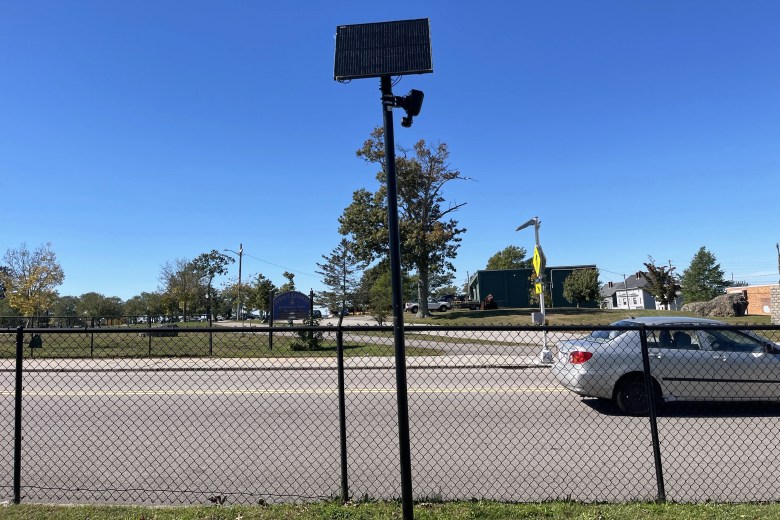
In what could be a deathblow for the controversial surveillance technology, Councilmember Stephen Whitburn announced during a press conference on Tuesday morning that he’s turned on Flock.
Whitburn represents downtown and the surrounding communities – home to the largest concentration of the more than 500 Flock cameras in the city. His new position is a reversal; he supported the use of the cameras as recently as June. During that month’s budget hearings, he was one of five councilmembers to vote down a proposal to nix the city’s contract with the company. His opposition now creates a simple majority that could potentially cancel the contract.
Mayor Todd Gloria, a supporter of Flock, has the power to veto decisions by the Council. The mayor’s veto can only be overturned by a 6-3 super majority.
Whitburn praised the AI-powered automated license plate readers. He said they have been an effective crime-fighting tool and he believed the San Diego Police Department had operated them responsibly.
But he framed his newfound opposition as a result of rising fear, particularly in immigrant communities, that President Donald Trump’s immigration crackdown will somehow utilize data collected from the cameras. The city currently bans sharing such data with federal immigration officials.
“Parents are afraid of what could happen when they take their children to school. American citizens have been detained. These are our neighbors, and they deserve to feel safe in their own state,” Whitburn said. “I want public safety tools that help San Diegans feel safe. If Flock cameras are causing many San Diegans to feel unsafe, then they have lost effectiveness as a public safety tool.”
Both Gloria and San Diego Police Department Chief Scott Wahl released statements pushing back on Whitburn’s comments. In an email, Wahl wrote that the technology has helped SDPD solve more than 900 cases.
“In this councilmember’s own district, it’s assisted in hate crime sprees against our LGBTQ community and helped find a suspect in the attempted kidnapping of a child,” Wahl wrote. “He knows firsthand the difference this technology has made.”
So, What’s Next?
Unless a councilmember pushes the issue sooner, the next step could come in mid-November, when the city’s annual surveillance report will come before the public safety committee. The report will then go before the full Council the following month, which would present an opportunity to cancel the contract, Whitburn said. If it’s punted until after the election, the anti-Flock councilmembers might not still have a majority.
“Let’s turn off the cameras and cancel the contract and let’s use the savings to speed up response times when people call for help,” Whitburn said. “I think we will accomplish this. I will not support the continued use of ALPRs, and as a result, I don’t believe there will be enough support to continue their use for much longer.”
Whitburn’s about-face comes as opposition to AI-assisted policing technology has mounted nationwide. Critics have railed against the invasive nature of an ever-growing network of surveillance tech and raised alarm about the fallibility of such technology.
Still, police departments can’t seem to get enough of such tech. Just last week we broke the news that SDPD was considering the use of AI to assist officers in writing police reports. Wahl also announced on Tuesday that he hopes to launch a program that would dispatch drones as first responders to the scenes of crimes sometime in the beginning of next year.
For activists who’ve long pushed back on technology’s increasing encroachment into law enforcement, Whitburn’s announcement is a welcome one. Seth Hall, a founding member of the TRUST Coalition, a community group that’s led the fight against mass surveillance in San Diego, said this was a “step in the right direction.”
But he cautioned the public against becoming too fixated on Flock as an avatar for all AI-enabled police surveillance. Even if the city ditches its Flock contract, there are other companies offering shiny surveillance toys waiting in the wings to take its place.
“Now is the moment for us all to not only organize and raise our voices against one company, but to decide as a community that those kinds of companies – private, for-profit, mass surveillance companies – are not something that fits the values of San Diego,” Hall said.