
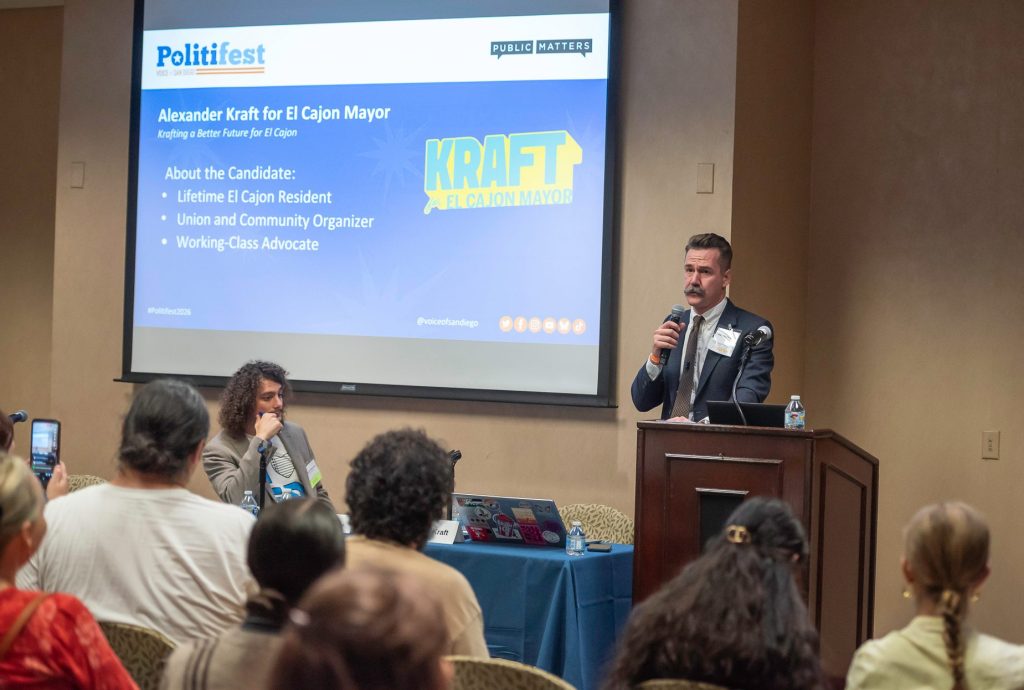
In early September, a video of El Cajon mayoral candidate Alexander Kraft outlining a new vision for Parkway Plaza – set to The Cure’s “Friday I’m in Love” – got more than 90,000 views on Instagram.
This kind of attention is invaluable for a candidate like Kraft, a local socialist with a measly campaign budget running to unseat a Republican incumbent. There’s perhaps no faster and cheaper way to capture the hearts and minds of potential voters.
“I’m really curious to see if that will translate into votes,” I told Kraft over the phone on a recent afternoon.
“You and me both, sister,” he replied.
Views don’t win elections – votes do. And El Cajon only has about 38,000 registered voters, fewer than half of the number of people who saw Kraft’s video. The city’s partisan split is nearly 50-50, with a slight edge to the right.
“I’m really popular with like middle schoolers and high schoolers,” he laughed, “which is great, but they’re just not old enough to vote.”
Kraft isn’t the only candidate fighting it out in the feed. Just look at San Diego City Council candidate Richard Bailey, who’s amassed almost 27,000 followers with his simple public policy explainers, or the cinematic frames and warm color grading of Martha Abraham’s videos out of southeastern San Diego.
These candidates are pulling from the blueprint of New York Mayor Zohran Mamdani, whose underdog campaign was carried, in no small part, by short, friendly, direct-to-camera videos.
But, how much of it was really about the videos? Can this strategy actually help more underdogs overcome the incumbency advantage, or rise to power from the minority party?
This election, San Diego will get a unique look into the effectiveness of the Mamdani method through four very different local candidates.
It’s not as sure of a bet as it may seem.
Results are mixed
TikTok has been ubiquitous for more than half a decade, but campaigns – especially local ones – took a while to catch up.
“Generally, I would say political campaigns are two to four years behind the rest of society,” said Ryan Clumpner, a Democratic political consultant.
Think back to 2024. Even the famous (albeit, unsuccessful) Kamala HQ account on TikTok didn’t attempt to make casual, direct-to-camera videos – at least not the way we know them now. The videos were more like fancams: clips set to trending audio, snippets of speeches, celebrity testimonials and a lot of coconut memes.
This lag isn’t entirely generational. Research suggests the link between social media clout and voter mobilization is mixed at best. The potential complications are endless: accounts are siloed into echo chambers, metrics distort a candidates’ appeal and digital engagement satisfies voters’ participatory impulses before they ever make it to the polls.
Yet it’s also true that social media has been a boon to local candidates facing unlikely odds, including the political influencer of political influencers: Zohran Mamdani.
Everybody is trying to have their Mamdani moment.

While his golden retriever-like disposition and populist policies made for great content, the social strategy didn’t end there. Mamdani’s digital team also successfully employed novel methods for recruiting volunteers that didn’t require them to leave Instagram, effectively converting social media followers into door knockers and phone callers.
San Diego’s most prolific political posters are employing similar strategies to navigate a familiar set of electoral challenges. Kraft and Abraham face the notoriously difficult task of unseating an incumbent, and then there are the conservatives – Bailey and La Mesa mayoral candidate Laura Lothian – building up digital clout in Democratic strongholds.
And it’s not just a matter of being on social media – you have to be able to pull it off. Good politicians don’t always make good influencers.
“It’s not a great idea if that’s not who you are,” Clumpner said. “If you were never holding a tiny microphone and talking about any other subject to any other audience on social media before being a candidate, then you should think very, very carefully about whether that is an authentic medium for you to choose.”
The Breakout Stars
Abraham from southeastern San Diego is no comrade, but her task is similar to that of Kraft from El Cajon: generate as much attention as possible to disrupt the status quo.
“An incumbent benefits from nobody paying attention,” Kraft said. “Somebody trying to unseat an incumbent needs as much attention as possible.”
With that, two vertical video stars were born: Kraft in the backrooms-esque corridors of Parkway Plaza, and Abraham in the parking lot of a small market that city documents classify as a “grocery store” (which seems much more like a liquor store with a few produce baskets by the door).
Abraham did not respond to Voice of San Diego’s interview requests for this story.
Needing to make big waves on a small budget, Kraft said he felt he had no choice but to go all in on social – on top of a healthy regime of phone banking and door knocking.
His videos are doing well, but it’s impossible to tell how much of that is local and how much is the result of a larger socialist wave in the wake of Mamdani’s win.
“The real pitfall with organic social media as compared to paid social media is that the algorithm is constantly going to direct your content to the people who already agree with you, which is counterproductive in most campaign contexts where your goal is to expand your support to persuade people,” said Clumpner, the political consultant.
As with most human endeavors, face-to-face remains the gold standard.
“Research is pretty clear that a face-to-face conversation is the most likely way to get somebody to vote who wouldn’t otherwise or to persuade them on how to vote,” Clumpner added. “It’s also really hard to do at a large scale.”
The Video Veterans
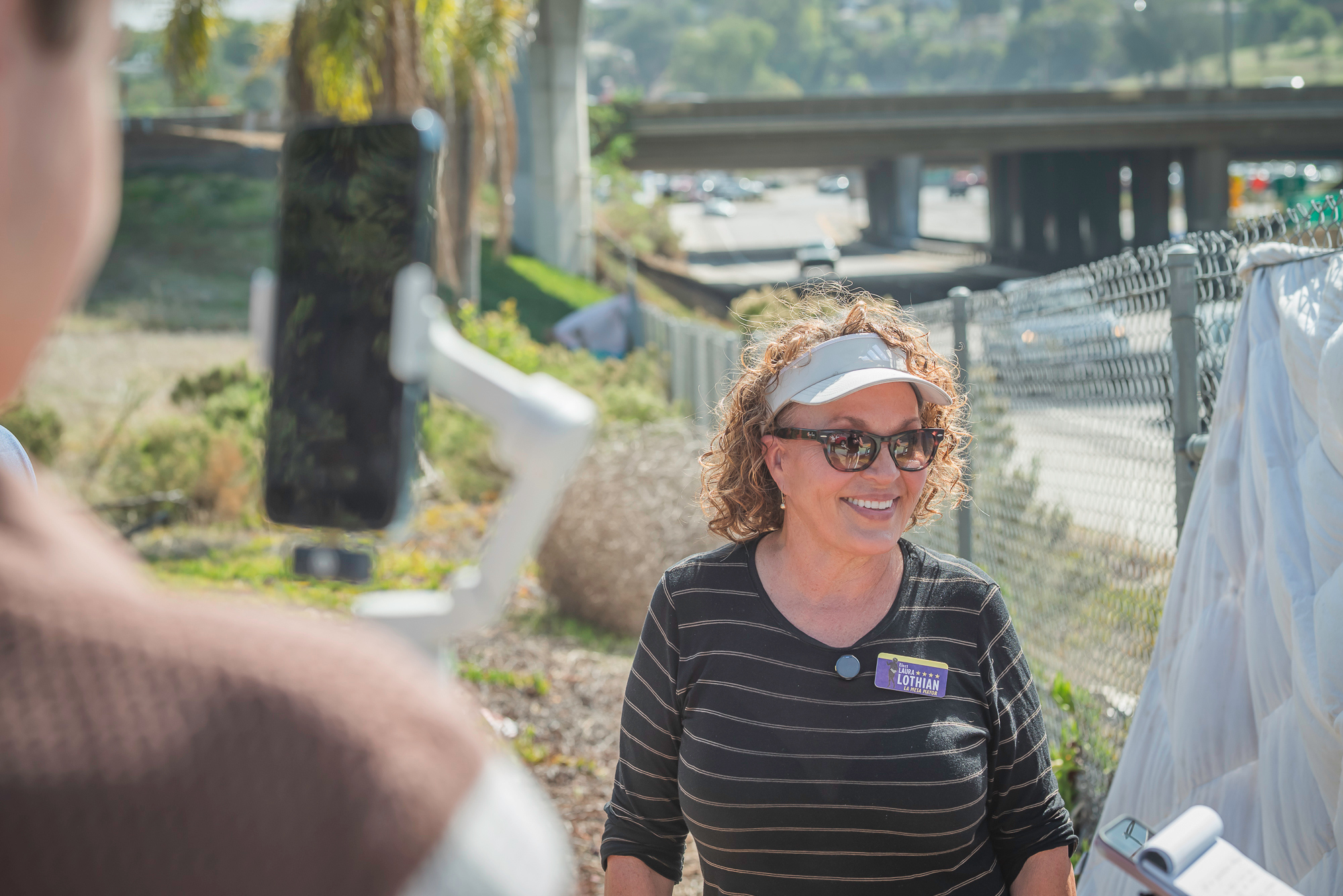
La Mesa Councilmember and mayoral candidate Laura Lothian is no stranger to social media.
If you don’t recognize Lothian by name – or by the pictures of her plastered across La Mesa banners and benches advertising her real estate business – you may recognize her videos. She’s been posting for a while now, and her look is consistent: curly hair tucked into a visor, clipboard in hand.

On a Tuesday afternoon in La Mesa, the councilmember picked up trash on the side of the freeway with a community member while her videographer, a 19-year-old community college student, filmed her with an iPhone attached to a handheld gimbal.
“Every post gets thousands of views,” Lothian said. “Every single post.”
“If we get 2,000 or 3,000, that’s like mild. As soon as we hit four or five to 6,000, it starts to feel pretty good. And then we get a lot of 10,000 or 20,000 – a lot of those – and a few hundreds of thousands.”
Lothian is a registered Republican, but she packages herself as nonpartisan and generally avoids controversial topics, such as immigration enforcement. Bailey in District 2 has struck a similar tone, ditching the Republican party earlier this year to register as an independent, and doggedly avoiding reporters’ attempts to prod his feelings about the president.
Part of the reason for this is explicitly partisan: these are two right-leaning individuals running in jurisdictions where Democrats outnumber Republicans by nearly 2-to-1.
It also changes how they’re perceived by the community: less as politicians, and more like journalists.
“I have found that most San Diegans care about what’s going on locally, of course,” Bailey said. “They just need it to be made accessible and digestible to fit into their day-to-day lives.”

Local journalism is struggling, and politicians aren’t the only ones who’ve identified the clout-building potential of filling local information gaps. San Diego Police recently called out a group of local community accounts for spreading misinformation on Instagram with their news posts, and many of the talking heads on local feeds that viewers may assume are journalists are actually realtors.
And then there are the so-called “slopulists,” political influencers who tap into populist disaffection with content that is often more entertaining than it is enriching. San Diego has many.
A few days after meeting with Lothian, she tagged me in an Instagram Reel featuring clips from our interview. In my quest to make content about people making content, I’d been turned into content. Go figure.
Not everybody is a fan of Lothian’s style, which recently included her rendered in AI as a member of the “Ghostbusters.” But the visible comments on this video were plentiful, and overwhelmingly positive.
“I have a sneaking suspicion we disagree about who we voted for on the top of the ticket,” one user wrote, “but I can’t help but like Laura and how passionate she is about her community.”
Lothian, too, is holding out on a definitive answer to the social media question.
“We will know – not on election day, because it’s gonna take a month to count – but we’re going to know if social media was the right platform to communicate your persona and your work,” Lothian said.