
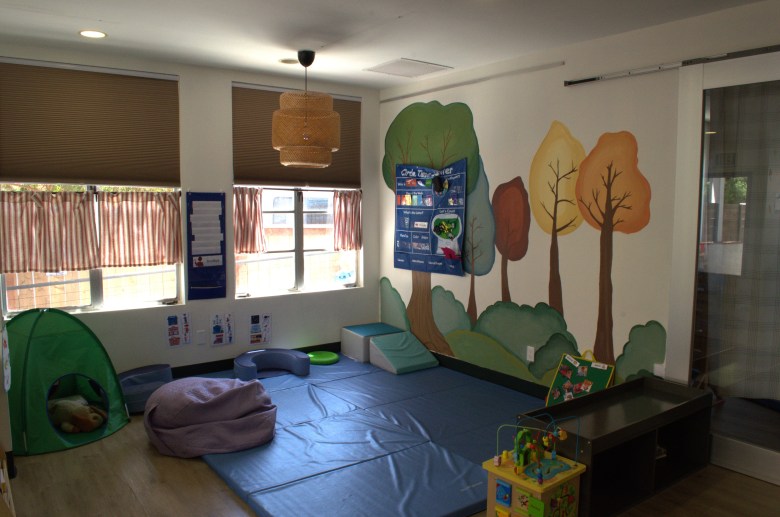
At a preschool tucked inside a Spanish Colonial-style church in Pacific Beach, founder Anna Chiles walks through an unfinished classroom with bare walls and scattered furniture. She gestures to a future sensory corner and a stack of unassembled bookshelves — signs of expansion threatened by rising costs.
“It’s already a miracle to make the budget work,” Chiles said. “Then you add in tariffs, and it starts to unravel.”
Preschools and child care centers like Includ(Ed) are being squeezed by a spike in tariffs on Chinese imports. Many of the items used to furnish and supply classrooms — from tables and chairs to cleaning supplies — are imported. While these taxes on imported goods are designed to pressure China, they are often paid upfront by U.S. importers, with costs trickling down to childcare centers and, eventually, parents.
Chiles founded Includ(Ed) as a “love letter” to her son with Down syndrome after he was rejected from multiple preschools. Includ(Ed) employs a highly specialized staff to serve children with disabilities. Teachers include physical, occupational, and speech therapists, along with special educators and music therapists.
“You walk into our classrooms and you’ll see our educators, many who have advanced degrees, their masters,” Chiles said. “You want to be able to pay your folks a living wage, a wage commensurate with their experience and skill. You want to be able to sustain your people while also not squeezing your beloved families.”
Though meant to protect domestic industries or pressure foreign governments, UC San Diego economist Caroline Freund said tariffs often raise consumer prices and strain businesses that rely on foreign-made supplies.
“It’s exactly the small and medium-sized enterprises that are most impacted,” Freund said. “Margins for the small guys are slim, and so they’re going to pass some of those tariffs on to the consumer right away.”
Freund said increases on Chinese imports include the 25 percent Section 301 tariff from the Trump administration’s first term, which remains in place on roughly 60 percent of Chinese imports. Freund said there is now a 20 percent fentanyl-related tariff and an additional 10 percent tariff resulting from U.S.-China trade negotiations.
Chiles said these pressures on early childcare providers are suffocating. Many classroom staples like bookshelves, chairs and changing tables are imported, and providers like Chiles say they are seeing sharp price increases.
“The same bookshelf that used to cost $200 now costs $350,” she said. “And we need multiple of everything because we’re expanding to another classroom.”
Childcare operators are not alone in shouldering the burden. Lee Siegel, founder of San Diego-based ECR4Kids — a company that supplies furniture and learning materials to preschools and daycares across the country — said the 30 percent tariff — combining the fentanyl-related and negotiated rates — could cost $1.5 million in upfront payments on $5 million worth of goods, before the products even reach a warehouse.
“Nobody has infinite resources,” Siegel said. “Just imagine what it’s doing to so many small and mid-sized businesses that … don’t have those additional resources.”
Siegel challenged the idea that China is bearing the cost, asserting instead that U.S. importers are paying — and often passing costs to retailers or consumers when they can. He said retailers like Amazon and Costco have declined to absorb the additional cost, leaving mid-size businesses like his to front the payments.
“We are the ones who have to front the money,” he said. “We’re the ones who have to carry the load and get reimbursed eventually, maybe, if the customer even still wants the product.”
Those costs, he added, eventually trickle down to the childcare centers themselves.
“There is no extra margin in this business,” Siegel said. “These schools are not flush with cash, they would need to pass [the increases] along to the parents and families, they can’t just absorb price increases.”
Freund added that large corporations often have the legal teams or financial margins to weather tariff shocks. Smaller importers and childcare-focused nonprofits do not.
“When tariffs hit, it’s the small importer or the family-run business that suffers the most,” she said. “They have fewer options and less negotiating power.”
The combination of paying their expert staff and rising material costs — including furniture, learning tools, and cleaning supplies — could make it impossible for smaller childcare centers to expand or survive, Chiles said.
“If it keeps going like this, only the big chains will survive,” Chiles said. “And they’re not serving kids like mine.”
Catie Griffith, Includ(Ed)’s preschool director, said the school is already facing price hikes on basic supplies.
“We’re watching our expenses go up on everything—diapers, wipes, cleaning supplies, even snacks,” Griffith said. “There’s just no room in the budget for surprise costs. None.”
The adverse impact on business has led Rick Woldenberg, CEO of the Illinois-based education equipment supplier Learning Resources, to take legal action against the Trump administration — something smaller businesses can’t do. He said the lawsuit contends that the tariffs are unconstitutional, asserting the executive branch does not have legal authority to impose them without congressional approval.
“We took a body blow when massive tariffs were imposed, and by April 9, it had pretty much re-engineered our entire business,” Woldenberg said.
He said tariffs cost the company $2.3 million in duties across all transactions in 2024. At projected full-year rates, Woldenberg said that figure could skyrocket to $100 million.
“While litigation is expensive, tariffs are more expensive,” he said.
For Chiles, the urgency is growing. With grant funding in place to build an accessible playground on their campus for their children, she said she is rushing to lock in vendor contracts before prices rise further.
“We got a grant to renovate our playground to make it accessible, but now we’re rushing to spend it before prices go up again,” Chiles said. “If we don’t, that funding won’t go as far.”
Even as costs climb, Chiles said the vision remains the same: to create a nurturing, accessible space for children too often overlooked by the broader system.
“When I tell you every dollar is so vital to us, I really mean it,” Chiles said. “We’re scared of tariffs, we’re very afraid.”
🤣🤣🤣
These are the exact businesses that need a focus on children wellbeing.
Provide an environment free of
VOCs.
Buy quality furniture that does not off gas and lead free materials.
A majority of these business seek to serve the disadvantage child but fail to provide quality education.
Staff often have neither child development credentials nor education credentials.
44,000 USD online People’s lives are changing rapidly. Every year more and more people are participating in online trading. 73.3 million Americans donated last year, and that number is expected to grow significantly.
For INFO click my user Name<<<<<<<
Plant some trees.