
Sacramento Report Countdown
17 days until the end of the legislative session
81 days until the November election
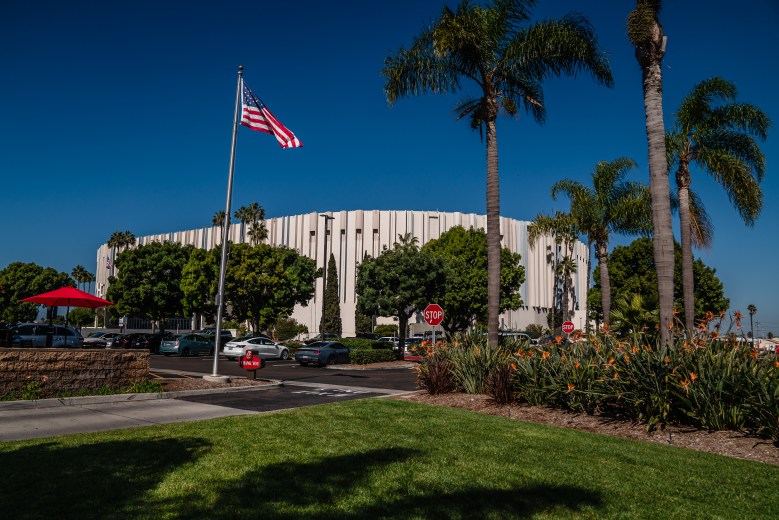
A new bill related to San Diego’s Midway Rising project was set in motion Thursday as lawmakers began a process to gut and amend an unrelated bill that would potentially give broader environmental exemptions for the planned dual sports arena and housing complex.
New bill language isn’t available yet, but it’s expected to appear next week ahead of an Assembly Natural Resources Committee meeting where it’ll be taken up in a public hearing. State Sen. Akilah Weber Pierson is expected to be the primary author and several San Diego delegates will be co-authors.
Project leaders for Midway Rising joined Weber Pierson at a town hall earlier this week to field questions and comments from an at times contentious crowd. About 150 people showed up at the Pechanga Arena. Many opposed the construction of Midway Rising, including former San Diego Assemblymember Lori Saldaña, who shared concerns about infrastructure and environmental damage.
Shortly after in Sacramento, lawmakers also advanced Senate Bill 958, a bill which would rule out building height alone from being considered a significant environmental impact. When asked about the legislation and event this week, Weber Pierson said SB 958 is “not a Midway Rising bill,” and emphasized that the proposal would apply to other projects statewide if they meet the bill’s narrow financing and construction requirements. It awaits a final floor vote in the Assembly.
Also this week: In a unanimous decision, Senate Republicans voted to replace outgoing Sen. Brian Jones with Republican Sacramento area Sen. Roger Niello as Senate Minority Leader.
“He’s established himself as a senior statesman, not just in our caucus but across the aisle as well,” Jones said of Niello. “He brings a breadth of experience from his days in the Assembly a while back and as county supervisor.”
How Chatty Are San Diego Lawmakers? We Take a Look at the Data
For the past two weeks I’ve been unpacking stats from the legislature and tracking vote records, wins and loses. This week, I looked at word counts.
One thing some San Diego lawmakers have in common? They have a lot to say.
Each lawmaker of the region’s 10-member delegation spoke for an average of about 16 hours total throughout the current two-year session, according to an analysis of CalMatters’ Digital Democracy database. But some talked a lot less.
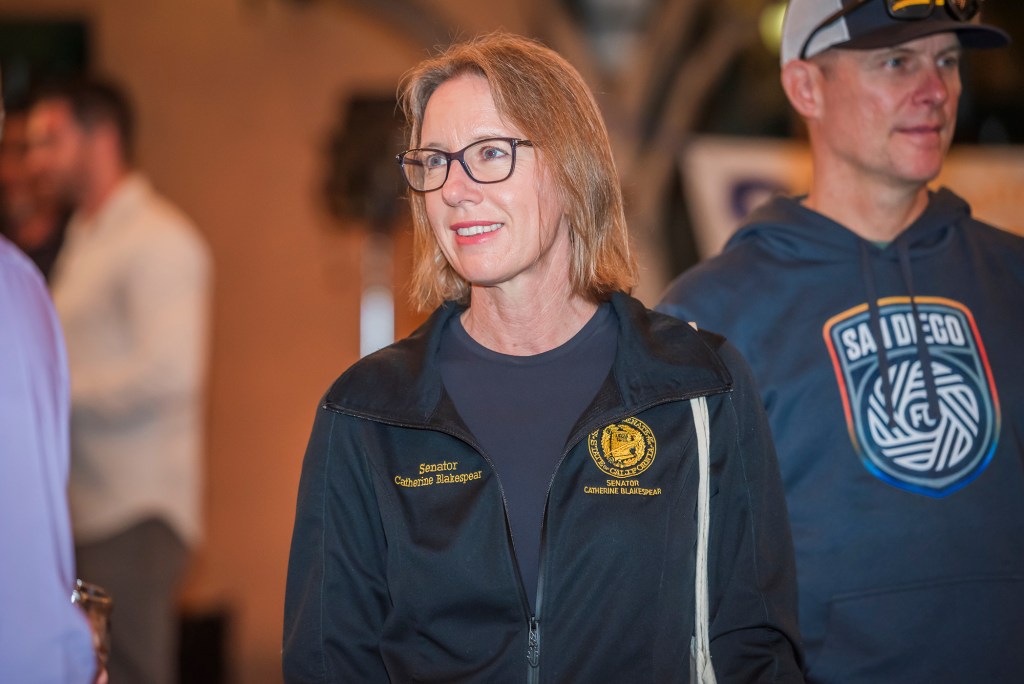
Among the most talkative is Democratic Sen. Catherine Blakespear, who’s clocked in a whopping 26 total hours of speaking. She’s pushed for more controversial legislation in the final leg of her first term compared to San Diego’s other members.
Clamping down on homeless encampments and placing people with severe mental illnesses in treatment programs are among Blakespear’s marquee policy priorities. These include controversial proposals to force cities that don’t receive state homelessness funding to report their homelessness and housing data and another to create a pathway for severely mentally ill people to move from voluntary to involuntary treatment programs. She has more speaking time than nearly 90 percent of all legislators.
Her background as an attorney could partially explain her style, longtime former San Diego lobbyist Ben Clay said.
“The art of the legislative process is they’ve got to be able to take an idea and convert their membership, or their side of the aisle, versus the other side of the aisle, and the more eloquent ones were able to pull in people on both sides,” Clay said.
Part of building clout in the state Legislature is to establish yourself as a subject matter expert, which is easier for legislators with law backgrounds. Some of that plays out in how well lawmakers present themselves and their bills, as well as their understanding of the personalities and biases of their colleagues.
“It’s people engineering,” Clay said.
Committee chairs, which many Democrats are, almost always clock several minutes of speaking time per week, too. Blakespear leads the Senate’s environmental quality committee, and Democratic Assemblymember David Alvarez, who recorded more than 28 hours of speaking time, chairs the education finance subcommittee.
But talking (a lot) isn’t always everything.
Alvarez’s colleague, Sen. Steve Padilla, differs in approach and policy. The Democrat is less chatty, tallying 15 hours overall in speaking time, and is one of a handful of lawmakers tackling artificial intelligence chatbots and data centers, where outrage over plans for an Imperial Valley data center are echoing the national fight over AI.
They’re both largely effective at coalition-building and each is up for re-election in safe blue-leaning districts come November.
And who tops the list for most speaking time? That distinction belongs to Weber Pierson who’s spoken more than 31 hours and 43 minutes, sixth overall in the Legislature. She frequently reads bills from the dais, likely inflating her speaking time. She’s up for re-election in 2028.
Democratic Assemblymember Tasha Boerner of Solana Beach and Jones were the quietest of the bunch. Boerner, a fourth-term lawmaker, spoke for roughly seven hours and 45 minutes from January last year to this August. Fewer than a third of California’s 120 legislators spoke less than her.
Jones, a Republican, is not too far behind, speaking for a total of eight hours and 20 minutes. It’s common for members of the party out of power to speak less than the majority who hold the most sway over legislative proceedings. As Jones tells it, he’s had less time to speak than other Republicans because he’s on fewer committees as a member of leadership.
“I talk less on the floor, too,” Jones said. “Typically, I’m leaving it up to my vice chairs of the committees to carry the weight of speaking on the floor, or if there’s a particular member that’s concerned about an issue, we let them take a lead on it.”
But he wouldn’t call himself quiet. When “riled up” or the moment calls for it, he speaks extemporaneously on the floor, Jones said.
Boerner is up for re-election this year in her solidly blue coastal district.
What I’m Reading Now
Newsom moves to reduce utility wildfire payouts against the wishes of fire survivors, CalMatters reports.
Federal immigration agents could soon be outfitted with gloves that produce electric shocks, The Associated Press writes.
Marvel Studios gets fined a superhero-sized tab: the production company got a $160k slap on the wrist for covering a Gaslamp arch in marketing materials during last month’s Comic-Con, The San Diego Union-Tribune explains.
Thanks for reading this week’s report! Please feel free to reach me for any questions or comments: nadia@voiceofsandiego.org.
CalMatters’ Digital Democracy engineer Andrew Chan contributed to this report.

The claim for helping a 0.2% for forced treatment
While harming 99% of everyone that goes through there is not even justifiable
It’s full of lies, an enormous amount of Mal-Practice along with Due Process
Creates huge lines so that the 0.2% that IS CLAIMING TO BE HELPED gets thrown at the back of line with NOT ENOUGH ROOM because it’s full of people who shouldn’t be there.
This isn’t just MALPRACTICE
IT ALSO REAL MEDICAL TORTURE
Has injustice as “due process”
So that people can be rubber stamped into locked facilities.
You can’t just throw people in jail when they haven’t done anything.
How does the logic of these people think that this is any better than a quick way to hide people ALONG WITH DISPLACEMENT
That’s called “EXTORTION”
It’s 100% MAL-PRACTICE
When used for the wrong reason
This is injustice
And it’s MORALLY WRONG
Lacks REAL due process (rigged)
This is a complete mockery of justice
A complete mockery of the mentally ill
And a complete mockery of the homeless situation
911 hey parole officer hey parole board
DANGEROUS MENTALLY ILL AND UNSTABLE GUY ((THE EXACT SAME PERSON KNOWN TO GET VIOLENT))
with history and several psychiatric medical diagnosis
“He going mental again” saying doing that same things that show haywire brain dysfunctioning AND IS UNSTABLE AGAIN”
THE SYSTEM, “Call us back after you get attacked or when he gets violent ”
(attack occurs later on)
“How about I take you both to jail”
(more dangerous brain dysfunction)
“Get an eviction”
The parole board says “that’s mental health and there’s nothing we can do”
James 2
Favoritism Forbidden
1 My brothers and sisters, believers in our glorious Lord Jesus Christ must not show favoritism. 2 Suppose a man comes into your meeting wearing a gold ring and fine clothes, and a poor man in filthy old clothes also comes in. 3 If you show special attention to the man wearing fine clothes and say, “Here’s a good seat for you,” but say to the poor man, “You stand there” or “Sit on the floor by my feet,” 4 have you not discriminated among yourselves and become judges with evil thoughts?
5 Listen, my dear brothers and sisters: Has not God chosen those who are poor in the eyes of the world to be rich in faith and to inherit the kingdom he promised those who love him? 6 But you have dishonored the poor. Is it not the rich who are exploiting you? Are they not the ones who are dragging you into court? 7 Are they not the ones who are blaspheming the noble name of him to whom you belong?
8 If you really keep the royal law found in Scripture, “Love your neighbor as yourself,”[a] you are doing right. 9 But if you show favoritism, you sin and are convicted by the law as lawbreakers.
12 Speak and act as those who are going to be judged by the law that gives freedom, 13 because judgment without mercy will be shown to anyone who has not been merciful. Mercy triumphs over judgment.
10 For whoever keeps the whole law and yet stumbles at just one point is guilty of breaking all of it. 11 For he who said, “You shall not commit adultery,” also said, “You shall not murder.” If you do not commit adultery but do commit murder, you have become a lawbreaker.
9 But if you show favoritism, you sin and are convicted by the law as lawbreakers.
3 If you show special attention to the man wearing fine clothes and say, “Here’s a good seat for you,” but say to the poor man, “You stand there” or “Sit on the floor by my feet,” 4 have you not discriminated among yourselves and become judges with evil thoughts?
1 My brothers and sisters, believers in our glorious Lord Jesus Christ must not show favoritism.
Purchased politicians profiting off public properties.