

San Diego’s recently implemented trash fee has politicos and residents down in the dumps. But a new effort to repeal it could lay waste to the city’s already busted budget.
The chief complaint of the anti-fee crowd is the claim that the fee was a bait and switch. When voters approved the concept of a fee in 2022, city officials gave them an estimate of how much it would cost a month. What they ended up charging, though, was nearly twice as much as the original estimate.
Some groups have seized on that opening, launching campaigns to repeal the tax altogether. There’s just one problem – the fee is bringing in a lot of dough. If the repeal-heads get their way, the trash fee’s nixing would blow an entirely new hole in the city’s budget, even as leaders try to dig out of an already massive deficit.
Just how big a hole would it leave? Currently, the trash fee accounts for about 5 percent of city revenue. To put that into perspective, that’s equal to the entire city budget for libraries.
Charles Modica, San Diego’s independent budget analyst, was blunt about the potential impact of the fee’s repeal: “The city would need to really have a real conversation about just picking a service that it is currently providing and not providing that service anymore.”
Related: When city officials originally pitched the fee, they estimated it would cost voters between $23-$29 a month. But they didn’t chain themselves to that number.
One reader pointed out some fine print on the item’s fiscal impact statement:“Given that a Cost of Service Study could take several years to complete, and the costs to provide this service may increase over the next several years, the actual fee levied could be higher.”
South County Report: About that State of the City
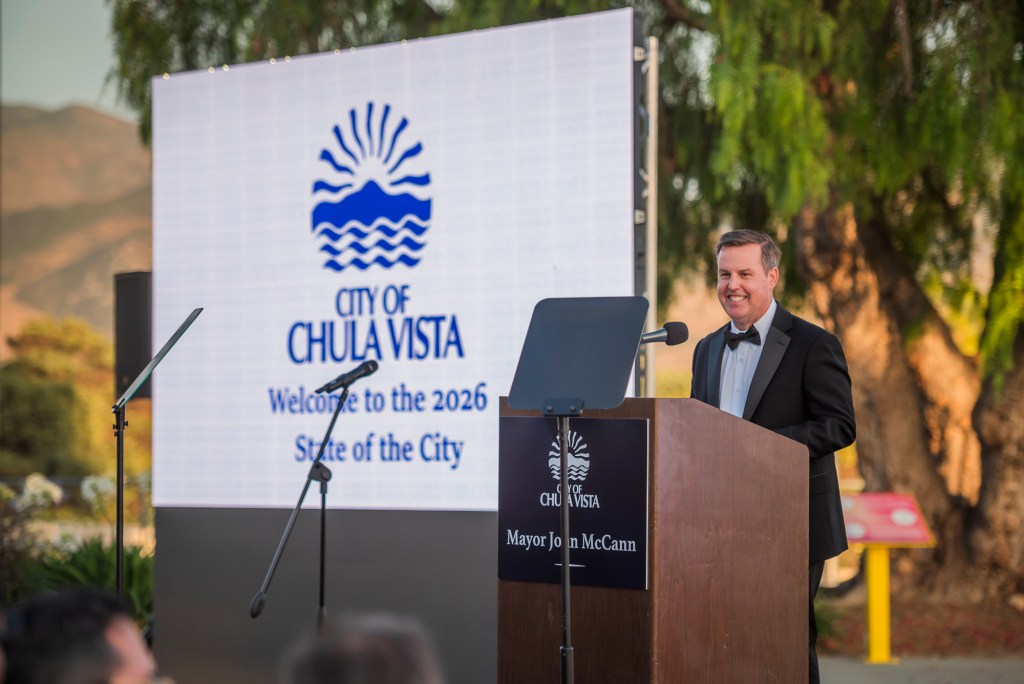
How much can $28,000 get you nowadays? Apparently, a fully-catered extravaganza featuring an opera singer, a Mission Impossible-themed intro video and a skydiver.
Just ask Chula Vista Mayor John McCann, who on Tuesday rang in the State of the City with all of the above. And McCann, who’s running for re-election, has some things to celebrate. After all, it’s not just his State of the City that puts San Diego’s to shame. Unlike their neighbor to the north, Chula Vista’s finances are in good shape. It’s yet to be seen if that will be enough for voters in November.
Plus: County Supervisor Paloma Aguirre has built her political career on bringing attention to the Tijuana River sewage crisis. And boy, has she been bringing attention to it this election season.
On Wednesday, former United States Health and Human Services Secretary Xavier Becerra became the sixth wannabe-governor to visit the area to get a gander at the health hazard.
Candidates Clash
It’s clashing season in local politics, as candidate debates begin to heat up in earnest. That means local newspapers will begin to fill with one of our favorite words: clash.
On Monday night, six candidates vying to replace District 2 City Councilmember Jennifer Campbell clashed over Mayor Todd Gloria’s Midway Rising plan and long-term plans for Liberty Station.
Last week, four candidates running to represent City Council District 8, which represents San Diego’s southernmost neighborhoods, clashed over the Tijuana River sewage crisis and the need to revamp the San Ysidro border crossing. In District 4, Councilmember Henry Foster clashed with two challengers over the city’s lightning rod trash fee and homelessness.
If you have deja vu, it’s likely because local candidates for decades have clashed over issues important to constituents. They’ve clashed over labor unions, they’ve clashed over jobs, they’ve clashed over vacation rentals and they’ve clashed over cops. They’ve clashed over graffiti and even clashed over trees and you better believe they’ve clashed over fees.
Heck, if the clash is quite fierce and the clashers like the bright lights, they may not only clash once, they may just clash twice.
In Other News
- Correction: Wednesday’s Learning Curve incorrectly identified Akila Weber Pierson as a California Assemblymember. She is a state Senator. D’oh.
- In 2022, Measure H passed with more than 68 percent support by San Diego voters. Four years later, the measure, which would have helped address a shortage of available child care, has hardly seen momentum. (Union-Tribune)
- April weather conditions across San Diego County have been warm and dry, making regions more prone to wildfires as summer draws near. Even with a wetter winter, firefighters hoped the region would receive more heavy rainfall. (Union-Tribune)
- On May 17 from 10 a.m. to 2 p.m. Coast Highway 101 will be car-free and open for cyclists, pedestrians and more as Cyclovia Encinitas partners with the city of Encinitas’ Environmental Commission and Mobility and Traffic Safety Commission for a free event to explore Encinitas in a new way. (The Coast News Group)
- Senate Bill 958, is a bill currently being ushered through the state Legislature that focuses on making the proposed height for the Midway Rising mega project permissible. Plans for the project aim for a 165-foot-tall sports arena and 105-foot-tall residential buildings. (Union-Tribune)
The Morning Report was written by Jakob McWhinney and Rami Alarian. It was edited by Andrea Sanchez-Villafaña.
clash crash? did you learn a new word and HAD to (over)use it?
and, btw, “French” fries do NOT belong in “Mexican” burritos!!
Millions of tributes continue to poor in from around the world despite the hatred of VOS.
Hello Mr. Smiechowski! ☺ I’m Ane from Norway. I just watched your episode on HBO’s Neighbors and I just gotta say you’re iconic! Please don’t let anyone get you down, or stop you from being your wonderful self. I’m a big fan!!! ☺️ Love, Ane