
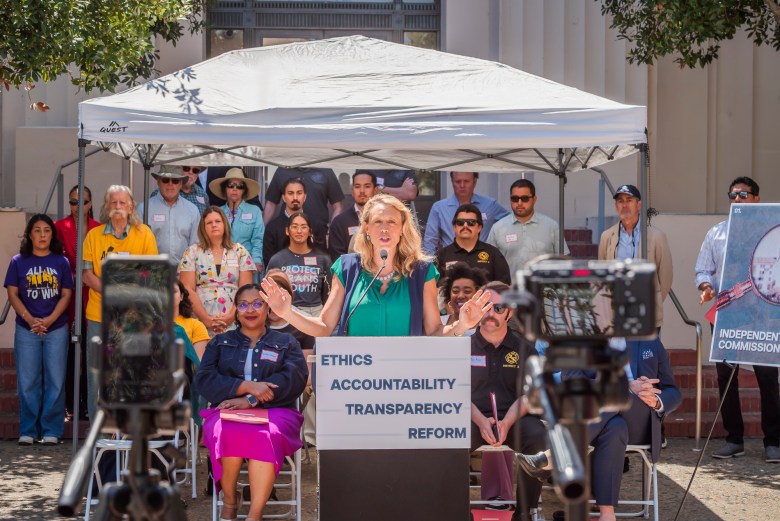
To secure a victory in the war over competing county governance reform measures, County Board Chair Terra Lawson-Remer on Wednesday agreed to a key concession to keep her pitch moving toward the November ballot – and tackle a key criticism addressed in Supervisor Joel Anderson’s rival one.
Lawson-Remer’s likely pitch to voters will no longer suggest that countywide elected officials including the sheriff and district attorney could be held to three terms, something only possible if state law changes.
Vice Chair Monica Montgomery Steppe proposed the amendment on Wednesday to Lawson-Remer, who attended the meeting on Zoom fresh off having her second child.
It’s a major shift for Lawson-Remer who said on Voice of San Diego’s podcast last week that her key motivation for proposing a third term for county elected officials including sitting supervisors was “creating a framework” that applied to all officials chosen by voters. Now the measure headed toward the November ballot will give simply supervisors a crack at a third term – including sitting ones like Lawson-Remer.
On Wednesday, Lawson-Remer said was willing to accept the amendment after recently consulting with the coalition of unions, advocacy group and local leaders who backed her measure – though she remained convinced all county elected officials should have to three terms. Opponents of her proposal including Anderson had argued the passage was misleading and Sheriff Kelly Martinez, District Attorney Summer Stephan and County Assessor-Clerk Jordan Marks endorsed Anderson’s proposal as a result.
The amendment to Lawson-Remer’s proposal means that supervisors must take another vote on it on June 25 before it can be placed on the November ballot.
Wednesday’s 3-2 vote, opposed by Anderson and Supervisor Jim Desmond, followed presentations on the two competing ballot measures that both Republican supervisors said were the most significant reforms they’ve considered while on the county board.
Lawson-Remer’s proposal now appears almost certain to land on the November ballot. If voters approve it, the measure would shift the power balance in county government, giving supervisors and the constituents who support them more influence on day-to-day operations and the budget. Lawson-Remer’s measure would give supervisors a potential third term in office and the power to approve the hiring of top county officials. It would also create two positions that report to the supervisors: an auditor and budget analyst, create an ethics commission and adjust rules on board members’ interactions with county staff and contracting officials.
“This is about giving voters the final say on whether San Diego County should have modern checks and balances to support the scale of the services we deliver,” Lawson-Remer wrote in a statement after Wednesday’s vote.
Anderson’s competing proposal would have exempted sitting supervisors from extended term limits, nixed new hiring and firing powers, created an elected auditor position and stuck with existing rules on supervisors’ interactions with county staff.
About the residency clause: Last week, our Lisa Halverstadt wrote about passages in both county governance reform proposals that would allow the county to remove the mandate that supervisors live in the districts they represent if state law changed. County Counsel Damon Brown clarified Wednesday that the language wouldn’t shift county practices absent changes to state law – and that his office had suggested the new language. Montgomery-Steppe, with Lawson-Remer’s support, directed county lawyers to maintain the language now in county charter to ensure it’s clear that supervisors should live in the districts they serve.
What voters need to understand is the underlying concept to give the Board of Supervisors (generally speaking, the majority block which in this case is the 3 Democrats) virtually unrestrained power – over professional civil service staff, the ability to insert themselves into the purchasing process (this leaves the possibility of pay-for-play which is what happened in the reviled “boss” governments), and to hire/fire the Ethics and Audit watchdogs themselves (foxes guarding the chicken coop.)
We don’t need to have this kind of power given to the majority block when they conducted this charter amendment process with select groups instead of making it a publicly visible and engaged process. This speaks to how they will be making policy and conducting business in the future. This is not good for San Diego County.