
This post has been updated.
Mayor Todd Gloria just signed the budget to tackle the city’s $118 million deficit, and he’s not happy about it.
“While I disagree with several of the Council’s adjustments, I will sign this budget,” he said in a press release.
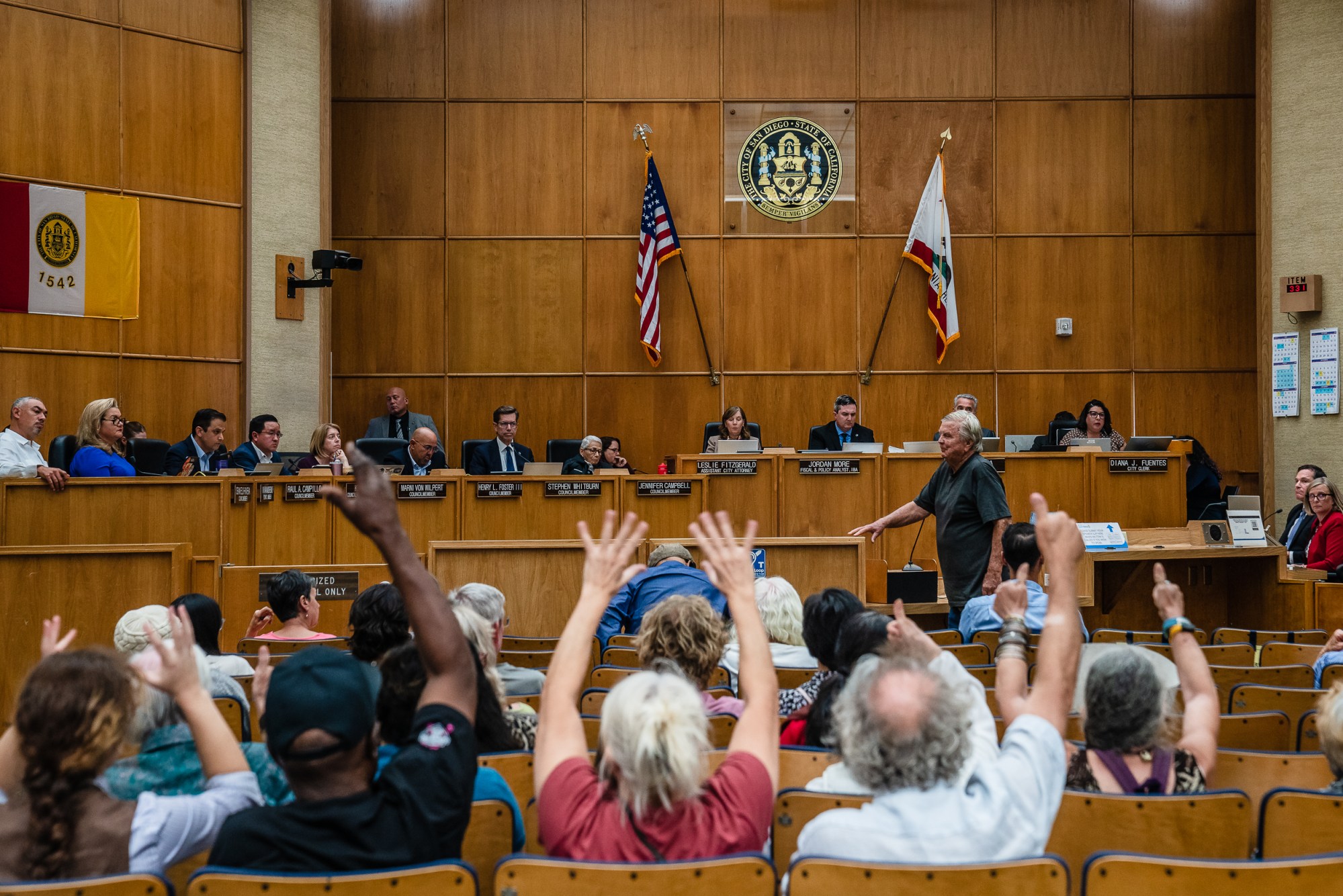
After months of tense negotiations, Gloria and the City Council somehow managed to get a final budget passed this week without a veto showdown.
The negotiations also come off the heels of a deal city officials struck to kill paid parking at Balboa Park and reduce the trash fee. This move, combined with no new revenue streams in sight, doesn’t bode well for the city’s ongoing deficit.
Despite the budget woes, here’s what did and didn’t make it into the year’s final budget.
What the Flock?
It was the most contentious point to get the final budget approved.
Four councilmembers supported the cancellation of a $2 million contract with a company called Flock. The company operates “AI-powered video surveillance” and license plate reader technology and has been the subject of continuous public backlash.
But the councilmembers couldn’t score a fifth vote to pass a budget without Flock funding. So, it remains.
More on the police budget: Despite some minor staffing cuts and additions, the police department’s $718.7 million budget remains largely intact.
Fire department cuts: Gloria’s proposed cuts to the Fire-Rescue Department were included in the final budget. They include:
- Reduction of three fire captains and three fire engineers from the city’s dedicated bomb squad. Instead, those firefighters will be staffed on fire engines, and their engine will be taken offline each time there is a bomb-related emergency. According to the Union-Tribune, the bomb squad responded to 134 calls in 2024.
- Reduction of a recruitment officer, a community resources officer, a fire information officer and a fire academy instructor. These officers will be placed back on fire engines.
One firefighter union leader from Local 145 warned these budget reductions will compromise public safety.
Middle Managers Chopped
In an effort to hunker down on the city’s growing ranks of so-called middle managers, Gloria proposed cutting $9.3 million worth of these positions – or 48 unclassified employees.
We broke down who they are, how they became so plentiful and why San Diego’s politicos have so much beef with them.
In the final budget, the City Council requested additional cuts in the performance and analytics and communications departments.
The council also voted to retain the city’s Filming Program Coordinator.
Arts & Culture Spared
Mayor Gloria originally proposed entirely slashing the city’s arts and culture funding by $11.8 million. The public outcry came quick as ballerinas, artists and musicians flooded City Hall during the initial budget discussions.
Councilmembers Kent Lee and Budget Chair Henry Foster managed to strike a deal with the Prebys Foundation to restore the majority of the funding.
That plan includes:
- Six million dollars in transient occupancy tax funds from Measure C.
- Three million dollars from the Prebys Foundation.
- One million three hundred thousand dollars in city funding for grant programs.
Libraries and Rec Centers (Partly) Restored
Gloria’s initial proposal also called for more than $3 million in cuts to city libraries and more than $5 million in recreation center funding.
Some Councilmembers said these cuts pose a threat to public safety.
The Council managed to maintain library and rec center hours in districts 4, 8 and 9– which include some of San Diego’s most low-income neighborhoods. The final budget also restores Monday hours at the North Park library and half-day Saturday hours at the Mira Mesa and Linda Vista libraries.
Fully Restored Recreation Centers
- Carmel Valley
- Pacific Highlands Ranch
- Robb Athletic Field
- Canyonside
- Doyle
- Mira Mesa
- Hourglass Field
- Nobel Athletic Fields
- Standley
The final budget also retains the Office of Child and Youth Success.
Public Restrooms
Restroom access in downtown, Balboa Park, Mission Bay and Fiesta Island took a big hit this budget cycle, but an earlier plan to cut five restrooms at local beaches was dropped in the mayor’s May revision.
The final cuts include:
- Two public restroom sites in downtown that primarily served unhoused people, including some portable restrooms.
- Thirteen out of the 28 restrooms in Mission Bay Park.
- Seven out of 14 portable restrooms on Fiesta Island.
- Six out of 17 permanent comfort stations in Balboa Park (including three on the park’s East Mesa, three in the Central Mesa, and one in the West Mesa).
Goodbye, Neil Good Day Center
Some of the public restroom cuts downtown are due to the pending closure of the Neil Good Day Center, which serves unhoused San Diegans. The center will relocate after a six-month wind down, during which cuts to services and operating hours are expected, said Josh Bohannan, chief strategy officer for the site’s operator, Father Joe’s Villages.
The center is the only dedicated walk-up location where people experiencing homelessness can be connected to resources such as case workers and shelters. The site also offers laundry, mail service, showers, phone charging and a respite area.
“We’re exploring the possibility of renovating our existing space to create a day center program,” Bohannan said, “but it’s not gonna have the same footprint, not the same capacity. It’s not gonna be able to serve the same number of people and there will be less services and probably less hours of operation and days of the week.”
More Cuts to Safe Parking, Fewer Cuts to Shelter Beds
The final budget avoided cutting hundreds of shelter beds at the 16th and Newton shelter as Gloria originally proposed.
The shelter would lose only 50 beds under the new plan. The San Diego Housing Commission said female residents of those beds will be moved to Rachel’s Promise downtown, a shelter for women and children.
The budget also cut 37 city-funded beds at the Lighthouse Shelter in National City, which is overseen by the non-profit San Diego Rescue Mission. This will save the city about $980,000.
The independent budget analyst said those beds would remain open but won’t be set aside for San Diego residents in the absence of city funding.
Philanthropists are also stepping in. Drew Moser, CEO of the Lucky Duck Foundation, said if shelter beds remain at 16th and Newton, the nonprofit is ready to invest thousands in flood prevention for the shelter.
The budget also adds 292 shelter beds split between various locations, creating a net increase of 205 shelter beds, said Matt Hoffman, spokesperson with the city’s homelessness services department.
The budget also slashed two safe parking programs: Aero Drive Safe Parking in Serra Mesa and Central Elementary Safe Parking in City Heights.
Stormwater Stalls
It is hard to overstate the scope of San Diego’s infrastructure problem.
Independent Budget Analyst Charles Modica put it this way: “The magnitude of the City’s unfunded capital infrastructure needs is such that it cannot be addressed without a significant new revenue source.”
Over the next five years, the city faces a $7.8 billion funding gap to address its ever-growing backlog of infrastructure needs. Out of the $47 million the city allocated to capital improvements this year, $30 million is dedicated to emergency projects. (Here’s to hoping that “Super” El Niño takes it easy on us!)
In the end, the City Council added $1.1 million in one-time funding for clearing stormwater channels and $841,000 in ongoing funding for wetland and channel maintenance.
Climate Equity Fund
San Diego’s Climate Equity Fund was created in 2021 to funnel money from our SDG&E bills and state gas and transportation taxes to support local infrastructure projects.
This year’s budget moved $7 million that was earmarked for climate projects in disadvantaged communities into the general fund to be spent elsewhere.
Traffic Safety Wins
San Diego cyclists and pedestrians, rejoice!
The budget includes funding to improve what’s known as the Fatal 15 — the 15 most dangerous intersections in the city.
It also maintains funding for the Multi-Modal Team – which design safety improvements like crosswalks, stop signs and bike lanes – and $2.4 million for the speed management plan to reduce speeds near schools and other recommended areas.
Measure A: The Revenue Stream That Almost Was
This year’s budget notably avoids new revenue after the backlash to last year’s fee increases.
Instead, they left it up to the voters.
In the June election, San Diegans weighed in on a potential new revenue stream: Measure A, otherwise known as the Non-Primary Homes Tax.
This tax, proposed by Councilmember Sean Elo-Rivera, would’ve added anywhere from $9.2 million to $21.4 million to the general fund by taxing properties that are vacant for more than half the year, with some exceptions. The measure’s proponents also said it might help free up housing.
As of June 11, the polls showed 46.7 percent of voters in favor and 53.3 percent opposing.
Elo-Rivera chalked up the loss to outside spending, while others said there are trust issues at play.
FY 2028 Preview
As it stands, we have no reason to believe next year’s budget cycle will be any less scarring.
Structural budget deficit aside, the biggest culprits of this are the elimination of paid parking in Balboa Park and the reduction of the city’s trash fee.
ICMYI: A group of homeowners filed suit against the city last year alleging it was overcharging for trash service. Then, they started working with the Lincoln Club to put a trash tax repeal measure on the ballot.
So, instead of risking losing the revenue entirely, the City Council voted in May to enter a settlement deal that will kill paid parking in Balboa Park and lower the trash fee.
Parking revenue is expected to take a $9.4 million hit, according to an IBA report, and trash rate revenue is estimated to reduce by $10.8 million next year with cuts to services such as bulky item pickup and weekly recycling. At current service levels, the trash fee change would result in a $40.9 million revenue decrease next fiscal year.
While the city may have avoided the worst case scenario, how they will plug the hole created by this deal (on top of the city’s omnipresent, structural shortfall) remains an open question.
Correction: A previous version of this post incorrectly stated that a proposal to take one of the mayor’s deputy chief operating officers and promote them to a chief operating officer made it into the final budget. It did not. And a deal to spare art funding was done with the Prebys Foundation not the county. We also added additional information about the trash fee, shelter beds and cuts to the fire department.

Leave a comment