

The city of San Diego’s expanding ranks of middle managers have become the go-to attack line on how spending got out of hand. But for years, city leaders saw them as the only way to get flexibility or roll out special projects. Now, everyone agrees there should be fewer of them.
Mayor Todd Gloria historically supported these roles, but they cost the city’s general fund more than $49 million this fiscal year. Amid a projected $118 million budget deficit, he is now proposing cuts.
It’s unclear what the long-term impact of the proposed cuts will be on city operations. But the city’s chief financial officer told us the cuts will increase risks and response times across the city.
But who exactly are these employees and why did they become the budget’s biggest target?
Middle Managers for Dummies
The city’s workforce is split into two groups: unclassified and classified.
“It’s basically just a fancy way of saying unionized versus not unionized,” said Mark Kersey, president and CEO of the San Diego County Taxpayers Association. Kersey is also a former city of San Diego councilmember.
Unions represent classified employees – they have clear roles and responsibilities strictly defined in their contracts.
Department heads can’t assign them work outside of the scope and intent of their job title.
Unclassified employees, on the other hand, are not part of a union and are at-will employees. (Except for the city’s deputy city attorneys, who are unclassified and have a union.)
Unclassified employees make up 7 percent of the city’s more than 13,000-person workforce. Here’s what that looks like in a pie chart.
Kersey said administrations like having unclassified workers. Unclassified employees are more flexible. Department heads can assign them different tasks beyond what they are responsible for in their job descriptions.
The general fund budget has more than 700 unclassified individuals and about 210 of those are middle managers.
That includes about 97 program coordinators and 113 program managers.
Kersey said middle managers are primarily in these two roles.
The city’s chief financial officer, Rolando Charvel, confirmed that same description in a memo to city staff last month.
Kersey said middle managers fill a role between frontline workers and department leadership.
The city charter says they do that but in fancier terms.
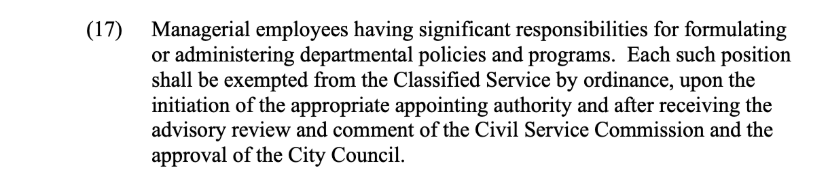
Every time a department director wants to create a middle manager position, they need approval from something called the Civil Service Commission, which the personnel department reports to.
Personnel staff bring forward the recommendation of the exemption of the position. Then the Commission deliberates on the position and if approved, it moves to City Council for final approval.
Rolando Charvel, chief financial officer with the city, gave us an example of a middle manager.
When the state mandated an organics recycling program in early 2022, the city had to roll out the program and hire new drivers to support the increased collection of organics recycling.
Because of that the city needed to hire someone, like a program manager, to oversee those workers. A manager is also required to ensure proper compliance with state organics recycling laws.
He said managers are important to coordinate employees and ensure compliance and communication.
“The good news is that you can give them [middle managers] different duties, but the bad news is that they do cost more,” said Kersey.
Which Leads Us to How They Got So Big
A 2024 presentation to City Council by Michael Zucchet, General Manager of the San Diego Municipal Employees Association, kicked off the whole conversation around middle managers.
He pointed out that between 2015 and 2024 positions like program manager and program coordinator grew from 70 people to 393.
Zucchet said that’s because of two reasons.
First, a 2012 ballot measure called Prop B mandated a pay freeze at the city from 2013 to 2018. The freeze made the city very uncompetitive in wages.

Classified employees got stuck in this pay freeze. So, city officials turned to unclassified employees as another option.
Their reasoning was they could pay these workers more because they wouldn’t have to negotiate with the unions and pay unionized workers the same salaries.
Zucchet said city officials decided they could make a “program coordinator” position, or other unclassified positions and effectively recruit someone they can pay more.
He also said the city’s finances were bouncing back in 2013. The city’s revenue sources like property tax, transient occupancy tax, and sales tax were on the rise.
Kersey agreed with Zucchet and said they had the money to hire middle managers at the time.
Kersey also told me the funding for the roles came from a variety of places, including federal and state grants.
This drove an increase of middle managers from 2013-2018.
But at a recent press conference, Zucchet called Kersey out for adding all those middle managers “back then.”
“In FY2014 through 2020 there was a tripling of these positions, tens of millions of dollars. Not to make this personal but who oversaw that tripling? Mark Kersey who was on the City Council, who’s now at the Taxpayers Association lead. So, it’s a little rich to be hearing that,” Zucchet said.
I asked Kersey about Zucchet’s comment.
“We actually had the money to pay for those positions, which is why we funded them,” said Kersey. “If we didn’t have the money, we would not have funded them.”
Over the past five fiscal years, city officials added 169 unclassified employees to departments that directly report to the mayor’s office. These are departments like Public Utilities Department, Human Resources, police and more.
City officials added about 73 employees to departments independent to the mayor. These include the City Auditor’s Office, Independent Budget Analyst’s Office, Ethics Commission and more.
The Covid-19 pandemic created a need for more middle managers. In a memo to city staff, Charvel detailed how the expansion of new programs, homelessness-related services, and grant-driven staffing needs “reflected the operational demands of that period.”
For example, Charvel told me in fiscal year 2023 both the state organic recycling program and Pure Water project required more hires.
Of those workers, 74 percent were funded by the general fund, and 26 percent were funded by other sources like grants and enterprise funds.
In the memo, Charvel said at least 47 positions are directly tied to new programs, like Citywide Translation & Interpretation Services, Sidewalk Vending Ordinance, Immigrant Affairs and more.
He said most of these positions are approved by the City Council, mandated by the state or federal government, or driven by settlement agreements and grant requirements.
Charvel said nearly half of the positions added were also eliminated over this same period as programs wound down or funding changed.
“I think while they [Taxpayers Association] may be looking at 2011, I’m living in 2026. You look at the data today, we have made substantial reductions in those kinds of positions. Reminder that does not come without impact,” said Mayor Gloria in a press conference.
For his budget this year, Gloria announced he would cut 37 unclassified positions from the general fund to save over $9.3 million.
But Some People Still Have Beef with Middle Managers
In his 2024 presentation to City Council, Zucchet called middle managers “substantial, low hanging budget fruit.”
Kersey said while these employees are doing good work for the city, at some point tough, choices must be made. “It’s not like they’re just sitting around on TikTok all day,” he said.
Kersey and Zucchet have made a big deal out of middle managers, along with former mayor of Coronado Richard Bailey.
Bailey has made it a focal point to wrangle in the city’s personnel costs if he’s elected for the District 2 Council seat.
District 4 candidate Martha Abraham and District 8 candidate Gerardo Ramirez have also called out the city’s “middle manager problem.”
If the mayor were to cut all the current middle managers in the city, that would result in approximately $49.9 million in savings to the general fund budget.
That’s about 2.3 percent of the budget. It is about 42 percent of the city’s deficit of $118 million.
Both Bailey and Zucchet think that while these people may do important jobs, they aren’t delivering the basic neighborhood services that frontline workers do.
“I think it’s really a question of what we’re getting in return – are roads better paved or not, are we seeing those frontline services fulfilled,” said Bailey.
But Charvel told me how cutting some of these roles will have an impact on city operations, increasing risks and response times.
He said the risks vary depending on the department and specific position. Some examples include reduced oversight of programs and contracts, slower implementation of projects or policy direction, less capacity to monitor budgets, and more.
“In practical terms, when management capacity is reduced, the work does not always go away. It is either reassigned to remaining staff, which can slow response times, or it is deprioritized,” said Charvel in an email statement to Voice.
According to the city’s annual financial reports, property tax revenue increased from 471.3 million to 807.1 million between fiscal years 2016 and 2025, a 71.2% increase. Revenue from the Transient Occupancy Tax, or hotel tax, increased 53.8%, from 107.7 million to 165.6 million over the same 10-year period. Spending has outpaced revenues by 14% over that time. Aside from the cost of the mm’s, 533 million went to the pension system. Then we have the error list. Ash St., a 30 million police settlement, a 16.5 million traffic ticket settlement. In terms of spending added to the budget, the largest single category increase was the city’s “General Government and Support” bucket.
If council wants them cut so badly, cut the positions ALONG WITH the programs they run. That’ll make council see their value real quick…
I have inside information and the reason why they don’t want to touch middle management is because someone’s family member is a middle manager and the position was created exactly for that person.
How many employees are needed to run a City like San Diego? When we compare the number of city employees to population size, its clear that the City of San Diego is already very lean compared to other cities across the nation. For Fiscal Year 2026 City of San Diego had 13,115 Employees serving a population of 1,400,000. That averages out to each employee serving 107 people.
Percent of City employees compared to the population they serve.
City of San Diego 0.94%
San Antonio: 1%
Los Angeles: 1.29%
Denver:1.5%
NY City: 3.6%
San Francisco: 4%
The City of San Diego is experiencing significant personnel expenses due to overtime because of the lean workforce. Would you rather pay an employee the expected pay rate or 1.5 times the rate to cover extra shifts. The City needs to attract talent and fill vacancies in order to lower personnel costs.
The problem is not the NUMBER of employees, it is the compensation structure. We should pay HIGHER starting salaries to attract workers, but NOT have DROP … the most costly unfunded liability. Existing workers, unions, and retirees all LOVE the sweetheart deals, but it is NOT a model that successful, well funded cities use.
Best solution – get rid of the Unions
How many employees are needed to run a City like San Diego? When we compare the number of city employees to population size, its clear that the City of San Diego is already very lean compared to other cities across the nation. For Fiscal Year 2026 City of San Diego had 13,115 Employees serving a population of 1,400,000. That averages out to each employee serving 107 people.
Percent of City employees compared to the population they serve.
City of San Diego 0.94%
San Antonio: 1%
Los Angeles: 1.29%
Denver:1.5%
NY City: 3.6%
San Francisco: 4%
The City of San Diego is experiencing significant personnel expenses due to overtime because of the lean workforce. Would you rather pay an employee the expected pay rate or 1.5 times the rate to cover extra shifts. The City needs to attract talent and fill vacancies in order to lower personnel costs.
Hard to compare these percentages without an apples-to-apples bureaucracy review. For example: Unlike San Diego, LA also runs its own Water & Power, a function requiring a staffing component that San Diego does not have.
In the police department there are two unbudgeted program mangers who are paid via “supplemental funds.” What are those funds? I have no idea, because it’s not in the budget and there is zero transparency. It is completely outrageous there are any full time permanent positions in the city not in the annual budget and that are not approved by the Council. This is an issue that needs Charter reform.
We blame the City of San Diego when we as citizens have our hands out (increasingly) for more and more of everything. Are we unrealistically asking for too much from our leaders? Notwithstanding staffing levels, could that be a large crux of the financial problem faced by the City of San Diego and every other government structure in this present age? JFK was probably right, “ask not what your country can do for you……….” Just asking.