
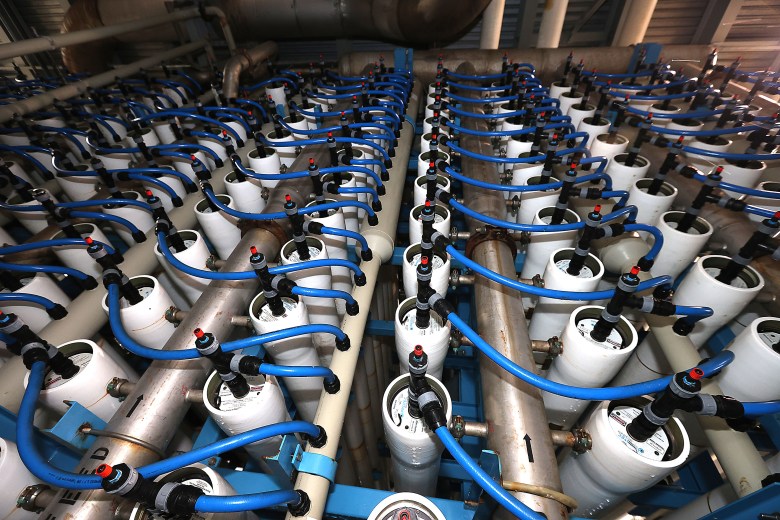
Mexico says it’s finally going to hire a company to build a plant that turns the ocean into freshwater in Rosarito, reviving an idea shelved years ago amid protests that the government was privatizing water.
And, in the name of reducing how much water Mexico takes from the Colorado River, the United States is going to help get the water to the cities that need it. Construction could start as soon as Aug. 1, according to a federal Mexican project website, but the government had not yet selected a builder.
Mexican President Claudia Sheinbaum’s administration announced plans to restart the building of the desalination plant in May 2025. But multiple attempts by the Sheinbaum administration to secure a private builder have failed.
In March, the North American Development Bank – a special bank created by the United States and Mexico to pool equal shares of investment for infrastructure projects – announced it would lend Mexico up to $114 million to build and reinforce the pipes and pumps the plant needs to get water to rapidly-growing urban cities in Baja California.
Treated ocean water, the bank says, would replace some of the Colorado River water Mexico is entitled to under a treaty with the United States.
“The only source of water for Baja California is the Colorado River,” said Baja California’s governor, Marina de Pilar Ávila, during a press conference on March 18.
However, desalination is one of the most expensive ways to create new water, mostly because the process of separating salt from water requires tremendous amounts of energy. But Mexican politicians promised its citizens wouldn’t be saddled with the cost.
“The need to build a desalination plant is real and we’re doing it without an impact on (rates), but rather guaranteeing water supply for the next 30 years,” Pilar Ávila said.
Concerns over that expense, plus a proposal to eventually sell Rosarito desalination water to the United States, doomed the project in the past.
On paper, the project looks like a win-win for Mexicans.
Building a freshwater source along the coast means Tijuana and other urban centers wouldn’t rely as much on pumping Colorado River water through a 78-mile-long aqueduct from the Mexicali area, according to financing documents from the bank. That’s key as the seven U.S. states and northern Mexico, which rely heavily on the Colorado River, grapple with intensifying drought and overuse of that source.
The plant would actually result in an energy savings of up to 36 percent, the bank wrote, because pumping water from a plant next to the cities that need it would use less energy than pumping it across a desert from Mexicali through the aqueduct. The bank also claims the new de-salted water wouldn’t generate any new water demand or generate more wastewater.
But critics of these large desalination plants being built in the Tijuana area worry it will.
The Bids Dragged On
The Mexican federal government has been trying to select a private company to build the plant since May of 2025. But the Mexico’s National Water Commission (Conagua) rejected all of the bids submitted during two rounds of competition, citing that none met the government’s legal, technical or financial requirements.
Three consortiums of companies are in the running under a third bidding attempt, one that includes the same company that runs the Carlsbad desalination plant.
Acciona Agua Mexico, a Spanish company that builds desalination plants and renewable energy projects all over the world, scored highest in previous rounds of bidding, offering to build the project for about $418 million.
Tecno Arrendamientos y Construcciones, which scored sixth in a previous bidding round, has made it to the third round. It offered to build the plant for about $433 million. Within its consortium of businesses is IDE Water Mexico, a subsidiary of the Israeli company that’s currently operating the Carlsbad desalination plant.
The final bidder is Cox Energy, which placed third in the original round of bidding, and originally offered to build the plant at the cheapest cost, for about $306 million.
Acciona just built a desalination plant in Los Cabos at the very tip of the Baja California peninsula. But the plant being proposed in Rosarito is about eight times larger than the one in Los Cabos.
The company that wins this bid will be in charge of building the plant itself and the main pump that pushes the water into the distribution system. But the government will be in charge of hiring another private company or companies to build the system that gets the water to cities, which is being funded by the North American Development Bank.
Historical Struggle Building Desal Plant in Rosarito
This is not the only desalination plant in Baja California. There are multiple across the state, but they are small in comparison to what’s being proposed in Rosarito.
The Rosarito plant would be the size of a desalination plant in Carlsbad, which has the ability to produce 50 million gallons per day and currently provides San Diego with about 10 percent of its drinking water needs.
But the Rosarito plant could eventually grow larger than that. According to project documents on a federal Mexican website, the 50-million-gallon-a-day Rosarito plant is just the first phase.
What a second phase or expansion of the Rosarito plant might look like is unclear.
This idea isn’t new. Mexico tried to build a plant back in 2016 when Francisco “Kiko” Vega de Lamadrid was governor of Baja California. At the time, it was pitched as the largest desalination plant in Latin America.
On the eve of its eventual construction, political opposition warned that the government was trying to privatize water, increase rates and sell that water to the United States. Massive protests broke out across several cities in Baja California. A new governor, Jaime Bonilla Valdez, took over and cancelled the project in 2020, sparking a legal battle between the company who wanted to build it and the government.
After Bonilla cancelled it, Mexico faced a legal dispute with the company that was going to build the project – called Consolidated Water. Mexico’s then-president Andres Manuel Lopez Obrador revived the plan as a federally funded and operated project. When Sheinbaum took over the presidency in 2024, she decided to execute his plan.
On June 25, speaking from the National Palace, Sheinbaum said that the desalination plant is “the only way” to guarantee water for Tijuana and Rosarito.
But advocates on both sides of the border have been arguing Baja California should first recycle its wastewater before investing in more expensive desalination water.
Most of that wastewater either crosses into the United States to be treated, flushed out into the ocean in Mexico or pollutes San Diego via the Tijuana River.
“The desalination plant isn’t the solution…because the water they extract will just end up back in broken pipes,” said Jessica Castaneda, an engineer who works at the Centro de Innovacion y Gestion Ambiental Mexico, a sustainable development organization.
A former U.S. Environmental Protection Agency expert on the Tijuana River wrote an opinion piece in the San Diego Union-Tribune earlier this year, warning that the addition of a desalination plant of this size to the region threatened to make the TIjuana River pollution problem worse by adding a bunch of new water to the system.
“Spending millions to produce desalinated water only to later discharge it back into the ocean after a single use seems crazy,” wrote Doug Liden, who worked for EPA’s San Diego Border Office. “Crazier still: Tijuana’s main wastewater treatment plant discharges into the ocean only a few miles north of where the proposed Rosarito desalination plant will pull its seawater from.”
Then build one of those Pure water plants and drink your treated sewage.
You never have anything constructive to say.
Oh no, building poop plants is constructive.
How about treat TJ’s poop water they keep dumping into the ocean.
more water means more pollution entering the tijuana river valley in south bay