
This story has been updated.
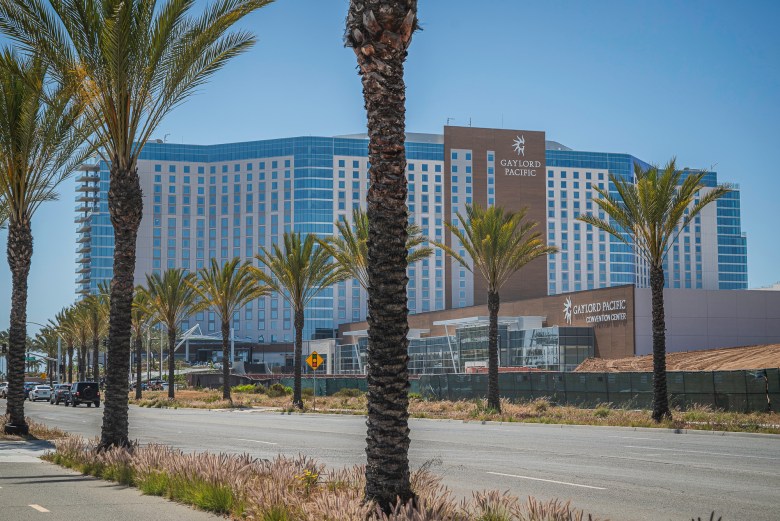
A little more than a year after the Gaylord Pacific Resort and Convention Center debuted on the shoreline of South San Diego Bay, signs are emerging that the cost of publicly subsidizing the $1.3 billion mega-resort could end up being significantly higher than officials originally predicted.
Officials at Chula Vista and the Port of San Diego borrowed $383 million to subsidize the 36-acre resort. They did so, as many governments do, by issuing bonds, which function like a loan. Now they’re gearing up to refinance those bonds.
When leaders greenlit the project in 2018, they expected to spend roughly $870 million to pay back the bonds plus interest, according to city and port documents.
But the Chula Vista finance official overseeing the planned refinancing said current economic conditions, including headwinds facing the nation’s travel industry and stubbornly high interest rates, will likely increase the long-term cost of paying back the bonds.
The final total required to pay off the bonds, said Deputy City Manager Sarah Schoen, will end up being north of the $870 million officials originally predicted, though she said officials are not yet sure by how much.
“The total cost of the debt will be higher than what was estimated in 2018,” Schoen said.
Adam Meyer, real estate director for the port, said he remains confident the Gaylord is on track to generate enough revenue in the long run to pay back the bonds and even bolster both the city’s and port’s bottom lines.
That idea – that tax revenue brought in by the hotel would pay back the bond debt and then some – was one of city and port officials’ chief rationales for backing the project.
When Chula Vista and the Port of San Diego teamed up in 2022 to issue the subsidy bonds, they relied in part on an independent economic analysis that predicted by the Gaylord’s “second year of operation… the city will begin to receive amounts [of tax revenue] in excess of what is necessary to service the [bond] debt.”
That won’t happen, according to city and port budget documents.
This fiscal year, which will be the Gaylord’s second in operation, the hotel and two adjacent resort-area properties (a small motel and an RV park) are on track to generate roughly $25 million in taxes, according to city and port budget documents.
At the same time, the financing authority created by the city and the port will have to pay roughly $29 million in bond debt.
Factoring in all revenues and expenses, the financing authority will generate roughly $3 million less in revenue than the total amount needed to make this year’s annual bond payment plus cover other expenses.
Issuing bonds is essentially the same thing as taking out a loan. A government agency writes an IOU (the bond) which it then sells to investors. It pays the investors back over a period of years, plus interest. (The city and port created a joint powers authority called the Chula Vista Bayfront Financing Authority to issue the bonds and handle paying them back.)
When the port and city borrowed the original $383 million, they set aside a portion of project revenue to help cover future costs. They’ll draw from that money to make up this year’s $3 million shortfall.
City and port officials said they’re confident the hotel eventually will generate enough revenue to pay back the bonds without having to dip into the reserve funds. That depends in part on how many guests use the resort and convention center – and the tourism tax revenue they bring – in the coming years.
A transition period while the hotel gets up to speed as a business was always part of the plan, officials said.
In a statement, port spokesperson Brianne Mundy Page said city and port officials expect tax revenue generated by the Gaylord to exceed the amount needed to pay off the bonds before the hotel’s 20th year in operation.
“In years 15-19 [of hotel operation], the project is projected to begin generating more cash than the bond payments and reimbursements to public agencies,” Page said. “That would mean a positive cash flow to the city and port at that point.”
That’s an extremely different calculation than the 2022 analysis that predicted the resort would create positive cash flow for the city and port in its second year.
Following publication of this story, a Chula Vista spokesperson said city officials disputed Voice’s characterization of what it means for the project to have positive cash flow.
The spokesperson John Cihomsky said city and port officials always envisioned it would take the hotel many years to begin generating a positive cash flow — all expenses considered — for the agencies.
“The city and port have consistently shared this timeframe for positive cashflow,” he wrote.
Meyer said his “napkin calculation” of the hotel’s current economic performance suggests “it’s in the magnitude of 25 percent above what was predicted when we closed [on issuing the bonds] in 2022.”
Other city and port officials also have been bullish about the hotel’s success and economic impact.
At the Gaylord’s gala opening last year, Chula Vista Mayor John McCann promised the resort would make the city’s bayfront “a world-class people’s bayfront… creating $475 million of economic impact annually.”

Ann Moore, the city’s port commissioner, told South County business leaders earlier this year the Gaylord already was “one of the top-performing properties in the Marriott International portfolio, ranking as the third-highest grossing Marriott on the planet.”
(Marriott operates the hotel via an agreement with RIDA Development, which built the resort.)
“This is more than a resort,” Moore said at the South County Economic Development Council’s annual economic summit in May. “It’s a game-changing investment shaping the future of the Chula Vista Bayfront.”
Schoen said the city and port recently hired two firms to provide an updated economic feasibility study of the hotel and adjacent convention center in preparation for the bond refinancing.
Until that assessment is complete, she said, the city and port do not have enough information to make a confident prediction about the long-term cost of paying back the bonds.
“It’s still young,” she said of the Gaylord. “It’s… only a year into business.”
Schoen said the hotel, as a private company, does not share proprietary financial information with the city.
She said a key determinant of the long-term cost to repay the subsidy bonds will be the financial rating assigned to the refinancing by bond rating agencies.
Ratings agencies, such as Fitch or Moody’s, examine financial information related to a bond issue and assign a rating based on their assessment of the likelihood the bonds will be paid off on time.
The agencies will have access to the full spectrum of information about the hotel’s economic performance.
Their ratings will affect the bonds’ interest rate, which in turn will affect the long-term cost of paying off the bonds. A higher interest rate means higher annual payments.
Meyer said he believes the interest rate on the bonds will go down after refinancing because, unlike when the bonds were initially issued in 2022, there is now a fully operational hotel generating revenue to repay the bonds.
“When a project is not built, it’s risky,” Meyer said. “Now it’s less risky. [We’re] likely to have better interest rates than last time.”
Schoen said she can’t predict what the final interest rate will be.
Interest rates, especially on bonds, are high in the current economic climate, she said. And hotel operators in the city have reported a recent decline in cross-border tourism.
Combined with high nationwide inflation and overall economic uncertainty, a constellation of factors is making it hard to predict the ultimate interest rate the city and port will pay on the refinanced bonds, Schoen said.
Most likely, “The debt service payment won’t go down a ton,” she said.
If the debt service payment doesn’t go down and revenues from the hotel don’t go up, the city and port could be waiting to break even for a long time. It’s a lot ifs.
“We have six scenarios right now” Schoen said of efforts to prepare for the bond refinancing. “We only have a year of experience. That’s different than a 10-year trend.”
Voice of San Diego sent a list of questions about the Gaylord’s financial performance to the hotel’s press office, as well as to the RIDA Development corporation and the Marriott Corporation.
None responded.
So far, tax revenues generated by the hotel do not give a definitive picture.
Chula Vista’s 2026-27 budget predicts some taxes generated by the hotel and surrounding properties will grow this fiscal year. Other revenues generated by the resort area will decline slightly, the budget predicts.
Schoen said numbers in the budget are not the final word on the hotel’s financial performance because the numbers are affected by the timing of when tax revenue comes to the city and flows out to repay the bonds.
“We anticipate that overall revenues from the hotel will increase this year compared to last year,” Schoen said.
Chula Vista City Councilmember Cesar Fernandez, whose district encompasses the hotel, said, as far as he can tell, the hotel is succeeding economically. Though he cautioned the hotel does not share financial results with the city.
Fernandez said a handful of restaurants near the hotel are experiencing overflow business from hotel guests and conferencegoers venturing outside the hotel.
At the same time, he, like other local residents, has noticed the hotel’s parking garage is almost never full and on some days appears almost empty.
“I agree when I drive by I don’t see the parking garage full,” Fernandez said. The lack of cars, he said, could stem from the fact that many hotel guests are attending conferences and didn’t drive to the hotel.
An online hotel events schedule shows a series of multiday business conferences booked at the Gaylord over the next several months, with gaps of a few days or weeks between events.
None of the conferences appears to take up the entire convention center. There are no overlapping events on the schedule.
Fernandez said the city is still figuring out how to ensure the hotel’s presence benefits everyday Chula Vista residents.
Overflow business from the hotel hasn’t yet reached the city’s downtown Third Avenue business district a few miles inland, he said. “I don’t think conventioneers get that far,” he said.
Nor, he said, do many locals stay at the hotel, where rooms start at roughly $400 per night and can cost more than $1,000 per night.
The hotel “is not made for Chula Vista residents,” he said. “That’s not a great thing for Chula Vistans to hear. But it’s the truth of the matter.”
Correction: This story previously stated that taxpayers were on the hook for paying off the bonds used to fund construction on the bayfront. Technically, the joint powers authority created by the city and the port are on the hook, not taxpayers directly. The story also stated the joint powers authority would come up $3 million short in paying bond-related expenses. It is projected to come up $3 million short in paying bond-related expenses plus other costs. The joint powers authority has received revenue from multiple places, including the city, port and county — not just from bond revenue.
Chula Vista has been “Trumped.” Trump’s on going destruction of the US economy is driving borrowing costs up. The really bad news is that Trump never admits to a mistake and could have two more years left in his term.
There is a possible way to change the path of the economy, make sure you vote in the Mid-Term elections.
BTW when I asked US Rep Sara Jacobs if she would vote for Impeachment of Trump if she was reelected in an email exchange, she refused to answer. I informed her in a follow up email, she had just lost my vote.
So don’t vote red bc of Dumpy, but don’t vote blue bc of sarah? Gotcha. Makes no sense.
I knew it all along. I live in Chula Vista, 10 minutes from Gaylord.
When I learned about a billion dollar hotel in sleepy bayfront going up, I told my wife ” that’s crazy, ridiculous.” The size of it is senseless. There is nothing in the area to support business there. No one in Chula Vista can stay there, too expensive and nothing to do but jump in the pool. Stupid boondoggle waste. Convention center? Hahahahahah. Downtown San Diego is preferable with city life all around , tons to see and do.
I knew it all along. It was obvious.
I am not surprised at all. As a former Port Commissioner representing the City of San Diego 2006 – 2009, I did not vote in favor of this project back in 2007. There were pollution issues and other issues with residential v commercial on the Chula Vista Waterfront. Why support a billion dollar project that puts the San Diego Convention Center in competition with another one 10 miles away, subsidized by the same municipality, The Port of San Diego? It is a beautiful facility and I have been a few times already. Back in 2007, I thought the funds from the Port should have gone to cleaning up the B Street Pier which is still an eye sore on the front porch of San Diego as well as Seaport Village renovation. It is very tough to have five cities collaborate and share waterfront property, funds and income. Hopefully this will eventually pencil out for the Port as well as the City of Chula Vista.
LOL, why do we vote for anything with borrowed dollars? It never goes well. But yet every election kicks a can down the road with money we don’t have and we then wonder why?
You can thank City Manager Tiffany Allen for this. Former Development Services Director and head dealmaker—she’s always selling out the city.
It is prob a top grossing Marriott only because of its size. That’s sort of a meaningless statistic.
The money that went to Gaylord could have gone to improving and expanding the existing quite popular convention center (supposedly $ was allocated for that but it’s not happened).
Maybe locals would go to the Gaylord restaurants but the nearly parking is a $45 money grab.
Welcome to Scam Diego in action with this project and all the others in the works for this area. As a 50+ year native Chula Vistan our current city clowncil has got to go next election.