
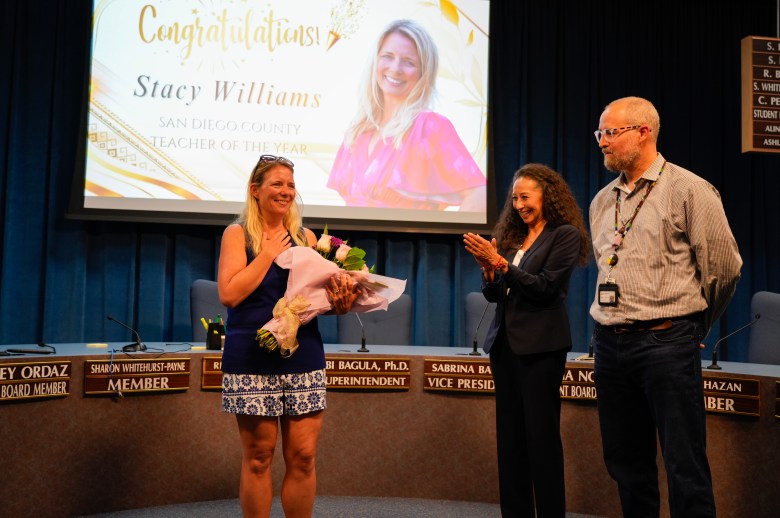
When Stacy Williams found out she was one of the local educators selected to be a San Diego County Teacher of the Year she was elated.
“It kind of took my breath away,” Williams said. “I have done so many different things in transition that have been unique and outside of the box, innovative, and this was like ‘Oh, wow I’m finally getting seen and acknowledged for that work.”
For Williams, the award was particularly validating because of how challenging and misunderstood her job can be.
For the last 19 years she has worked at TRACE Alternative School in San Diego Unified. It’s a transitional school that teaches life skills to adult students with disabilities aged 18 to 22. Providing such services is federally mandated.
TRACE’s goal is to teach students the skills necessary to live independent, productive lives after school. Sometimes, they provide additional instruction to students still struggling to read. At other times, they work on more hands-on skills. That could mean helping a student earn their driver’s license or providing intensive job training or even help navigating benefits programs.
As part of that work, students receive in-depth case management from educators. That’s what Williams does. Or at least, what she did.
Less than a month into the new school year, that celebration ended. Williams was excessed. In edu-speak, that means her position was eliminated – and she may no longer get to teach at TRACE.
“I’m broken,” Williams told me. “The district has broken me.”
The experience can be not only demoralizing, but entirely destabilizing. While teachers retain a job within the district, they’re shuffled around to a new school in need of someone with their credential, weeks after the school year has started.
Like most teachers, this wasn’t Williams first go-around with excessing. She knows it’s been a fact of life in schools for years. This time was particularly crushing, though. The whiplash of going from winning one of the region’s top awards to losing the role she’d built her life around made her feel disposable.
“It’s so demeaning, because you go from being in the spotlight to feeling useless,” she said. “You’re spiraling and you don’t know what’s going to happen and you’re scared.”
Historically, dozens of teachers each year have been excessed. Often the driver is enrollment at a school coming in lower than expected, meaning a teacher that was assigned to a campus isn’t necessarily needed.
“Excessing decisions are made according to enrollment at the school site, and in accordance with our negotiated allocation formulas,” San Diego Unified spokesperson Susan Shamoon wrote in an email.
A recent MOU with the teachers union significantly reduced the number of general education teachers excessed each year. Special education teachers were less protected by the agreement, though.
According to Shamoon, the district used to excess 60 to 80 general education teachers every year. This year, only three general education teachers and one counselor were excessed. Shamoon wrote that district officials are still finalizing allocations for special education teachers, para educators and some shared positions, so the final numbers aren’t clear.
TRACE has been especially hard hit by excessing in recent years. Last year, five of the school’s mild-moderate disability teachers and one extensive-support-needs teacher were excessed. This year, in addition to Williams, who teaches mild/mod students, TRACE lost two more extensive-support-needs teachers and five paraeducator independent facilitators, staff who work with students to provide behavioral and academic support.
But Williams’ worry isn’t just for herself. As a special education instructor, particularly one who works to prepare older students for life after school, relationships are particularly important.
“Students with disabilities need consistency. It’s all about relationships. I’ve been working the past two months to build those relationships and now they have to start over with a stranger,” Williams said.
“The biggest concern is what these changes are doing to our students. Students have been moved from one teacher to another, sometimes multiple times,” Williams said during Tuesday night’s board meeting, fighting back tears. “For students with disabilities, the lack of consistency can be incredibly disruptive. They build relationships with teachers, learn routines and depend on familiar people who understand their needs. Our students deserve stability consistency and teachers who have the ability to have the time to truly know them.”
Over the years, she’s done all sorts of stuff that went far beyond the remit of a traditional teacher. She’s been there for the birth of a student’s child, helped a kid get into a welding program and attended a drug addiction meeting with a student. She even started a small business that helped students get job experience, the latter of which was commended by the County Office of Education as part of her award.
“None of that matters now,” Williams said. “It’s heartbreaking to look back on the 19 years in this school.”
The strength of the relationships she’d built with students were evident at Tuesday night’s board meeting. One of Williams former students, Tu Tran, spoke about the impact she’d had on her life. It was her first time speaking publicly.
“My teacher is Miss Stacy. She is a really good person who helped me with a lot of things,” Tran said. “She helped me learn how to take the bus, how to take the trolley, how to use money… She helped me to improve my communication.”
Like all teachers who’ve been excessed, she’ll end up with a job. But what kind of job? This late into the school year, she worries that the only assignment available will be a Frankenstein’s monster sort of position cobbled together from part-time special education jobs at different schools across the district.
Beyond the potential mish-mash assignment, she’s heartbroken because it won’t be the same role as the one that’s brought her such meaning over the years.
“This is not my skillset, I’m a transition teacher,” Williams said.
As part of the award, one colleague gushed about Williams’ “compassion” and “clarity of vision.”
“She understands that for many students, especially those with disabilities, education must be relevant, functional, and connected to real life,” an unnamed colleague wrote as part of the county ed office’s write-up for her award.
As far as what comes next, Williams isn’t sure. There are some practical considerations. The award came with a $500 gift card meant to help teachers with classroom supplies. Now, she doesn’t have one.
Long term, she hopes to land in a place where she can make an even greater impact on the lives of students receiving transition services. That may be working to help integrate transition services into high school, or it may be moving into an admin role if one becomes available.
What is clear, is just how vital these services are and that San Diego Unified, like many other districts, “just isn’t there yet,” she said.
Every year, Williams and her colleagues get 18-year-old students who can’t read. Students who don’t know the basic skills they’ll desperately need for whatever comes next in their lives.
Not only do Williams and her colleagues work with those young people to help them get their first jobs, open their first bank accounts, learn how to ride the bus or pass drivers permit exams. It’s those moments, the profound milestones, that she’s most grateful to have experienced alongside her students.
“These services are more important than getting a high school diploma in a lot of cases,” she said. “Anybody can go and get a piece of paper, but having these transition services that bridge the gap from high school to adulthood is the most important thing. Having a diploma means nothing if you don’t have the skills.”
Catch Me Outside (Moderating a State Supe Forum)
I’ll be moderating a state Superintendent of Public Education forum this weekend featuring candidates Richard Barrera and Sonja Shaw. It’s hosted by a whole slew of community organizations and will take place at PANA’s City Heights event hall on Saturday at 10 am. Come say hi and hear from the contenders about how they think education in California should work.
You can RSVP to the event here.