
Sacramento Report Countdown
46 days until the November election
Shhhhh.
Do you hear that, everyone?
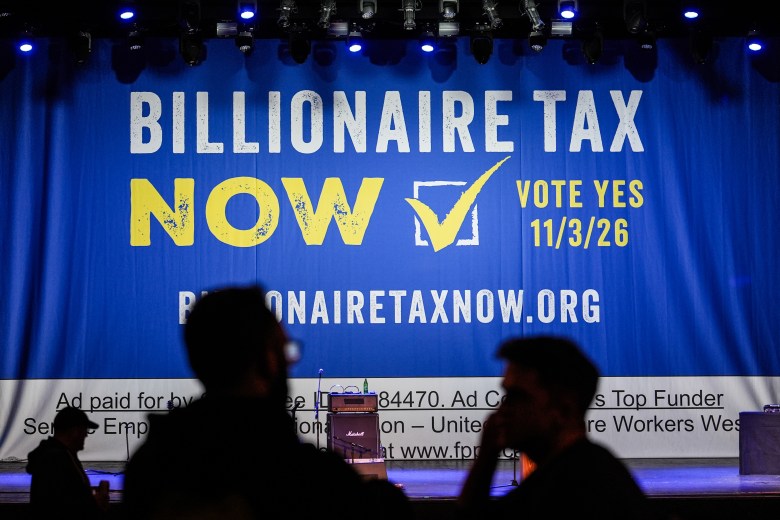
That’s the sound of Democrats dodging questions on what they think of Proposition 40, the divisive ballot measure that would force Californians with a net worth of more than $1 billion to pay a one-time five percent tax on their assets.
The proposal, placed on the ballot by the Service Employees International Union-United Healthcare Workers West, would go toward healthcare. And while billionaires remain unpopular with, well, almost everyone, it has split Democrats into dizzying camps long before it qualified for the November election in June.
The proposal would create billions of dollars in much-needed revenue to address federal funding cuts to Medicaid and ensure thousands of people don’t lose their healthcare coverage, according to backers, including the California Democratic Party.
Opponents such as Gov. Gavin Newsom and leading Democratic gubernatorial candidate Xavier Becerra argue the tax would drive out the state’s wealthiest residents, and backfire by hurting the state’s long-term revenue over time. Republicans also oppose the measure.
But you’d be surprised how difficult it is to find out where San Diego’s Democratic state lawmakers stand on Prop. 40.
Voice of San Diego and CalMatters (namely me) sent out inquiries in July and September to each member of the delegation asking whether they support or oppose the wealth tax.
This included multiple emails, phone calls, voicemails and text messages sent to lawmakers’ offices, their campaigns and themselves throughout the summer.
All the Republicans oppose it.
Only one Democrat, state Sen. Catherine Blakespear of Encinitas, took a position: no.
“We need a federal billionaire wealth tax or we’ll disproportionately disadvantage CA when our highest net worth individuals move out of state and pay no taxes here,” she said in an emailed statement in July.
To Tax or to Not Tax Billionaires?
In an emailed statement on July 28, Assemblymember David Alvarez said he was still weighing the arguments for and against it, according to spokesperson Chris Jonsmyr.
His office did not respond to a Monday follow-up email asking where he stands now.
First-term Assemblymember Darshana Patel’s office didn’t respond to our July inquiry. On Tuesday, spokesperson Annie Chou confirmed her office received the request and said staff would run it by the member. As of publication time, the office has not followed up.
Assemblymember LaShae Sharp-Collins’s office has not replied to any of our July or September emails.
In July, campaign spokesperson Teannae Owens said that Assemblymember Chris Ward was still considering his stance on all 14 propositions and that he plans to release his positions after Labor Day.
During the final days of session, outside the Assembly chambers, Ward again told Voice he would say where he stands on Prop. 40 after Labor Day.
Ward did not return a phone call or voicemail message seeking to find out whether he supports or opposes the tax as of publication time.
State Sen. Akilah Weber Pierson’s staff in July directed Voice to contact campaign spokesperson Jeremy Addis-Mills about whether she backs Prop. 40.
On July 20, Addis-Mills said he’d circle back to our question, but did not respond to follow-up emails sent on July 27 and on Monday.
Chula Vista state Sen. Steve Padilla’s office did not respond to our July request and on Monday told Voice to contact Dan Rottenstreich with Amplify Campaigns. As of publication, Rottenstreitch has not responded to my phone calls or text messages about whether the senator supports the measure.
In July, our request to Assemblymember Tasha Boerner was not answered. After our September email, spokesperson Annel Lopez said the four-term Democrat generally doesn’t take positions on ballot measures.
Her campaign spokesperson, Derek Humphrey, said Boerner was traveling and that she hasn’t taken a position on Prop 40. Humphrey declined to make Boerner available for an interview.
Every member except Weber Pierson is up for re-election in November.
Why are Democrats Mum on the Wealth Tax?
Democrats “are stuck between a rock and a hard place,” said UC Riverside political science professor Shaun Bowler about why Democratic lawmakers are unable to commit on Prop. 40.
“On the one hand, everyone hates billionaires. On the other hand, it’s not a good policy,” Bowler said.
Critics argue the one-time tax proposal is too narrowly focused on healthcare, pointing out that the expected $100 billion in new revenue it’d generate would mostly go toward backfilling federal cuts to Medi-Cal, the state’s low-income health program. It’s also a tax on assets, which California does not have a mechanism to tax.
And a few of the 200 or so California billionaires who’d be affected have already begun fleeing the state to uproot their businesses (and tax dollars) to lower-cost states, Google’s Sergey Brin among them. But as Americans continue to feel crushed by an affordability crisis, taxing the rich has become a salient issue across the political spectrum, Bowler said.
Many progressives are also conflicted because they generally agree with taxing wealth but not on the particulars of this proposal, UC San Diego political science professor Thad Kousser said.
“Because there are good arguments on either side, it’s reasonable that a lot of people aren’t taking a position,” Kousser said.
Another reason could be that some Democrats may not want to upset wealthy donors who oppose Prop. 40 and are bankrolling their campaigns, San Diego State University political science professor Brian Adams said.
“I think some Democrats like to give lip service to significantly increasing taxes, but actually balk at actually doing it,” Adams said. “I don’t know if that’s necessarily the case for anybody in the San Diego delegation, but I certainly wouldn’t be surprised if that were also the case.”
Tech entrepreneurs, including Brin, have pumped tens of millions of dollars into political committees to kill the measure, all while Google, Meta and other Silicon Valley companies have funneled nearly $10 million to candidates in state legislative races this year, according to the California Target Book.
It’s safer to avoid taking a side altogether so as not to upset the base or funders. That’s even more true for Democrats who represent San Diego’s wealthy coastal cities, Bowler said.
“If their district is at all overlapping with North County, there’s going to be a lot of city voters that are going to be against it,” he said.
North County state representatives Blakespear and Boerner have staked out different approaches.
Blakespear, who represents Encinitas in the Senate, said she’s opposed to the idea with a bent similar to Newsom’s: She’d like a federal wealth tax rather than a California one to avoid a mass wealth-exodus from the state.
Boerner, who represents Solana Beach, has opted to not take a position at all.
As for the candidates in the race to replace outgoing GOP state Sen. Brian Jones, former San Diego City Attorney Mara Elliott told The San Diego Union-Tribune in May that she was in favor of the one-tax time. She later reversed course, telling anchors in an August NBC 7 interview that she was against it.
Her Republican challenger, former Assembly candidate Kristie Bruce-Lane, opposes it.
Is it Fair for Politicians to Not Say Where They Stand?
The idea that elected officials wouldn’t take a stance on something as consequential as a wealth tax “makes no sense,” Adams said.
“Ballot propositions are laws. And as lawmakers, you would expect them to take positions on whether they think it’s a good law or not,” he said. “The idea that somehow they shouldn’t be taking a position on whether it’s a good idea or not is ridiculous.”
Kousser thinks the delegation’s silence is about leaving the decision up to voters, who worked to get enough signatures to put it on the ballot in the first place.
“No legislator has more of a vote on this than the rest of us do,” he said. “In that way, there’s a reasonable argument that it’s respectful to voters in the direct democracy process for politicians to let voters decide and listen to what they say.”
In an age where everyone is pummeled by social media algorithms showing them what to see, think and feel, it can be refreshing for lawmakers to give voters space to decide what they want to believe, Bowler said. None of the lawmakers Voice reached out to except for Ward said this decision should be left to voters.
But silence means something, too.
“Saying ‘I’m not going to voice an opinion on that,’ is actually informative for voters, especially when it’s a controversial issue as this one is,” he said.
Your Ballot Questions Answered
I’ll be moderating an event with CalMatters’ Angel Rodriguez where we’ll break down, analyze and answer your burning questions about this year’s election with a focus on the propositions on your ballot. Our conversation will be centered around CalMatters’ latest edition of its definitive Voter Guide. Get your tickets here.
What I’m Reading Now
Ex-gubernatorial candidate Tom Steyer is in the clear after the state’s campaign finance watchdog dismissed a complaint that his campaign improperly paid online influencers, The Sacramento Bee breaks.
In a decades-long reversal, unmarried people might soon not have to pay more for auto insurance premiums than those with a ring on their finger, from The Los Angeles Times.
New cat alert! Researchers say they’ve discovered a new cat species for the first time in 100 years, and it’s absolutely adorable. See more at National Geographic.
Thanks for reading this week’s report! Please reach me at nadia@voiceofsandiego.org for any questions or comments.