

San Diego County’s oldest jail has reached the end of its useful life.
That’s according to the Sheriff’s Office and San Diego County officials and it means the Vista Detention Facility is no longer operating safely or efficiently.
First built in 1972, the jail underwent some expansions through the 80s but has never really been modernized. Now, it’s slated for a major replacement — one the Sheriff’s Office says is necessary to keep inmates and staff safe, as well as to sustain progress on jail deaths.
The project has a $950 million price tag and could take 10 years to complete.
A public safety communications officer for the county said that the Board of Supervisors approved its plan for upcoming capital projects in March, and that plan included replacing the Vista Detention Facility, which is currently in its planning and environmental assessment phase.
County spokesperson Chuck Westerheide Jr. said the county set aside about $3 million in the current fiscal year budget for that initial planning phase. Regarding how the rest of the project will be funded, another county spokesperson, Sarah Sweeney, said via email that the funding will likely come in phases.
“The county uses a five‑year planning strategy to guide major investments and ensure long‑term stability across departments. This approach helps us manage fluctuations in revenue, plan for future needs, and maintain responsible, sustainable operations even during periods of uncertainty — so while allocations are made on a yearly basis, they are part of a longer‑term framework that allows the County to phase funding for large capital projects like this one.”
Lt. David Collins, a spokesperson for the Sheriff’s Office, said the county is responsible for funding the project, “and it’s our understanding the county is actively working to identify funding.”The cost and scale of the massive project have left some questioning if it’s really necessary and how it addresses one of the county’s most pressing issues: its high rate of in-custody deaths.
Sheriff Kelly Martinez told Voice of San Diego that the department has already implemented policy changes and fostered a cultural shift that contributed to recent drops in inmate deaths, but replacing aging and outdated facilities is critical to sustaining that progress.
The Case for a Rebuild
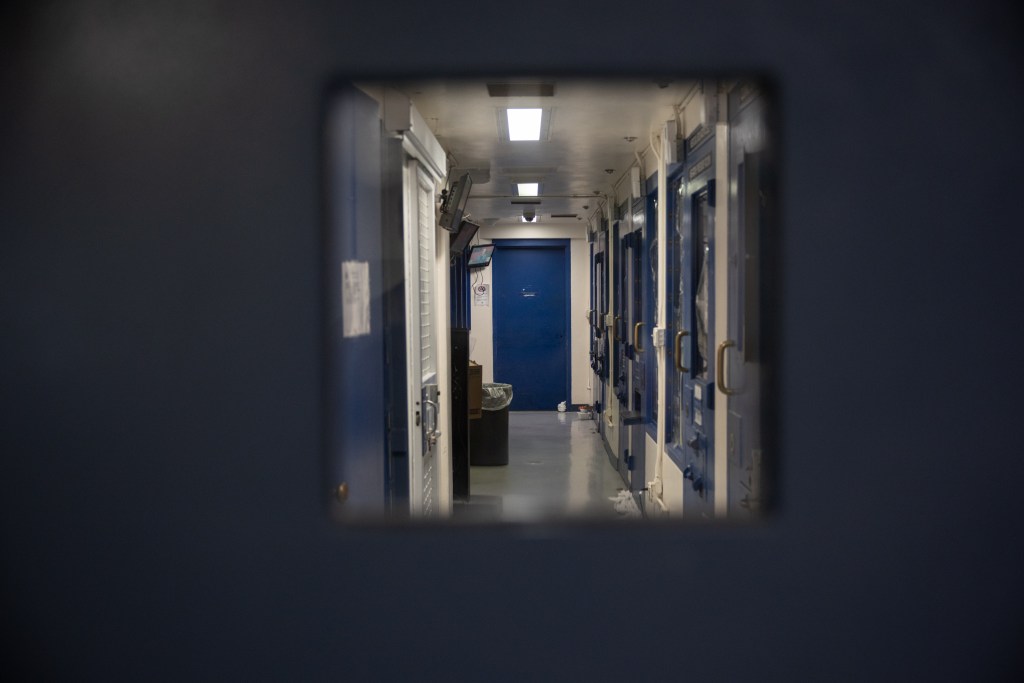
In January, I toured the Vista Detention Facility. It looked old, but not necessarily decrepit. Still, there were glaring issues.
I quickly noticed how cramped some of the areas were. The intake area, which is typically one of the busiest areas of any jail, was small and oddly configured. Our group of six — three journalists and three deputies — had to squeeze around doors and other staff members to look around.
Deputies confirmed that lack of space is a huge problem, often forcing them to use one area for multiple purposes. Holding cells, for example, have had to double as office spaces or body scan rooms, where deputies use an X-ray machine to scan inmates for drugs and contraband during intake. The deputies’ station, where there are about four deputies to one computer, also serves as the nurses’ station, they said. And some hallways have become dedicated spaces for storing laundry.
As we walked, I saw some water leaks spreading across the ceiling and a couple of areas where the ceiling tiles had completely fallen off. Deputies pointed out several broken intercoms, all of which “are so old they don’t even make parts for them anymore,” one deputy said. They’ve even tried eBay.
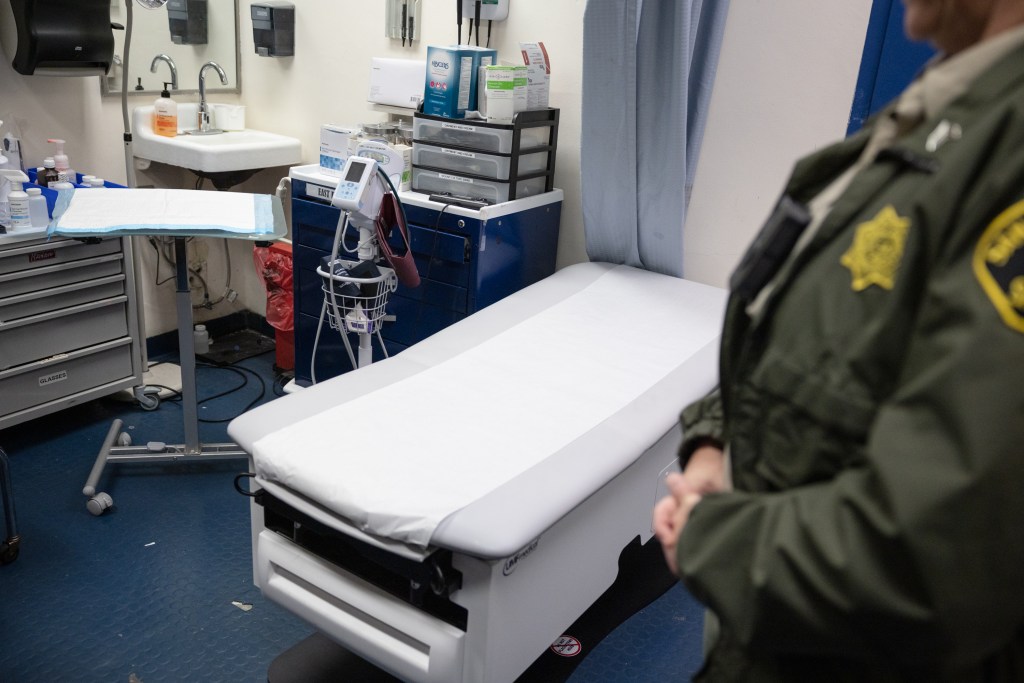
The deputies also told us about the jail’s faulty sewage systems, with pipes so old they have caused leaks into some of their offices. And they pointed out failing HVAC units and malfunctioning doors that have left some jail cells unusable.
There was clearly a consensus among the deputies: a new Vista jail is necessary and long overdue.
It’s the same message Sheriff Martinez, deputies and staff members from the Vista Detention Facility have been sharing at recent community forums where they maintain that the jail’s physical decay directly impacts the health and safety of inmates.
That small intake area doesn’t allow inmates the space or privacy to safely disclose their medical or mental health history when they arrive, Director of Nursing Cristina Clonts said during a June forum.
The jail’s medical observation area, where inmates who can’t live with the general population due to their medical needs stay, is often limited in space, she said. And pharmacy areas are also confined to small spaces, creating an environment that’s conducive to error, she added.
And often, medical staff and nurses have to visit inmates in their cells to conduct evaluations because of a lack of private areas, which again runs the risk of inmates not fully disclosing their medical or mental health concerns, Clonts said.

The Vista facility is also not ADA compliant, meaning it doesn’t meet federal accessibility standards for people with disabilities. If someone shows up to intake with a wheelchair, deputies have to transfer them to another detention facility. Moving people from one space to another can create greater health risks for anyone already medically or mentally struggling, Clonts said. Such a transfer can also move people further away from their community, family and support system.
It’s partly because of when the facility was designed, staff said. In the 70s and 80s, jails weren’t necessarily constructed with safety and privacy for inmates as a top priority. It was a “tough on crime” era where jail cells were built small, facilities were overcrowded and not many people were concerned with what happened to inmates once they went in.
One deputy offered protective custody as an example. When the facility first opened, hardly any inmates needed to be separated from the general population; today, protective custody populations account for a significantly larger portion of the jail system, which requires a lot more space.
Although in-custody deaths have trended downward across the system in recent years, Martinez insists replacing the Vista jail will help sustain that progress.
“I understand that a lot of times, the blame is pointed at deputies or staff, and we do look at that. We do audit performance and we do hold people accountable,” Martinez said. “But there’s also a real problem with the age of our facilities.”
Over the last 20 years, San Diego County has consistently held one of the highest in-custody death rates for any major metropolitan system in California, with most of those deaths occurring at San Diego Central Jail downtown and the Vista Detention Facility.
In 2022, the California State Auditor found that “deficiencies with how the sheriff’s department provides care for and protects incarcerated individuals likely contributed to in-custody deaths.”
In April of this year, a study contracted by the county’s Citizens’ Law Enforcement Review Board (CLERB) revealed that nearly 55 percent of deaths across the jails over the last 12 years had unnatural causes, including accidental overdoses, suicides and medical neglect.
Those findings have sparked widespread calls for operational reforms, stricter oversight of staff and increased accountability across the jail system. Physical upgrades, critics say, aren’t enough.
A New Jail Isn’t Enough

The scathing 2022 report on San Diego County’s jail system by the state auditor found that the Sheriff’s Office didn’t do enough to prevent deaths in its jails.
In fact, many jail deaths were caused by inadequate safety checks by deputies and failure to administer timely medical and mental healthcare to inmates when needed.
In the past two decades, there have been more than 250 in-custody deaths in the seven detention centers the Sheriff’s Office oversees, which is among the highest total deaths in the state. There were 19 in-custody deaths in 2022 alone, and 18 the year before.
Between 2011 and 2024, the Vista facility recorded a death rate of 4.5 per 1,000 “person-years,” which means that for every 1,000 individuals held in the facility every day for a full year, an average of 4.5 deaths occurred. San Diego Central Jail’s rate was nearly double, reaching 8.3 deaths per 1,000 person-years over that same period, according to the study commissioned by CLERB.
By comparison, the county’s five other detention facilities reported significantly lower death rates, ranging from 0.1 to 1.5 deaths per 1,000 person-years.
“The high rate of deaths in San Diego County’s jails compared to other counties raises concerns about underlying systemic issues with the Sheriff’s Department’s policies and practices,” the report said.
Most of those deaths resulted in lawsuits against the county, costing taxpayers more than $80 million in total settlements paid to families over the past decade.

Julia Yoo, an attorney who often works on jail death cases against the county, told Voice she has seen many deaths caused by medical neglect at the hands of the jails’ medical staff or panic calls from inmates that seem to have been completely ignored by deputies.
Yoo said she’s happy the jail and its technology will be modernized, but the underlying issues are systemic.
“You can have the most state-of-the-art facility, but if there’s no leadership or enforcement of policies or actual oversight over people who work in the jails, it’s meaningless,” she said.
She was referring to the Citizens’ Law Enforcement Review Board (CLERB), which is an independent oversight body that investigates citizen complaints and in-custody deaths involving the Sheriff’s Office but does not have direct mandating or disciplinary power over it.
Last year, the county Board of Supervisors gave CLERB new authority to investigate medical and mental health care providers involved in jail deaths, making San Diego the first county in the nation to extend such powers to its civilian oversight board, despite opposition from the Sheriff’s Office.
Yoo said she supports this and believes CLERB should have oversight authority over every employee working in the jails. She’s not the only one. Some inmate safety advocates believe CLERB should have mandating power over the Sheriff’s Office.
The Sheriff and her deputies disagree.
“We have so many different oversights in law enforcement and so many different groups—from the state, local and federal level—that all have some jurisdiction over what we do,” Martinez said. “So having one body to have the power to mandate, that could be very disruptive of other things that we’re doing.”
When it comes to the deputies who work in the jails, the overall feeling is that CLERB, which doesn’t have a single board member who has ever worked inside of a jail, doesn’t really get it.
Brett Kalina, executive officer for CLERB, said via email that board members are appointed by the Board of Supervisors and “have varied backgrounds, including the medical field, law enforcement and professors.”
“Civilian oversight is designed to invite the perspective of the civilians from which law enforcement agencies are duty-bound to serve,” Kalina said. “Board Members may not all have a law enforcement background, however, CLERB staff … have over 150 years of experience in the field.”
‘There Is Real Change’
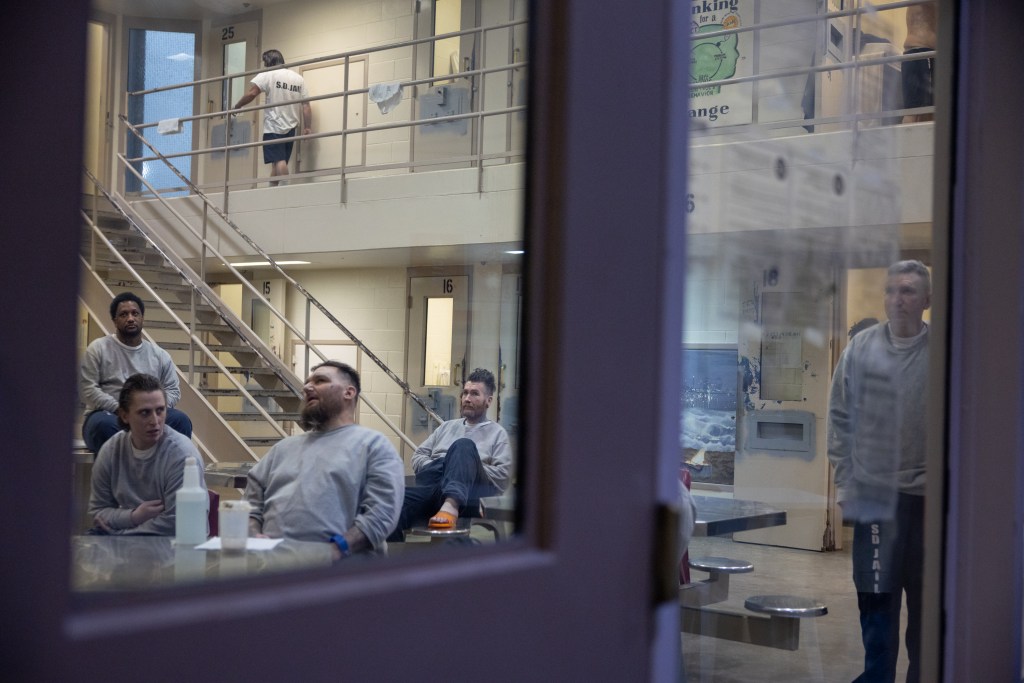
Over the past few years, in-custody deaths across all of the county’s jails have been trending downward.
Reaching 19 in 2022, the number dropped to 13 in 2023, nine in 2024 and 10 in 2025. So far, this year, there have been seven in-custody deaths — one overdose, one suicide, one natural death and four with causes pending, according to the Sheriff’s online database. None of this year’s deaths occurred at the Vista facility. The most recent death happened just this month when a 50-year-old man was pronounced dead in his cell at the San Diego Central Jail on Sept. 5. The cause is not yet known.
Martinez said the declining numbers are a direct result of the changes they’ve made throughout the entire jail system, primarily focused on early health interventions, expanded drug interdiction, upgraded technology and enhanced mental healthcare.
One of the most significant changes, Martinez said, was placing a medical physician at intake, so that every individual booked into custody is immediately evaluated by a physician. They’ve also moved to a primary care model, she said, where nurses are assigned to specific housing floors to provide continuity of care.
To prevent fatal overdoses, a major point of public criticism, the jails have expanded drug searches, added employee screenings and made naloxone more readily available across all facilities. Martinez said they’ve already seen significant decreases in overdose deaths.
The Sheriff’s Office is also working on restructuring how it handles mental health and behavioral care, Martinez said. They are currently recruiting for a newly created chief of psychiatry position, a mental health counterpart to the department’s existing chief medical officer.
There’s also an effort underway to obtain accreditation from the National Commission on Correctional Health Care (NCCHC), a nationally recognized body that evaluates correctional medical standards. Martinez said she expects the Las Colinas facility in Santee to achieve accreditation by January 2027.
Regarding new technology, the Sheriff’s Office fitted all detention staff with body-worn cameras in 2025 and is currently upgrading facility camera networks, glucose monitoring tools and other health tracking systems.
“It’s kind of impossible on our end to convince people who aren’t seeing what we’re doing day-to-day that there is real change,” Martinez said. “It’s fundamental and foundational. Our culture has changed. Everyone is trying a lot harder to prevent preventable deaths.”