

For a small city that often feels overlooked by its wealthier neighbors, National City suddenly is getting a lot of attention.
The city’s four-way mayor’s race has risen to the top of South County’s political agenda, attracting more outside money since the primary than any other mayoral race south of the city of San Diego and emerging as a bellwether.
Political heavyweights are getting involved. Business interests supporting City Councilmember Marcus Bush are squaring off against labor unions backing City Councilmember Jose Rodriguez. The amount of money flowing into the race already eclipses the total spent the last time National City elected a mayor in 2022.
Residents are taking notice.
“We’re in the spotlight,” said Maria Betancourt-Castañeda, a longtime city resident who is running for a seat on the Sweetwater Union High School District school board. “People are trying to see where we’re going to go and who’s going to take the reins.”
Reasons for the sudden prominence are complex and intertwined.
Democrats this year are determined to elect one of their own to a South County mayoral seat. For the past year, they have been boxed out of leadership in all three of the region’s cities, despite an overwhelming voter registration advantage.
Chula Vista, the county’s second-largest city, was a prime target. But it now appears out of reach.
Francisco Tamayo, the Democratic school district trustee challenging incumbent Republican Mayor John McCann, said in a recent interview with Voice of San Diego he has all but stopped fundraising for his campaign and faces a tough climb because “McCann is strong.”
“They seem to have shifted to National City,” Tamayo said of the county’s major labor unions, which typically provide the bulk of funding for Democratic political campaigns. “I don’t know if they’re going to do anything for Chula Vista.”
At the same time, the Imperial Beach mayoral contest has taken an unexpected turn that dims Democratic prospects.
Strategists had hoped the race would shape up as a two-way contest between incumbent Mitch McKay, a conservative-leaning independent, and City Councilmember Matthew Leyba-Gonzalez, a business officer for the San Diego County Building Trades Unions.
But a third candidate entered the race, Democrat Karl Bradley, a retired school construction manager who has been active in local politics.
Bradley said prominent Democrats pressed him to exit the race to clear a path for Leyba-Gonzalez. But he declined. With three candidates on the ballot, even union leaders concede there is a risk of splitting the Democratic vote and handing the race to McKay.
That leaves National City, where the recent retirement announcement of long-serving Mayor Ron Morrison, a conservative-leaning independent, has opened up a once-in-a-generation opportunity to determine the city’s political future.
“All eyes are on us,” Betancourt-Castañeda said.
The pivotal moment comes as the city faces an existential budget crisis. The city manager recently predicted that, if left unaddressed, the city’s current multimillion-dollar deficit could balloon and render the city insolvent in just a few years.
How the city resolves that crisis “is going to be a bellwether of sorts,” said Chris Cate, president and CEO of the San Diego Regional Chamber of Commerce, one of the outside interests putting money into the mayoral contest. Cate is a member of Voice’s Board of Directors.
“National City is a microcosm of what’s happening regionally,” Cate said. With other cities, including San Diego, facing their own budget challenges, National City’s decisions will signal “the direction [other] cities will be taking and how they approach various governing issues.”
The stakes are high.
The city currently is wrestling over whether to shore up its budget by sharply raising business license taxes. A proposed ballot measure would increase the total citywide amount the city collects from businesses each year from roughly $700,000 per year to $7.8 million.
The 10-fold increase would make the amount the city collects per business one of the highest in San Diego County, according to city figures.
At the same time, the City Council will have to reckon with rapidly rising personnel costs. A series of recent raises for city employees, intended to bring city salaries up to par with neighboring jurisdictions, has been a primary driver of spending growth.
In a recent interview with Voice, City Manager Doug Schulze said the city may have “to restructure [employee] contracts to reduce costs to the city.”
Schulze said city employees would get to “weigh in” on possible cuts. And he said, “Ideally, we end up in a situation where we don’t have to lay people off.”
No matter how the city proceeds, some interests will benefit. Others will not.
Everyone, including some of San Diego County’s highest profile political players, is seeking to influence the outcome.
Dan Rottenstreich, one of the county’s leading Democratic political consultants, is serving as campaign manager for Democratic City Councilmember Rodriguez, one of the four mayoral candidates.
The other candidates are Bush, a Democrat; former City Treasurer Mitchel Beauchamp, who declined to share his political affiliation; and teacher and grassroots organizer Jacobb Castrejon, also a Democrat. Interest groups have focused their attention on Bush and Rodriguez, who have higher name recognition and a clearer path to winning the race.
Last month, Rottenstreich’s wife, Brigette Browning, president of the San Diego and Imperial Counties Labor Council, signed paperwork establishing an independent expenditure committee that is poised to spend tens of thousands of dollars supporting Rodriguez and two allied city council candidates.
The San Diego Regional Chamber of Commerce last month formed its own independent expenditure committee that also plans to spend tens of thousands supporting Bush and two council candidates allied with him.
Auto dealers, whose business license taxes would rise sharply if the city adopts the new business tax policy, already have contributed $26,000 to the Chamber committee, alongside $5,000 from the Chamber itself.
The Labor Council, one of San Diego County’s most influential labor organizations, put $80,000 into its own committee and has begun paying for campaign materials supporting Rodriguez and his allies.
Other labor unions, including the union representing most National City employees, have contributed thousands to Rodriguez directly.
In total so far, Rodriguez has received more than $40,000 from donors in National City, throughout San Diego County and as far away as Washington, D.C.
Bush has collected roughly $22,000 from supporters inside and outside of National City, including several auto dealers and real estate interests.
The total amount of money in the race, with a crucial month left to go before Election Day, is heading toward $200,000 – more than six times the amount an average National City resident earns in a year.
The candidates are pitching their campaigns in idealistic terms.
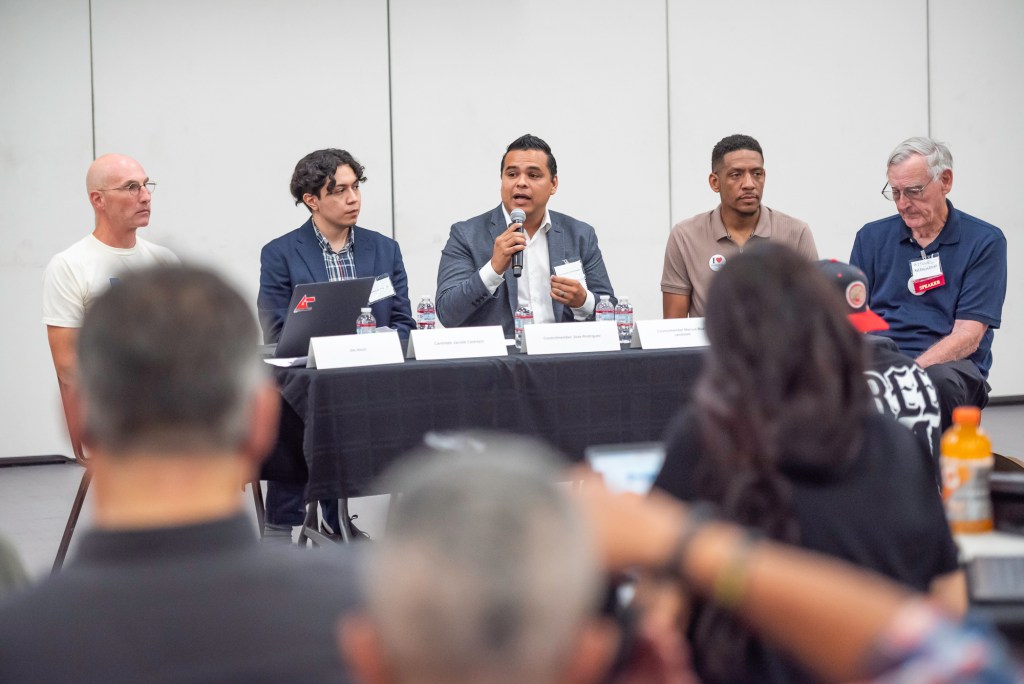
At a candidates’ forum Thursday hosted by the League of Women Voters, all four candidates pledged to clean up city streets, solve the budget crisis, help families affected by immigration enforcement and make housing more affordable.
Bush stressed his local roots, reminding voters he and two allies running for City Council graduated from National City’s Sweetwater High School and share a lifelong love of their hometown.
“National City strong!” he said, echoing his campaign slogan.
Rodriguez highlighted his efforts to cap mobile home rents and proclaimed his strong commitment to labor unions.
“I’m humbled to be in this position,” he said. “We are all passionate about our community.”
Paul Wapnowski, an English teacher at Sweetwater High School who posts video commentaries on city politics, said he was unmoved by the candidates’ gauzy statements.
A dedicated critic of Rodriguez, Wapnowski said National City is at the epicenter of a battle for control between powerful interests, in particular labor unions with a large stake in how cities spend taxpayer dollars.
“This isn’t the benevolent leaders of labor power trying to do the right thing for workers,” Wapnowski said of the dual involvement of Rottenstreich and Browning in the mayoral race. “This is about…control.”
State law forbids political candidates and their campaign staff from coordinating with independent expenditure committees spending money on the candidate’s behalf. Wapnowski said it strains credulity to believe Rottenstreich and Browning, who live together in Chula Vista, never discuss their political work at home.
Wapnowski said National City residents took notice when another powerful labor union recently tried to make numerous union-friendly changes to the city charter in neighboring Chula Vista.
That effort failed in the face of opposition from city residents.
Depending on how National City’s mayoral race turns out, Wapnowski said, “I think you can see similar stuff starts to happen [here].”
Rodriguez, Rottenstreich and Browning all denied they are seeking to engineer a union-led takeover of National City. They said there is nothing improper about the way they are approaching the mayoral race.
“Dan [Rottenstreich] has been my consultant for three [election] cycles and someone I trust and does a very good job as a consultant,” Rodriguez said. “Brigette [Browning] is the head of the Labor Council, and she has a very long track record of fighting for working families and I’m glad she does that regionally.”
Browning said she and fellow union members support Rodriguez not in a bid for control but because Rodriguez has been a longtime backer of worker-friendly policies, including tenant protections for renters and economic development projects.
One in four National City residents belongs to a union, Browning said, a higher percentage than in any other San Diego County city.
“Jose [has] consistently stood up for our folks,” she said. “Dan and I have never even spoken about this race. It’s often that we align on races and are supporting the same candidates. But that’s because he supports good electeds who support workers like I do. There’s no controversy about it.”
Asked whether he and Browning discuss their political work at home, Rottenstreich, who also is managing a local congressional campaign and several ballot measures in and outside of San Diego County, said, “I’m so busy, I don’t even go to the dinner table right now.”
Rodriguez said the real effort to control city politics is being waged by the business interests backing Bush and his allies.
“They’ve strayed from working families’ values,” Rodriguez said.
Bush denied that contributions from local businesses influence his decision-making.
Rodriguez, he said, was simply demonizing businesses to score political points.
“I don’t agree with him excluding people and accusing them of being out of town,” Bush said.
At the Thursday candidates’ forum, National City resident Drusila Lomeli said she doesn’t pay much attention to candidates’ political machinations. She just hopes someone can make life more affordable for modest-income families like hers.
A graduate of Sweetwater High School, Lomeli, 47, said National City is her heart’s home. “When I’m here, I feel my soul is at ease,” she said.
And yet, she said, despite living and working in the city for most of her life, she can’t afford to buy a house. She said she fears the city is slipping out of her financial reach.
“If you go on the [real estate website] Zillow, it will make you cry,” she said.
The political battling of election season, she said, “becomes too much.” She said her needs are simpler.
“I hope it would become a little less gentrified,” she said of National City. “I want to buy a home.”