
Last month, a prominent San Diego County labor union launched an ambitious effort to re-engineer Chula Vista’s elected government.
Representatives of Local 89 of the Laborers International Union of North America drafted a 30-page-plus initiative for the November ballot that, if adopted by voters, would have made major changes to how city leaders are paid, elected and do their jobs.
The initiative included a 70-percent salary increase for the city’s part-time city councilmembers, a smaller raise for the full-time mayor, an additional third term in office for elected officials and changes to contract bargaining rules that stood to benefit some of the city’s public employee unions.
After factoring in pension and benefit costs, the councilmembers’ salary increase was even larger than an initial estimate by city staff.
The proposal was arguably the most significant change to Chula Vista’s government in at least a generation.
It represented a striking bid for influence by a labor union that has spent millions in recent years to become a major player in San Diego County politics.
To meet an Aug. 7 filing deadline, the union had just six weeks to muscle the proposal through the city’s public approval process.
Addressing the City Council on June 16 shortly after submitting the measure for approval, Kelvin Barrios, LIUNA’s director of government affairs, said the initiative’s intent was to modernize Chula Vista’s government and make it easier for people from all economic backgrounds to hold elected office.
“These reforms would increase transparency…strengthen accountability [and] create additional opportunities for public engagement,” Barrios said.
There was just one obstacle.
Chula Vista voters.
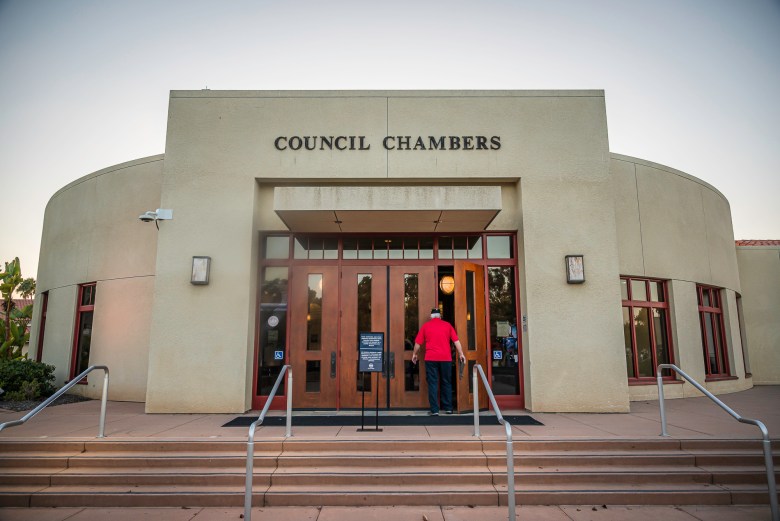
Earlier this week, just one month after Barrios addressed the City Council, a restive cross-section of city residents packed the Council’s wood-paneled chambers to voice their fury at what they characterized as a naked attempt by a deep-pocketed interest group to take over their city.
Hooting, clapping and brandishing signs with images of the city’s four Democratic city councilmembers dressed as red-nosed clowns, residents said they weren’t buying the rhetoric about transparency and accountability.
“You are opening yourselves to the charge you are servants of the union, not servants of the people,” said Planning Commission Vice Chair Jerome Torres in an address to councilmembers.
“This union proposal is bad policy. It’s bad politics. It sets a dangerous precedent,” Torres said. “Why inflict this…disrepute on our city?”
“We are watching you,” more than one speaker warned.
Councilmembers heard the message.
Just a week earlier, several of the Council’s Democratic members had expressed interest in key parts of the ballot initiative and sloughed off efforts by Republican Mayor John McCann to halt it.
On Tuesday, they practically competed to see who could kill it first.
Residents erupted in cheers when Councilmember Michael Inzunza announced his opposition and proposed referring the measure to the city’s Charter Review Commission for further review.
“I’m against anything going on the ballot,” said Inzunza. “I want the public and the [city’s] Board of Ethics to weigh in.”
The Council voted 4-1 in favor of Inzunza’s proposal, with only Councilmember Cesar Fernandez opposed. Fernandez said he didn’t want to short-circuit further opportunities for public input.
Councilmembers also voted 4-1 for a proposal by Mayor McCann to strip out all mentions of the salary increase and other compensation-related changes before sending the initiative to the charter commission.
“The desire to help the city thrive should be driven by service to the community, not by a larger paycheck,” McCann said.
Until Tuesday, LIUNA had enjoyed a run of success in Chula Vista.
Over the last two election cycles, the union spent more than $200,000 backing all four Democratic members of the five-member City Council, along with City Attorney Marco Verdugo.
The union also spent more than $100,000 this year backing the successful primary campaign of Chula Vista Elementary School District Trustee Francisco Tamayo, who in November will face McCann in a general election contest for Chula Vista Mayor.
In a statement following Tuesday’s Council meeting, Barrios conceded defeat. But he said the union intended to try again.
“Though we did request that the Council move a measure forward to the ballot this year, we welcome the additional review by the Charter [Review] Commission,” he said. “We look forward to these transparency measures moving forward in the near future and encourage the commission to look at increasing voter participation by proposing moving the mayoral election to the presidential year.”
Residents on Tuesday made the reasons for their opposition clear.
The problem, they said, was not necessarily the ballot measure’s proposals.
Several speakers on Tuesday expressed support for beefed up lobbying and ethics rules.
Others said more time in office or turning City Council service into a full-time job could help improve the quality of city leadership.
What voters objected to were many of the same things opponents of a strikingly similar union-backed overhaul of San Diego County government have criticized this year.
Simply put, they felt the measure was too much, too fast, too underhanded, too self-serving and too divorced from voters’ actual priorities.
“It feels as though you’re trying to push this significant change under the radar,” resident Sandy Chavez said to councilmembers. “How can anyone justify such an enormous pay raise, especially at these times?…The people you represent are struggling. Many do not earn in a year what you earn in a part-time position.”
Residents noted the ballot measure kept changing every time councilmembers discussed it, creating the impression a massive government overhaul was being assembled on the fly.
They asked why the measure, which proposed 13 changes to the city’s governing charter, had not been submitted first to the city’s Charter Review Commission, a customary initial step in government reform efforts.
They were angry that neither city leaders nor the union had made efforts to alert or consult them.
Chula Vista historically has been a working-class city.
Nevertheless, many residents expressed deep skepticism about the motives of LIUNA, which they seemed to regard as a not wholly trustworthy powerbroker.
“We’re seeing the results of the union cartel come to town,” said longtime resident Rosie Vasquez in an interview shortly before Tuesday’s meeting. “This Council has been hand-picked to do what’s happening tonight.”
The Council’s four Democrats appeared caught off guard by McCann’s ability to rally opposition.
Last week, when the ballot measure first appeared for public discussion on the City Council’s agenda, McCann came prepared with a speech criticizing it.
“We have for decades had good government in Chula Vista,” McCann said. “We work together and work with the community and listen to the community. I’m very concerned when you look at this item. It has 13 charter amendments on one item.”
McCann methodically forced his Democratic colleagues to take a stand by making a series of motions to slow down the ballot measure’s progress and solicit more public feedback.
Councilmembers declined to back the motions.
Just a handful of residents were present for the July 14 meeting. Most said they hadn’t heard of the measure until that evening.
Days later, McCann went before TV news cameras and denounced the measure. He rallied allies and held a press conference Tuesday morning.
Word spread, opponents mobilized and by Tuesday night, just one week after councilmembers appeared on track to move the ballot measure forward, an angry crowd assembled at City Hall.
McCann made the most of the moment.
In opening remarks, he dropped a bombshell, accusing an unnamed LIUNA representative of trying to buy his support by promising not to oppose McCann’s re-election bid if he let the measure through.
The audience gasped.
Barrios, the union representative McCann referred to, vehemently denied McCann’s accusation in an interview following the meeting.
“In no way was I trying to tie consideration of [the ballot measure] to political spending,” Barrios said.
McCann doubled down with a follow-up statement Wednesday.
“My focus will always be on transparency, fiscal responsibility and protecting taxpayer dollars,” he said. “Throughout this process, I was committed to telling the community the truth about this proposed money grab and ensuring residents understood its impact.”
On Wednesday, John Moot, a local attorney and former Chula Vista City Councilmember, sent a letter to the mayor and city councilmembers asking them to request an investigation by the city’s Board of Ethics into how the ballot measure was drafted and rushed through the city’s approval process.
“What is particularly offensive about what occurred is that it had all the indicia of a bribe being offered in plain sight,” Moot wrote.
McCann’s claim of a quid pro quo seemed to crystalize voters’ feeling that their elected leaders were ignoring them.
Even the head of one of the city’s main public employee unions, which arguably stood to benefit from some of the measure’s proposals, took to the speaker’s podium to lambaste the Council.
City leaders recently told employees they did not plan to match salaries paid by other public agencies, Maida Estrada, president of the Association of Chula Vista Employees, said.
“Now you’re asking for raises for yourselves?”
Shortly after, Inzunza made his motion and the ballot measure was dead.
Note to Readers: I’ll be away next week attending a journalism workshop in New York, so there will be no South County Report.
The workshop is focused on municipal finance issues. I’m hoping to return with new skills that will help me shed more light on the finances of South County’s government agencies.
Have a great week, South County!
Excellent reporting on a highly complex situation.
Jim thank you for shedding light on the ongoing effort of special interest to shut out Chula Vista voters in their attempt to put their self serving interests ahead of the public good. They have done the same in the Sweetwater School District and the Chula Vista Elementary School district and seek to do the same in the city of Chula Vista and beyond.
I’m sorry Lisa, this is not a highly complex situation. This is a naked power grab by big money unelected public sector unions. People power.