
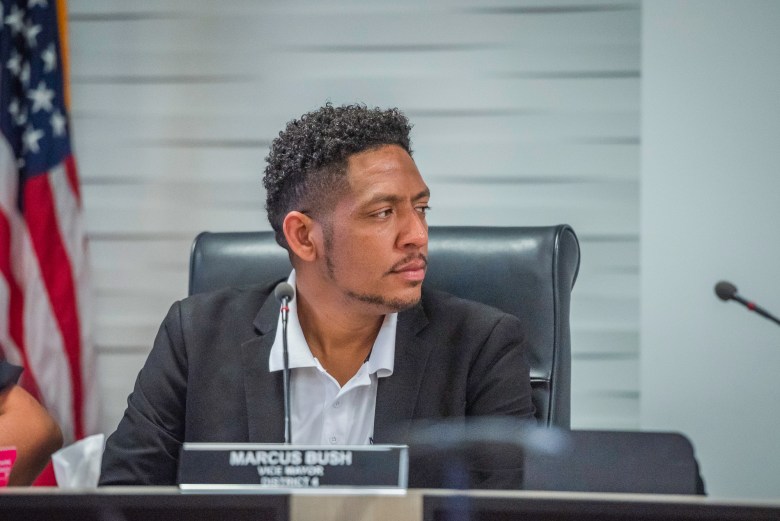
As election day nears, attacks have gotten even more personal in the race for mayor of National City. Councilmember Jose Rodriguez recently called out his opponent fellow Councilmember Marcus Bush for financial struggles – from a home foreclosure to unpaid traffic tickets.
Rodriquez even accused Bush of lining his pockets when it came to $4,015 in travel costs National City paid to send Bush to a conference, as part of his role on the governing board of the Metropolitan Transportation System. Documents show MTS reimbursed Bush — but he did not pay the money back to National City. Bush has paid $500 of the money back and said he plans to fully pay back the rest.
Rodriguez also slammed Bush for failing to pay a traffic ticket in Chula Vista and for having his home foreclosed upon after falling $17,000 behind on his mortgage.
“It’s deeply hypocritical for someone to run on transparency and accountability and then to line his pockets with public money,” Rodriguez said.
For his part, Bush characterized his financial struggles as part of what makes him the right candidate for the job. His “lived experience,” as he put it, is representative of the financial struggles many working people face.
“Getting away from the shame of financial struggle, it’s real,” Bush said.
Water Rates Will Increase for People Who Conserve
On Tuesday, the San Diego City Council voted to have all San Diegans pay the same flat water rate – regardless of how much water a person uses. The vote overturns the previous tiered system, in which people who used more also paid a higher rate.
The Council made the move because a court decision in 2025 forced the city to scrap the tiered water rate. The decision found the city had not adequately justified its tiered water rates, based on the actual cost of providing service.
City officials confirmed at the meeting that the cost of water will go up for families who were in the lower tiers of water usage.
Several councilmembers made it clear they didn’t like what they were voting on, but supported the new flat rate anyway, since a court was forcing their hand.
Councilmember Kent Lee – who voted against the item – said while he understands the limitations under state law, he thinks the city needs to do more to explore cost-effective options for residents.
“We just did so for trash. So to suggest that we cannot at least explore the opportunities for water would certainly be a disservice to our residents,” said Lee at meeting.
The new water rates passed 6 to 3, with councilmembers Henry Foster and Lee voting no, and Marni von Wilpert absent.
Until Now, Data Centers Were Easy to Build in San Diego
The San Diego City Council unanimously passed a temporary ban on data centers Tuesday. The ban is for 45 days, but can be extended for up to 20 months.
Before Tuesday, it was relatively easy to build one. (There are already a handful of small data centers within city limits.) Under the current city rules, a data center developer would need to get a “conditional-use permit” under laws governing “major transmission, relay and communication switching systems.” That means the developer would need at least some permission from the city and perhaps a public hearing.
But no city law actually classifies what a data center is or how it should be regulated, according to a city staff report. “Hyperscale” data centers, like the 400-megawatt one being explored on Navy land near downtown, need a ton of energy to run, and can guzzle a lot of water to cool the computer servers processing information inside.
Now the city has time to make its own rules – though those rules will have virtually no power over data centers on federal land, like the one being considered at NAVWAR. Even still, it’s clear councilmembers are determined to try to stop that project.
Councilmember Sean Elo-Rivera added language to the City Council’s motion that directs city lobbyists to immediately begin calling on Congress to prevent a data center from being built at NAVWAR. Council President Joe LaCava said he’d be looking into leverage the city may have over the data center via its franchise agreement with the energy grid builder, San Diego Gas and Electric.
“Federal ownership does not mean San Diegans should be shut out of decisions that will shape our city for generations,” said Councilmember Stephen Whitburn.
County Appoints Second Interim Behavioral Health Director in Two Months
The county announced Tuesday that its homeless services director will temporarily lead the county’s Behavioral Health Services Department when the current interim director retires this week.
In late August, Chief Administrative Officer Ebony Shelton fired then-director Nadia Privara at the same time the county released misconduct records following a Voice of San Diego lawsuit. The county assigned longtime Health and Human Services Agency executive Jennifer Bransford-Koons, whose last day at the county is Oct. 29, to serve as the department’s interim leader.
On Oct. 30, 25-year county veteran Dijana Beck will take over as the new interim director and Brigit Cooper, another longtime Health and Human Services Agency official, will temporarily lead the Office of Homeless Solutions.
The longer-term plan: County spokesperson Tammy Glenn wrote that the county will conduct a national search for a permanent director and “coordinate with stakeholders” along the way.
In Other News
- Six months after White supremacists murdered three at Clairemont’s Islamic Center, the San Diego Police Department placed the mosque on lockdown on Tuesday afternoon. The lockdown was ordered “out of an abundance of caution,” according to SDPD officials. The lockdown was lifted by early evening. (KPBS)
- After San Diego’s long-time lifeguard chief abruptly left his job, city records obtained by NBC 7 San Diego reveal that investigators found he and two lifeguard sergeants mishandled a sexual harassment complaint. (NBC 7 San Diego)
- A Guatemalan man died in ICE custody at the Otay Mesa detention center over the weekend. His death is the 30th in-custody death this year and the 63rd since the start of Trump’s second term. (inewsource)
- ICE identified the man who died Saturday as 43-year-old Roberto Jimenez Gutierrez from Guatemala. (CBS 8 San Diego)
- Former Poway City Councilman Tony Blain who faces criminal charges for alleged perjury and solicited bribes was recently denied access to a mental health diversion program which could have resulted in his criminal case’s dismissal. (NBC 7 San Diego)
- Bonus: Our North County reporter Tigist Layne wrote about Tony Blain’s rise and fall on Poway City Council last year.
- San Diego Pride is having a rough time. The nonprofit faces mounting financial problems, is set to do layoffs and just lost its 7th leader since 2023. (Union-Tribune)
- A company called Global Coin Logistics is suing the DEA in San Diego and CBP in Miami federal court, alleging the agencies seized $1.4 million from him and his company without ever giving legal reasons or facts for the forfeiture. (Union-Tribune)
- A letter from the Department of Justice ordered the San Diego County Registrar of Voters to hand over the private information of thousands of voters and set aside their ballots until their citizenship is verified, or face consequences from the federal government. (inewsource)
The Morning Report was written by Jakob McWhinney, MacKenzie Elmer, Mariana Martínez Barba and Lisa Halverstadt. It was edited by Will Huntsberry.