


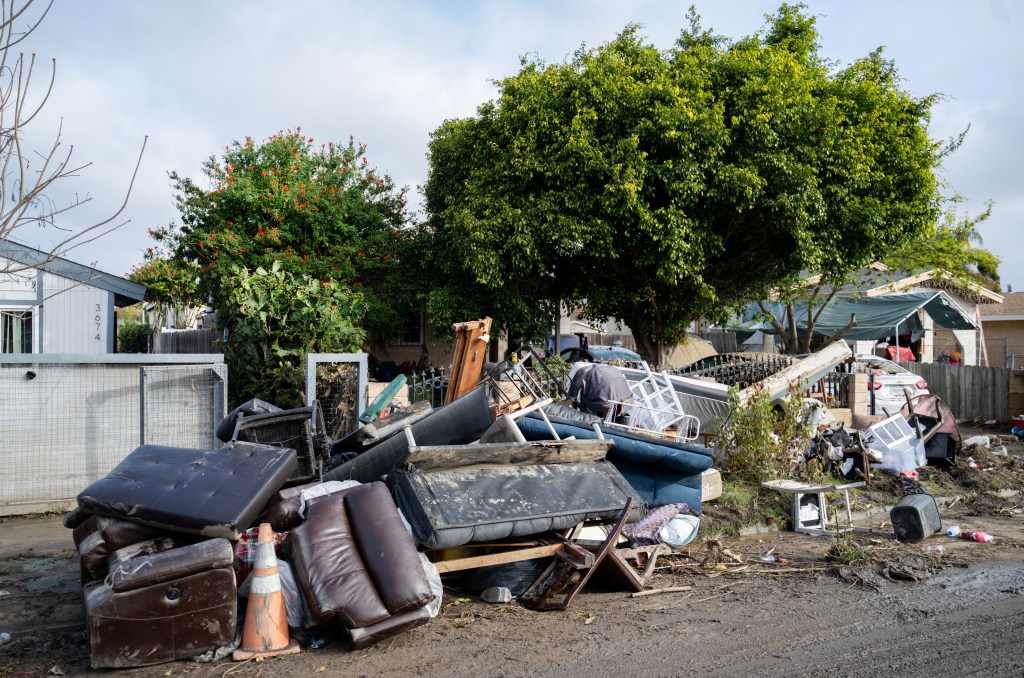
Even if the city of San Diego regularly cleaned urban creeks, last Monday’s historic rain still would have flooded parts of southeastern San Diego. But, a good dredging of the sand, trash and trees clogging up Chollas Creek could have minimized the devastation.
Residents in the Shelltown neighborhood along Beta Street were quick to blame the city for failing to keep the channel clean before an atmospheric river hit. Many count the clogged channel as another example of neglect these residents feel by their city government.
But the city can’t just dredge or deep clean a channel when it wants to, at least, that’s what Kris McFadden, San Diego’s deputy chief operating officer, explained during a press conference last week in response to angry residents whose homes were swallowed by the Chollas Creek topping its banks.
That’s because the city’s channels and creeks, even if lined with concrete, are considered wetlands and protected and regulated by several state and federal agencies, McFadden said.
“Every time we (clean) a storm drain channel it takes years to prepare. … The regulatory process to get those permits can be arduous,” McFadden said.
That’s not entirely the case. David Gibson, executive officer of San Diego Regional Water Quality Control Board, told me the city has had clearance from his agency to do routine channel maintenance work in preparation for storms like these since 2021. The city can dredge a channel, cut down trees, or tear out exotic or invasive vegetation without additional permits under this authorization.
“We made it easy for the city to be as flexible as possible,” Gibson said.
That means, the city could go out and do preventative clearing in Chollas Creek if it wants to.
The city disagrees. Craig Gustafson, a spokesperson for the stormwater department, said that’s not the only agency it needs permission to do channel clearing. The U.S. Army Corps of Engineers, the U.S. Fish and Wildlife Service, and even the California Coastal Commission play a role in what happens to these wetlands.
The city cited the recent emergency declaration made by Gov. Gavin Newsom in San Diego County as permission to enter Chollas Creek on Friday and tear trees away from the South 38th Street bridge in preparation for more storms this week.
“It’s a balancing act,” said Todd Snyder, director of the city of San Diego stormwater department. “This is a natural creek and so it provides a lot of critical habitats. That’s why those regulations exist. But it’s also a flood control channel, and so it provides critical (protection) for the surrounding homes and businesses. … How do you manage both of those at the same time?”
Still, two things remain true that no regulating agency can easily change with policy: Creek channels like Chollas and others weren’t built to hold intensifying rains from human-caused climate change. And the stormwater department is so vastly underfunded it can’t function fast enough.
“Even if they’re (authorized) to clean (Chollas Creek) out, it doesn’t mean they have the money,” Gibson said.
The stormwater department is already extremely behind on critical work to the city’s undersized and aging stormwater infrastructure. The department has run up an over $1.6 billion budget deficit. That’s largely because the department hasn’t been able to charge citizens more for increasing stormwater needs since 1996, when Californians passed a law that requires voter approval of almost any new local tax or fee.
Another atmospheric river – a band of tropical moisture – will make landfall on Thursday bringing up to two inches over the Chollas Creek watershed again, according to the National Weather Service.
Correction: This story has been updated to correct the name of the U.S. Fish and Wildlife Service.
Around the Environment
- Imperial Beach Mayor Paloma Aguirre says she’s in Washington D.C. to advocate for $310 million in emergency extra funding to help fix a broken wastewater treatment plant at the U.S.-Mexico border.
- Sacramento Report is back with Deborah Brennan, an esteemed journalist in the San Diego area. She’ll be covering all things critical to San Diego at the capitol. Her latest reviews the $53.9 million legislators announced for the troubled coastal rail line as a landslide from last week’s rains closed the tracks yet again.
- In other coastal cliff news, our Tigist Layne wrote a profile of this Del Mar councilman, the lone opponent of an idea to burrow beneath the city for a rail line that’s currently falling off coastal cliffs.
- MTS increased frequency of the 215 so-called Rapid bus line. (RideSD)
- I wrote about a how a San Diego spearfisherman saved his block from the flood that ravaged his neighborhood. (Voice of San Diego)
- And, took a crack at explaining the science behind atmospheric rivers – yes, they are more than just storms. (Voice of San Diego)
- San Diego’s biggest public power company was able to undercut San Diego Gas and Electric’s electric rates this winter, but the summer story is bleak at the moment. (Voice of San Diego)
- Sweetwater Authority which manages drinking water for South Bay communities wants to get into the energy business by floating solar on a reservoir. (Voice of San Diego)
- Los Angeles Times columnist Michael Hiltzik wrote about a controversial California company, with ties to a law firm central to the San Diego County Water Authority’s business, that’s under new direction.
Thank you for this story, for exposing that the City had permission to clear these channels and certainly storm drains since May of 2021. There is a big difference between “COULDN’T” and “WOULDN’T.” We need a Mayor and City Council who WILL get the job done to protect the people of San Diego and their homes.
Granted, the weather was extreme, but damage could have been minimized by stormwater infrastructure repair and maintenance, which has been neglected for years, including during the current administration.
Residents don’t need excuses! They need and deserve government officials who will prioritize ESSENTIAL INFRASTRUCTURE over bike lanes, purchasing 101 Ash Street, becoming a temporary World Design Capital, and miles of cosmetic slurry coating during an election year, etc.
This is total BS, it’s a concrete flood control channel designed and built to prevent the very catastrophe just experienced. Theses channels should be cleared and cleaned of all growth and debris on a regular basis.
It’s easier to ask for forgiveness than to ask for permission in a case like this when dealing with the Army Corps. Chollas Creek has been an issue for 65 years. And who was the fool that said a concrete lined drainage ditch was a “wetlands” should be fired instantly. One thing San Diego lacks is proactive leadership.
“Imperial Beach Mayor Paloma Aguirre *says* she’s in Washington D.C. to advocate for….” [emphasis added]
this wording implies disbelief in Aguirre’s statement.
Who says the storm system is undersize? Undersized for a 200-year storm maybe but California plans and builds for 100-year storm events. How many developments and homes would never have been built under a 200 year standard? Finally your word “minimize” when describing channel clearing is pure speculation designed to pull at the heartstrings of people hurt by Mother Nature.
I have been trying for more than two years to get the necessary permits from the Regional Water Quality Control Board to clear channels just like these in Chula Vista. The vegetation proposed to be cleared has grown on top of silt on concrete pads. The Army Corps of Engineers declined to take jurisdiction, however, the RWQCB has rejected our applications again and again, telling us to go back to the Army Corps of Engineers.
A neighbor recently, made a poignant observation that the city has plenty of money to build bike lanes that hardly anyone uses, but claims no money to clean flood channels. The state has some sizable funds to encourage the construction of bike lanes, but it appears few programs to help maintain infrastructure like the flood channels. The state could rectify this by broadening the uses of the CA Strategic Growth Council’s Cap and Trade program that generates billions in funding to lower greenhouse gas emissions. These funds are what cities and counties use to build the many of these bike lanes. When I was in graduate school in urban planning 30 years ago, the big issue was the lack of public investment in maintaining infrastructure. Sadly, not much has changed.
Many of the worst flooded areas along Chollas Creek are within a 100 year flood plain and should have never been permitted. Yes, it’s unfortunate that the City has dropped the ball on clearing and dredging, but data shows that these areas will flood. Yes a lot of stormwater infrastructure is undersized in often neglected SE San Diego, the damage all along the Orange Line Trolley tracks is evidence of that.
Yes the city has decided to kick the can on responsibility and avoid any repercussion of negligence from being proactive. I’m surprized there isn’t a lawsuit.
The complaint by the City is that it takes a long time to get permission. Look at the size of those trees – ten or fifteen years old, at least. Even if it takes time, it’s clear that no one even tried to get permission. And, with a stroke of the governor’s emergency pen, all of the state and federal agencies step aside and let the city do what they want to clear the channels? What is the point of all of the bureaucratic roadblocks? To maximize the damage to the citizens? This whole episode needs an independent commission to get rid of all the overlapping regulations and streamline the ability of cities to maintain their infrastructure. If nothing else, the various regulators should be forced to agree on a maintenance schedule, so cities don’t have to jump through hoops to do what should be a regular task.