
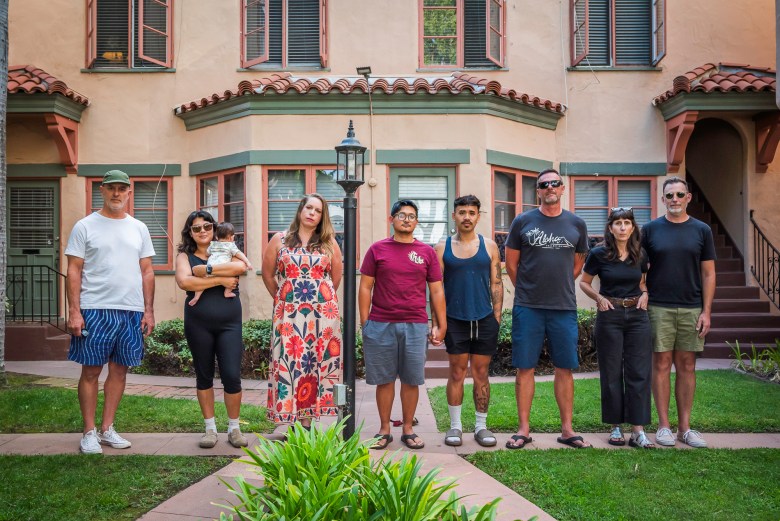
For half a decade at least, tenants at the Bankers Hill apartment complex La Suzanna paid a flat rate for utilities: $60 a month. Then, late last year, it all changed.
The property manager had partnered with a third-party company to institute a new type of utility billing, called ratio utility billing system, or RUBS. Many apartment complexes are charged for utilities on the property as a whole, rather than by what each unit uses. RUBS is supposed to allow landlords to charge per unit, based on factors like how many people live there.
Tenants immediately saw huge spikes in their bills, which in some cases neared $300.
“It was a shock,” said resident Michael Parker.
The tenants’ landlords said the old utility costs were outdated. Water and sewage rates have increased significantly in recent years; this new formula was put in place to recoup costs, they said.
The residents wanted to see the receipts — and thanks to a recent city law they were entitled to them. Ultimately, they organized and formed a tenants council. After initially refusing to pay the new bills, they negotiated with the landlords and ultimately secured a $100 cap on their utility bills.
‘Let ‘em Take Out San Diego’
On Wednesday night at a campaign stop in Nebraska, President Donald Trump dropped a rhetorical bomb about literal bombs. He seemed to suggest that Iran should “take out San Diego.”
“They can take out a city. Let ’em take out Los Angeles, let ’em take out San Diego. This is a very small price to pay,” Trump said during the rally.
But it’s not clear that’s what he actually meant — thought it was hard to tell from his trademark garbled ramblings.
In the longer version of the quote, Trump seems to actually be saying that high gas prices aren’t that high a price to pay for war — compared to how bad it would be if cities like San Diego were attacked. Trumpian grammar can make it nearly impossible to understand precise meaning.
The quote ricocheted across the internet, eliciting furious responses from practically every elected official representing San Diego County, including Supervisor Jim Desmond, who was endorsed by Trump in the race for the 48th Congressional District. Desmond’s response made clear, though, that he hadn’t gotten the memo about the real meaning of Trump’s comments: “No American city is expendable, and no American family should ever be treated as collateral damage,” he wrote in a post on X.
Beyond the dispute about Trump’s meaning, the darkest reality of all was the crowd’s response. The crowd in Nebraska seemed to cheer in approval at the prospect that Iran would “take out” California’s two largest cities.
Councilmember Reiterates Dissatisfaction with Mayor
Councilmember Henry Foster says Mayor Todd Gloria needs to rethink his priorities.
Late last week, multiple sources confirmed to Voice of San Diego that Gloria described Foster’s downfall as his No 1. political priority. Foster has been vocally critical of the mayor on multiple occasions.
At this year’s Politifest 2026, Foster called out the mayor for making political grievances his highest priority. It is “the greatest disservice I think I have ever seen,” he said.
Foster also told us he would consider introducing a measure to reduce the mayor’s power if he doesn’t see any changes to how the mayor runs the city, like hiring a chief operating officer.
Foster’s predecessor, County Supervisor Monica Montgomery Steppe also came to the Councilmember’s defense and called out the mayor for his leadership – or lack thereof.
“You could govern, Mayor. But you won’t. Because your petty and your politics have always merged together. Now, it’s just on display for all to see,” she wrote on Facebook. “The petty is FINALLY public.”
Southeastern Council Candidates At Odds on Flock
Foster and newcomer Martha Abraham have different ideas on the city’s network of Flock surveillance cameras.
The $2 million the city spends on Flock became one of the biggest flashpoints in the city’s tense budget negotiations. Ultimately, the City Council voted to continue the contract this year. Foster has made clear he wants to get rid of them.
Abraham on the other hand, isn’t ready to go that far. In a post on Instagram, she called for an independent audit into who has had access to the technology.
“Some neighbors have had their cars recovered because of these cameras. Others are worried about who can see their data and where it goes. Both are legitimate concerns. Our communities deserve accountability, transparency, and real solutions,” she wrote in a statement on Instagram.
County Supervisors Advance Public Records Policy Update
County supervisors unanimously voted Tuesday to direct county staff to explore options to extend the county’s retention policy for emails, text messages and other documents to five years.
Supervisor Joel Anderson proposed the extension in the wake of a Voice of San Diego story revealing that the county automatically deleted whistleblower emails sent years before an ex-county contractor faced criminal charges. That move was the result of the county’s current policy automatically purging county staff emails after two years unless they are flagged by staff.
“You can’t have transparency if there’s no history,” Anderson said Tuesday.
Anderson’s proposal calls for staff to return to the board within the next four months with options for a new policy, plus estimated costs and potential funding sources.
County Chief Information Officer Eric Shiotsugu told supervisors it could cost millions of dollars annually to preserve more emails but acknowledged more research is needed.
Supervisors Paloma Aguirre and Terra Lawson-Remer asked county officials to detail potential costs and tradeoffs when they return to the board with options.
- As the Union-Tribune reports, county supervisors also voted Tuesday at Lawson-Remer’s urging to approve new rules on public comments that limit speakers to addressing just three agenda items per meeting to minimize off topic, racist and time-consuming comments.
In Other News
- California’s Attorney General Rob Bonta says voting will be business as usual this election season. The remarks come off the heels of Trump’s actions to try to enforce new restrictions on mail voting. Trump has been successfully challenged in court. (KPBS)
- A longtime San Diego lifeguard was removed from his job Monday and replaced by the city’s deputy fire chief of emergency operations. A city spokesperson said no additional comment was possible because the situation is a personnel matter. (Union-Tribune)
- City Council candidates for El Cajon’s District 1 clashed at this year’s Politifest. They laid out their stances on immigration, homelessness and their vision for the future of Parkway Plaza. (Union-Tribune)
The Morning Report was written by Jakob McWhinney, Mariana Martínez Barba and Lisa Halverstadt. It was edited by Will Huntsberry.