
Sacramento Report Countdown
18 days until the November election
Of the 14 propositions on the November ballot, quite a few have flown under the radar, including ones that’d change how California conducts recall elections and another to allow public money to finance political candidates.
But first, let’s set the scene.
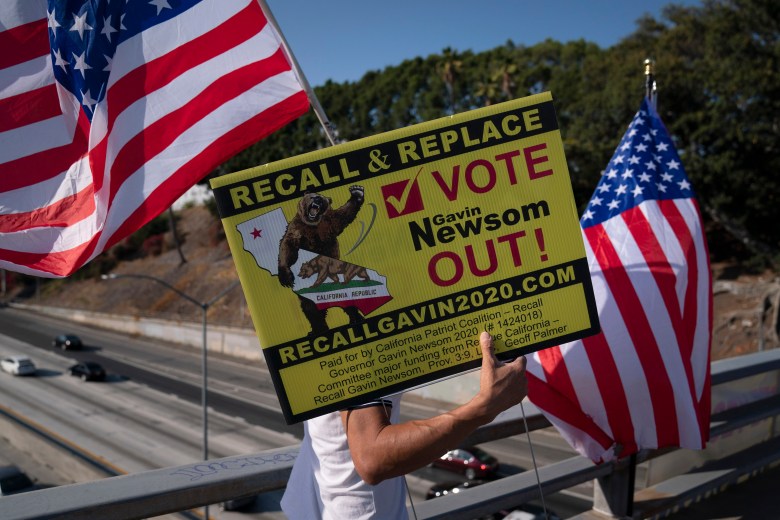
It’s 2021, the height of the Covid-19 pandemic, and Republicans just accomplished a historic feat: an effort to recall Democratic Gov. Gavin Newsom has qualified for the ballot, only the second time that’s happened to any sitting governor.
Newsom won in November decisively, with 62 percent of voters rejecting the recall. But conservative commentator Larry Elder and San Diego’s Kevin Faulconer were also on the ballot as potential replacements if Newsom was recalled. Elder, who received the most votes among them, could have become governor with only a plurality of the vote had the recall succeeded.
The secretary of state and other Democratic leaders want to change that with Proposition 5. If it passes, voters would decide first if a state leader or lawmaker should be recalled rather than also the question of who should replace them.
If an official was recalled, there would be a separate special election to replace them, in which the recalled official could also run.
In the case of the governor, the lieutenant governor would be acting governor until the special election. If the governor were recalled in the final two years of their term, the second in command would serve out the rest of their term.
Good governance groups Common Cause and League of California Voters are backing the measure, and former Orange County Sen. Josh Newman, the only California official besides former Gov. Gray Davis to be recalled this century, said he was emboldened to write the proposition in the years after the attempted Newsom recall.
Newman and other proponents argue the current recall rules — choosing who should replace a recall official in the same election they are recalled — can be taken advantage of by candidates who otherwise wouldn’t win a majority of support in a general election.
This was the case when Arnold Schwarzenegger, California’s last Republican elected to statewide office, won the 2003 recall to replace Davis, a Democrat.
The measure’s biggest critic is the California Republican Party which says Prop. 5 would weaken Republican votes and ultimately suppress turnout if voters aren’t picking a successor at the same time of a recall. They also point to the millions of dollars it would cost to hold additional special elections, which cost $200 million for Newsom’s 2021 recall.
Perhaps one of the initiative’s more surprising critics is San Diego Assemblymember Chris Ward, a Democrat. The current recall process is flawed because a successor can win without majority support, but a new measure shouldn’t increase costs with another election, he said in a statement. The appointment process also “denies voters the right to elect their representatives,” he said.
And there’s more election reform where that came from.
Another measure that’s flown under the radar is Prop. 4, which would allow candidates running for state or local office to use public campaign dollars. Currently, that’s illegal in all but a handful of big cities across California (think: Los Angeles or San Francisco) because of their own separate constitutions, but is prohibited pretty much everywhere else because of voters who banned the practice.
So, would that mean anyone could access public campaign money if they run? Not quite. It would be up to each local government to first decide if they even want to create a public campaign financing system.
In cities that do opt to create one, candidates would still have to meet certain requirements, like proving they have support beyond family and friends. But it’d be up to local governments to determine how that money would be distributed (Would it be a program? Vouchers for voters to dole out to candidates of their choice?) and what the spending limits would be.
The League of Women Voters, Common Cause and the California Democratic Party are backers. They argue allowing candidates to tap into public funds would give more people the opportunity to run for office and reduce the influence of private money in politics.
Spending in federal and state campaigns has ballooned over the past decade after the U.S. Supreme Court in a landmark case expanded how much money individual donors, companies and groups can spend in elections.
Critics of the self-funded Tom Steyers of the world say money shouldn’t buy politics, and this is one way to stymie wealthy donors’ influence. They also point to cities such as Oakland and Berkeley that already have public funding campaigns as a proof of concept.
But taxpayers don’t want to help fund candidates they may not agree with, opponents with the California Taxpayers Association argue. History is on their side. California voters have twice rejected proposals to reverse the ban over the past two decades.
Prop. 4’s critics also say bad actors can also misuse the funds, and the proposal, which would require local watchdog agencies to ensure candidates are in compliance, is too weak of an accountability measure.
Most voters are skeptical, with 42 percent in support, according to September polling from the California Public Policy Institute.
What I’m Reading Now
San Diego’s Todd Gloria picks a new chief operating officer after doing the role himself for more than a year, Voice of San Diego reports.
San Diego city councilmember pushes for tighter campaign finance rules, KPBS writes.
The Guardian reports from Tulare: How one of California’s poorest regions became one of its toughest political battlegrounds.
Thanks for reading this week’s report! Please reach me at nadia@voiceofsandiego.org for any questions or comments.